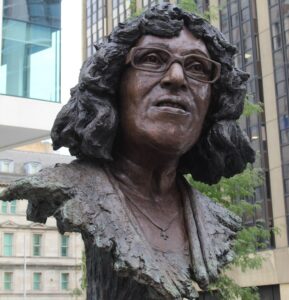
Betty Campbell
Betty Campbell (1934–2017)
- Became Wales's first Black headteacher at Mount Stuart Primary School in Butetown, Cardiff in 1973, having been told as a schoolgirl that her ambition to teach was facing "insurmountable" problems — and spent twenty-eight years at the same school building a multicultural curriculum that became a template for schools across the United Kingdom.1Dictionary of Welsh Biography — Betty Campbell
- Introduced the teaching of Black history, slavery, civil rights and apartheid into the Welsh school curriculum at a time when no framework existed for doing so, inspired by a trip to the United States where she encountered the civil rights movement — creating an educational model that directly influenced the Welsh Black Curriculum developed decades after her death.2Wikipedia — Betty Campbell
- Served on the Home Office race advisory committee and the Commission for Racial Equality, was elected as an independent councillor for Butetown, helped establish Black History Month in Wales, was requested by name by Nelson Mandela on his only visit to Wales in 1998, and in 2021 became the first named Black person to have a statue erected in an outdoor public space in Wales — chosen by public vote.3Cadw — Betty Campbell
Betty Campbell was born Rachel Elizabeth Johnson in Butetown, Cardiff, in November 1934 — the daughter of a Welsh Barbadian mother and a Jamaican father who had come to Britain at fifteen and was killed at sea in 1942 when his ship was torpedoed, leaving the family in poverty in one of the UK's oldest multi-cultural communities.1Dictionary of Welsh Biography — Betty Campbell She was a keen reader from childhood and won a scholarship to Lady Margaret High School for Girls in Cardiff. When she told a teacher she wanted to become a teacher herself, she was told the problems would be insurmountable. She went back to her desk and cried. She later said it was the first time she had ever cried in school — and that it made her more determined than ever.3Cadw — Betty Campbell
She became a mother at seventeen, dropped out of school, and married. In 1960, now aged twenty-six and mother to three children, she learned that Cardiff Teacher Training College had begun enrolling female students.2Wikipedia — Betty Campbell She applied. She was one of six women admitted. She qualified, and took a post at Mount Stuart Primary School in Butetown — the community she had grown up in — where she would teach for the next twenty-eight years. The hostility she encountered from some parents was immediate and explicit. They had not seen a Black teacher before, she later recalled. It was as if you could do a job, but if you were Black you were not quite as good.1Dictionary of Welsh Biography — Betty Campbell She channelled every expression of that hostility into becoming the most effective teacher she could.
In 1973 she became Wales's first Black headteacher.4Black Cultural Archives — Cardiff The appointment was a first, but what followed the appointment was the leadership act. A trip to the United States, where she encountered anti-slavery activists and the civil rights movement, had clarified for her what was missing from the education her pupils were receiving — a history of their own communities, their own heritage, their own place in the world.1Dictionary of Welsh Biography — Betty Campbell She introduced the teaching of Black history, slavery, civil rights and apartheid into the Mount Stuart curriculum at a time when no framework existed for doing so and no institutional support was available. The school became a template for multicultural education across the United Kingdom.2Wikipedia — Betty Campbell
The People variable in her profile describes not just the children she taught but the community she held together and the institutions she eventually changed. She served on the Home Office race advisory committee and the Commission for Racial Equality, was elected as an independent councillor for Butetown, and played a central role in establishing Black History Month in Wales.2Wikipedia — Betty Campbell When Nelson Mandela made his only visit to Wales in 1998, he asked to meet her.5Cardiff Youth Council — Betty Campbell She was awarded an MBE in 2003 for services to education and community life. She died in October 2017, aged eighty-two. Hundreds of people lined the streets of Cardiff to pay their respects.1Dictionary of Welsh Biography — Betty Campbell
In 2019 the BBC held a public vote to decide who should be the subject of Cardiff's first statue of a named woman. Betty Campbell won. The statue, unveiled in 2021 in Central Square, was also the first of any named Black person erected in an outdoor public space in Wales.3Cadw — Betty Campbell It stands in a city whose curriculum now reflects, in some measure, what she built in a primary school in Butetown with no resources, no institutional support, and no certainty that anyone beyond her own classroom would ever notice.
Score Comparison
Add up to 10 leaders. Click a name to visit their profile.
The 13 Equations
Scores for: Community LeadershipThe 22 Variables
Canonical scoresWhat changed: Mount Stuart → Community Leadership
Sources & Bibliography
The scores assigned to this leader are derived from publicly available sources. Variable inputs reflect documented behaviour, structural conditions, and historical record at the time of each snapshot.