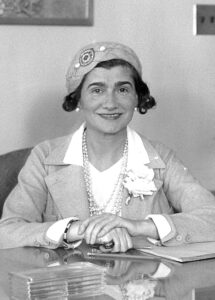
Coco Chanel
Coco Chanel (1883-1971)
- Built a fashion empire from nothing — opening her first hat shop in Paris in 1910, creating Chanel No. 5 in 1921, launching the little black dress, the Chanel suit and the quilted handbag across six decades of active design — becoming the only fashion designer on Time magazine's list of the 100 most influential people of the twentieth century and the founder of a company that by the end of her life employed thousands and generated revenues that have made it one of the most valuable privately held brands in the world.1Wikipedia — Coco Chanel ↗
- Liberated women's dress from the corset, petticoat and the elaborate restrictive silhouette of Edwardian fashion — introducing jersey, menswear-derived forms, comfort as a principle of elegance, and costume jewellery worn with sportswear — changing not just what women wore but what it meant to dress with authority, in ways that remain the dominant aesthetic framework of Western women's fashion more than a century later.2Britannica — Coco Chanel ↗
- Collaborated with Diaghilev, Stravinsky, Picasso and the Ballets Russes circle in the 1920s, funding Stravinsky's household when he was destitute, designing costumes for Le Train Bleu — operating simultaneously in the worlds of haute couture, avant-garde art, and cultural philanthropy while conducting an affair with the Duke of Westminster and maintaining friendships with Winston Churchill, before closing her entire business at the outbreak of World War II and living at the Ritz under German occupation in circumstances whose full implications remain disputed by historians.3EBSCO — Coco Chanel ↗
Gabrielle Bonheur Chanel was born on 19 August 1883 in Saumur, France, the illegitimate daughter of a market trader who, after her mother's death when Gabrielle was twelve, deposited her and her sisters at an orphanage run by nuns and disappeared.4Biography.com — Coco Chanel ↗ The nuns taught her to sew. She spent her early twenties as a seamstress and occasional cabaret singer in Vichy and Moulins — earning the nickname Coco from the songs she performed — before her relationships with wealthy men gave her access to a social world whose aesthetic she found insufficient and whose conventions she immediately began to subvert. The first analytical entry point in Chanel's profile is the decision to design for herself — to wear the clothes she made and to make clothes she herself wanted to wear. This is simultaneously a Congruence and a Defined Output statement. She was not designing a product for a customer she didn't understand. She was designing a life for a woman she understood entirely because she was that woman: working, independent, wanting to move freely, unwilling to perform the elaborate discomfort of Edwardian femininity.3EBSCO — Coco Chanel ↗ The Process variable reflects the methodical way she built the enterprise: hats in Paris, then a shop in Deauville where wealthy women on holiday needed practical clothes, then Biarritz, then the Rue Cambon premises that remain the house's address today. By the 1920s she was at the centre of the most productive artistic network in Paris — the Diaghilev circle, the Stravinsky household, the Picasso studio, the literary salons of Misia Sert — and her fashion empire employed nearly four thousand workers, mostly women.1Wikipedia — Coco Chanel ↗ Chanel No. 5, launched in 1921, was the first abstract perfume — not a single floral note but a complex synthetic composition — and is the best-selling perfume in history. The royalties dispute with the Wertheimer family that followed its commercial distribution occupied her for decades and she never succeeded in renegotiating the terms, receiving only ten per cent throughout. The wartime period is the most analytically complex phase of her profile and the one where the Congruence variable records its sharpest drop. She closed her couture house in 1939 — firing four thousand workers, including those who had struck for better wages in 1936, in what her biographer Hal Vaughan suggests was at least partly retaliatory — and spent the occupation living at the Ritz, which had become German military headquarters.2Britannica — Coco Chanel ↗ Her collaboration with Nazi officials, including an affair with a German intelligence officer, and her involvement in a 1943 peace mission operation have been documented. She was briefly arrested at the Liberation. The full extent of her ideological commitment to the Nazi regime remains debated by historians, but the basic facts of her conduct are not in dispute. She returned to Paris in 1954 at the age of seventy, reopened her couture house, and presented a collection that European critics dismissed and American women immediately adopted.1Wikipedia — Coco Chanel ↗ The Chanel suit of the 1950s became the defining garment of post-war professional femininity — worn by Jacqueline Kennedy, among thousands of others. She worked until the day she died, on 10 January 1971 at her apartment in the Hotel Ritz, one month short of completing her spring collection. The Congruence variable in her final snapshot reflects a woman whose stated values — simplicity, elegance, the liberation of women through clothes — had been upheld consistently in her work, if not in her conduct during the occupation. The equations will produce a high score for the creative and commercial phases, a lower one for the wartime period. Both are analytically correct.
Score Comparison
The 13 Equations
Scores for: Empire Building — 1910 to 1939The 22 Variables
Canonical scoresSources & Bibliography
The scores assigned to this leader are derived from publicly available sources. Variable inputs reflect documented behaviour, structural conditions, and historical record at the time of each snapshot.