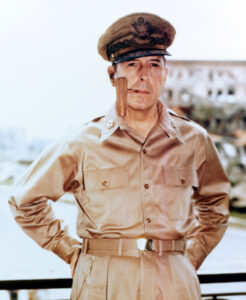
Douglas MacArthur
Douglas MacArthur (1880–1964)
- Graduated first in his class from West Point in 1903, earned seven Silver Stars and two Distinguished Service Crosses in World War I leading raids into no man's land,1Wikipedia — Douglas MacArthur and commanded the Southwest Pacific campaign in World War II through island-hopping strategy that drove the Japanese from New Guinea and returned him to the Philippines in 1944.2Britannica — Douglas MacArthur
- As Supreme Commander for the Allied Powers in occupied Japan, oversaw the drafting of a new constitution, universal suffrage, land reform transferring ownership to the farmers who worked it, the dissolution of the Zaibatsu, and the legalisation of trade unions — a wholesale reconstruction of a society accomplished without the violent resistance he had predicted would require a million occupation soldiers to contain.2Britannica — Douglas MacArthur
- Planned the brilliant amphibious landing at Inchon in September 1950 that reversed the Korean War,3National WWII Museum then failed to anticipate the Chinese intervention that followed — his intelligence operation estimated 71,000 Chinese troops in theatre when the true number was closer to 300,0001Wikipedia — Douglas MacArthur — before being relieved of command by President Truman in April 1951 for insubordination.2Britannica — Douglas MacArthur
Douglas MacArthur is the dataset's most extreme illustration of a leader whose exceptional variables and catastrophic variables operated simultaneously at maximum intensity throughout his entire career. Blamey's verdict — "the best and the worst things you hear about him are both true" — is not diplomatic ambiguity. It is an accurate description of what the equations record across four snapshots spanning five decades.
The Chaos score is the analytical key to every snapshot. The question the equations ask about MacArthur is not whether his variables were exceptional. They were. The question is whether his numerators were ever large enough to overcome a denominator that never reduced. The answer varies by snapshot, and the variation tells the story.
The World War I and interwar period establishes the template that every subsequent snapshot confirms. Seven Silver Stars, two Distinguished Service Crosses, physical courage so documented it cannot be disputed — leading patrols into no man's land at night, being gassed twice, taking a bullet through his clothes and continuing.1Wikipedia — Douglas MacArthur The tactical intelligence that produced the Rainbow Division's performance in the Meuse-Argonne was real. So was the personality that led a contemporary to observe that his father had been the most flamboyantly egotistical man he had ever seen, until he met his son. The West Point superintendency produced reforms that were ahead of their time, resisted, abandoned, and then gradually restored over the following decades — which is precisely the pattern of a leader whose vision exceeds the institution's willingness to follow but whose Ego prevents the collaboration that might have accelerated adoption.
The Southwest Pacific campaign is the profile's most analytically contested period and the Congruence score carries the weight of that contestation. The island-hopping strategy was genuine operational innovation — MacArthur fighting outnumbered, relying on manoeuvre and surprise, bypassing Japanese strongpoints to strike where the enemy was weak.2Britannica — Douglas MacArthur The Leyte landing and the Philippines liberation were real achievements delivered against real opposition. But running alongside the operational record is a parallel record that the equations cannot ignore: the PR machine that one contemporary described as the most powerful of any Allied general, producing daily communiqués that veterans called a total farce; the Medal of Honor awarded for actions that Eisenhower noted did not meet the criteria, explicitly to offset enemy propaganda; the Quezon payment of half a million dollars accepted while his men were dying on Bataan; and the Clark Field disaster, where twelve hours of paralysis after Pearl Harbor allowed the Japanese to destroy his air force on the ground.1Wikipedia — Douglas MacArthur The Congruence score is the equations' honest accounting of the gap between the image and the reality.
The Japan occupation is the profile's peak and its most undervalued achievement. As Supreme Commander for the Allied Powers, MacArthur had Autonomy at its maximum — no external check, no competing authority, no meaningful opposition. Against that structural freedom he deployed exceptional Defined Output: a new constitution, women's suffrage, land reform, the dissolution of the Zaibatsu, the legalisation of trade unions.2Britannica — Douglas MacArthur These were not incremental improvements to an existing system. They were the wholesale reconstruction of a society that had just lost a war, accomplished without the violent resistance MacArthur had predicted would require a million occupation soldiers to contain. MacArthur later claimed the occupation gave him more satisfaction than any of his military victories.4Wilson Center — Douglas MacArthur The equations agree with that assessment — the Japan snapshot produces his highest score because it is the one period where his exceptional personal variables operated in structural conditions that matched them precisely.
The Korea snapshot is the clearest illustration of Pride operating as the terminal variable in a leadership system. Inchon was genuine genius — MacArthur against the reservations of the Joint Chiefs, planning an amphibious assault at a location with extreme tidal conditions, landing deep behind North Korean lines, recapturing Seoul, forcing a North Korean collapse.2Britannica — Douglas MacArthur Within weeks, his intelligence operation — staffed from the Bataan Gang rather than from the best available analysts — estimated 71,000 Chinese troops in Korea when the true number was closer to 300,000. MacArthur flew over the front and saw nothing. The Chinese Army travelled at night and dug in during the day. The result was the worst defeat in American military history since the Civil War.1Wikipedia — Douglas MacArthur
What followed was not a response to operational failure. It was Pride preventing any acknowledgement that the failure had occurred. The public challenge to China to admit defeat, issued while his own forces were in retreat. The letter to Congressman Martin, read aloud on the House floor, openly criticising the President's strategy. Truman's verdict — that he fired MacArthur not for being a dumb son of a bitch, though he was, but for failing to respect the authority of the President — is legally accurate and analytically incomplete.2Britannica — Douglas MacArthur MacArthur's insubordination was not primarily a failure of discipline. It was a failure of Humility operating against Pride at maximum. He genuinely could not process the possibility that the President's strategy was correct and his was wrong.
The Japan occupation stands as the counter-argument to every MacArthur critic and every MacArthur hagiographer simultaneously. It demonstrates that his exceptional variables, given structural conditions that channelled them precisely, produced outcomes of genuine civilisational significance. A constitution that has stood for eighty years. A democracy that became one of the world's leading industrial powers. Land reform that transformed the economic lives of millions.2Britannica — Douglas MacArthur The equations record that achievement honestly — not because his Ego and Pride were lower in Japan than in Korea. They were not. He was the same man. What changed was the structure around him, not the variables within him.
That is the MacArthur equation in full. Exceptional numerators. Permanently elevated denominator. The outcomes varied entirely based on whether the structural conditions amplified the numerators or exposed the denominator. When the structure held, Japan. When it failed, Korea.
Score Comparison
Add up to 10 leaders. Click a name to visit their profile.
The 13 Equations
Scores for: Japan Occupation — SCAPThe 22 Variables
Canonical scoresWhat changed: Southwest Pacific — New Guinea to Philippines → Japan Occupation — SCAP
Sources & Bibliography
The scores assigned to this leader are derived from publicly available sources. Variable inputs reflect documented behaviour, structural conditions, and historical record at the time of each snapshot.