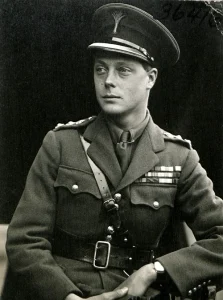
Edward VIII
Edward VIII — Duke of Windsor (1894–1972)
- At the height of his popularity as Prince of Wales, the most photographed celebrity in the world — setting men's fashion across two continents, conducting sixteen overseas tours, generating genuine warmth from veterans and working people alike1Wikipedia — Edward VIII — while the government was simultaneously reluctant to send him state papers for fear house guests might read them.1Wikipedia — Edward VIII
- Reigned for 327 days before abdicating on 10 December 1936 rather than relinquish his relationship with the twice-divorced American Wallis Simpson — the shortest reign of any British monarch since the disputed reign of Lady Jane Grey in 1553.2Wikipedia — Abdication of Edward VIII
- Toured Nazi Germany in October 1937 against the explicit advice of the British government, giving full Nazi salutes and meeting Hitler at his Obersalzberg retreat2Wikipedia — Abdication of Edward VIII — the New York Times reporting that the visit demonstrated the abdication had robbed Germany of a firm friend on the British throne.3Spartacus Educational — Edward VIII
Edward VIII is the dataset's most complete illustration of a leader whose public capital and private variable quality were entirely disconnected. At the height of his popularity as Prince of Wales he was the most photographed celebrity in the world, setting men's fashion across two continents, conducting sixteen overseas tours, generating genuine warmth from veterans and working people alike.1Wikipedia — Edward VIII The equations record all of that — high Visibility, Recognition, Confidence. They also record that behind those numbers sat deeply deficient Defined Output, Intent, and Congruence. The public capital was real. The leadership substance it appeared to represent was not.
The Prince of Wales period is analytically best understood as a prolonged performance without a mission. Edward visited poverty-stricken areas of Britain and said "something must be done" for the unemployed coal miners of South Wales — a statement that caused consternation in government because it appeared to guide policy, and that produced no remedy because he had not proposed one.4Britannica — Edward VIII The observation was genuine. The follow-through was absent. That is Intent and Process at their documented values — a leader who could see problems clearly and was constitutionally unwilling to do the operational work of solving them. His Ambition scores low not because he lacked drive but because his drive was directed entirely toward personal satisfaction rather than institutional output. The ranch in Alberta, the parties in Paris, the succession of married women — these are Ambition operating inward rather than outward.
The Congruence score in the Prince of Wales period requires careful reading. The gap between his public role — heir to the throne, representative of Empire, symbol of duty and service — and his private behaviour was documented and managed by the Royal Household for years before it became a constitutional crisis. The Metropolitan Police Special Branch followed him. The proprietor of an antique shop noted that the lady seemed to have the Prince of Wales completely under her thumb. The government was reluctant to send him state papers because it was feared house guests might read them.1Wikipedia — Edward VIII These are not retrospective observations. They were live operational concerns about a man whose public image was entirely disconnected from his private variable profile.
The reign snapshot is the shortest in the dataset and the most analytically decisive. Three hundred and twenty-seven days.2Wikipedia — Abdication of Edward VIII In that time Pride reached its ceiling and every numerator collapsed simultaneously. The abdication is not, as modern sensibility sometimes frames it, a romantic act of personal authenticity. It is a Pride event. A leader whose identity had become so fused with his relationship with Simpson that he literally could not process the alternative. He told Baldwin he would relinquish the throne if he could not marry her. He was presented with three options — abandon the marriage, marry against his ministers' advice, or abdicate. He chose abdication not because it was the right outcome for the institution he headed but because Pride made the other two options psychologically impossible. Abandoning Simpson would have required acknowledging that his identity had been wrong. Marrying against his ministers' advice would have required accepting a constitutional conflict he lacked the Ability and Process to manage. The third option was the one that required nothing of him except departure.4Britannica — Edward VIII
The Congruence score in the reign period records the total collapse of the gap between his stated role and his actual priorities. He told Baldwin that the decision was "mine and mine alone." He was correct — and that is precisely the problem the equations record. A constitutional monarch whose role required him to operate within the constraints of his ministers' advice exercised personal sovereignty on the single question that mattered most to the institution. The Pride variable at its maximum made that outcome structurally inevitable from the moment the relationship with Simpson became a constitutional question rather than a personal one.
The Duke of Windsor period is the profile's most analytically damaging, and it is damaging precisely because Pride remains at its ceiling throughout despite the absence of any variable that could justify it. The Nazi Germany tour in October 1937 — conducted against the explicit advice of the British government, with full Nazi salutes, with Hitler concluding that Anglo-German relations could have been improved through Edward had it not been for the abdication — is a Congruence event that goes beyond the abdication itself.2Wikipedia — Abdication of Edward VIII A man who had abdicated rather than compromise the political neutrality of the crown was actively compromising British foreign policy interests in private as a former king. The Bahamas governorship produced some genuine local achievements — poverty reduction, civil unrest resolution — but also racist correspondence and suspected intelligence contacts with German agents.3Spartacus Educational — Edward VIII The Congruence score is the same across exile as across the reign because the say-do gap never closed. It simply changed subject.
What the equations cannot record, and what the bio must note, is that Edward was not unintelligent. He was not cruel by temperament. He was not without genuine human qualities — his valet of thirty years was said to have loved him as a son, and his resolution of civil unrest in Nassau was genuinely praised even by those he had privately disparaged. The equations hold these alongside the Nazi salutes and the appeasement broadcasts and score the profile honestly. The outcome is a leader of considerable personal charm, minimal leadership substance, and a Pride variable that made genuine development of the missing variables structurally impossible.
George V said the boy would ruin himself within twelve months. He was wrong only on the timeline. The equations agree with the assessment and explain the mechanism.
Score Comparison
Add up to 10 leaders. Click a name to visit their profile.
The 13 Equations
Scores for: Prince of Wales — Peak PopularityThe 22 Variables
Canonical scoresSources & Bibliography
The scores assigned to this leader are derived from publicly available sources. Variable inputs reflect documented behaviour, structural conditions, and historical record at the time of each snapshot.