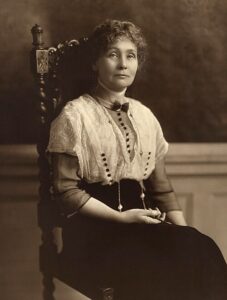
Emmeline Pankhurst
Emmeline Pankhurst (1858–1928)
- Founded the Women's Social and Political Union in her own drawing room in Manchester in October 1903 with the motto "Deeds, not words" — eliminating the WSPU's constitution, cancelling annual meetings, removing anyone who created friction, expelling the Pethick-Lawrences, dismissing her daughter Sylvia for insufficient loyalty, and giving her daughter Adela a ticket to Australia and firmly insisting she emigrate.1Wikipedia — Emmeline Pankhurst
- Imprisoned repeatedly between 1908 and 1914, released and rearrested twelve times within a year under the "Cat and Mouse" Act as she staged hunger strikes2Britannica — Emmeline Pankhurst — while coordinating a campaign of window-smashing across London, bombing, arson, and the slashing of the Rokeby Venus that drew the largest public attention the suffrage cause had ever received and the sharpest criticism from moderate suffrage organisations.3National Archives — Emmeline Pankhurst
- When war was declared in August 1914, immediately suspended all suffrage militancy, converted the WSPU's machinery to recruitment work, organised rallies encouraging young men to enlist, and publicly denounced her daughter Sylvia for her pacifism — then died in June 1928, six weeks before the Representation of the People Equal Franchise Act extended the vote to all women over twenty-one.1Wikipedia — Emmeline Pankhurst
Emmeline Pankhurst presents the Codex with its most analytically contested profile in the Political domain. The variable trajectory is not a simple arc — it is a peak, a cliff, and a long decline that the historical record both explains and complicates. The Conviction variable sits at maximum throughout. The Congruence variable moves in ways that the sources document precisely and that the Codex must record honestly. Both things are true simultaneously and the profile holds them without resolution, because the historical record has not resolved them either.
The early activism and WSPU foundation period establishes the variable template across fourteen years of political work before the organisation that made her famous existed. The Women's Franchise League, the ILP, the Board of Guardians where she encountered children scrubbing stones and pregnant women doing heavy labour almost until their babies came — these are the documented sources of Conviction at its maximum. She was not theorising about injustice. She was recording it and converting the record into political action.4London Museum — Emmeline Pankhurst The founding of the WSPU in October 1903 was a Defined Output event — the deliberate creation of an instrument precisely calibrated to do what the existing suffrage organisations had failed to do. The Codex records a developing variable profile for this period because the Resources and Environment variables were genuinely at their floor and the organisation was still establishing itself. The personal variable quality was already at its operational level. The structural conditions had not yet aligned with it.
The militant escalation period is the profile's canonical snapshot and produces its highest score, because this is where the personal variables and the organisational instrument she had built converged most completely. The analytical key to this period is the Administrative Impotence equation. She eliminated institutional friction from the WSPU by design. No constitution. No annual meetings. No democratic decision-making processes that could slow the organisation's response to political events. Anyone who created friction was removed.1Wikipedia — Emmeline Pankhurst Autocratic, she wrote in her autobiography. Quite so. The word was her own and she used it without apology. The Codex records it in the variable profile and notes that the same behaviour that fractured her family and drove out experienced colleagues also produced the operational coherence that made the WSPU more effective than any democratically governed suffrage organisation could have been at equivalent speed.
The Congruence variable below its maximum in this period reflects the historians' unresolved debate about whether the militancy advanced or retarded the cause. Millicent Fawcett, leader of the moderate National Union of Women's Suffrage Societies, declared by 1912 that militant activists were the chief obstacles to success in the House of Commons.2Britannica — Emmeline Pankhurst The moderate organisations refused to march alongside the WSPU after demanding without success that it end its support for property destruction. The bombing and arson campaign, the slashing of the Rokeby Venus, the window-smashing coordinated across London — these generated the visibility the Codex records in this period and the political controversy that the Congruence variable records at its contested midpoint. The Codex does not adjudicate the historians' debate. It records the evidence at the midpoint the sources support.
The First World War period contains the sharpest Congruence drop in the profile and the Codex records it precisely. When war was declared in August 1914, Pankhurst and Christabel suspended all suffrage militancy immediately. What followed was not merely a suspension of the campaign but a wholesale conversion of the WSPU machinery to the opposite purpose. She organised rallies encouraging young men to enlist. She denounced her daughter Sylvia publicly for her pacifism. Followers of the WSPU were among those who handed white feathers — symbols of cowardice — to young men not in uniform.5Britannica — WSPU A leader who had spent a decade arguing that the state's authority over women was unjust and must be resisted by any means necessary was now deploying the full machinery of that argument in support of unconditional state authority. The say-do gap in this period is the widest in her profile. The Codex records the Congruence variable at its lowest point and does not attempt to resolve whether her assessment of the strategic situation was correct — only that the gap between her stated values and her operational behaviour at this period was the largest of her career.
The post-war and later years period records the further dispersal of what the Militant Escalation period had built. The Women's Party withered. The women who had marched with her, smashed windows with her, gone on hunger strike with her, were no longer a coherent organisational force. She died in June 1928, six weeks before the Representation of the People Equal Franchise Act extended the vote to all women over twenty-one.2Britannica — Emmeline Pankhurst The Defined Output variable across her career records a mission that was delivered — partially in 1918, completely six weeks after her death. The Codex cannot give her credit for the final act she did not live to see confirmed. It records the variable profile at each snapshot and notes that the trajectory from early-stage through peak to declining is not a story of failure. It is a story of a leader who built and consumed an instrument simultaneously — who drove her organisation and her family toward a single objective with a Conviction that never declined and a method that produced both the constitutional change she sought and the personal cost that the variable profile records precisely.
Time magazine placed her among the hundred most important people of the twentieth century and wrote that she shook society into a new pattern from which there could be no going back. The Codex records how she did it — through Conviction at maximum, Administrative Impotence at its floor, and a Congruence variable that the historical record has spent a century debating. All three things are in the profile simultaneously. That is what the Codex is for.
Score Comparison
Add up to 10 leaders. Click a name to visit their profile.
The 13 Equations
Scores for: Militant EscalationThe 22 Variables
Canonical scoresWhat changed: Early Activism — WSPU Foundation → Militant Escalation
Sources & Bibliography
The scores assigned to this leader are derived from publicly available sources. Variable inputs reflect documented behaviour, structural conditions, and historical record at the time of each snapshot.