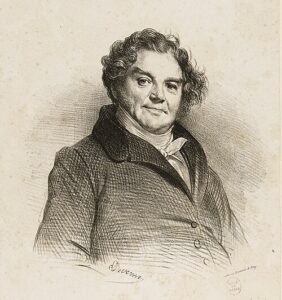
Eugene Vidocq
Eugene Vidocq (1775-1857)
- Founded the Brigade de Sûreté in Paris in 1811 — the world's first plainclothes criminal investigation bureau, composed entirely of former convicts who understood the criminal world from the inside — and built it into the Sûreté Nationale, which provided the template for Scotland Yard in 1829, the FBI a century later, and every subsequent national detective agency, while making eight hundred arrests in 1817 alone, three times the rate of the regular uniformed police.1Wikipedia — Eugene Vidocq ↗
- Invented systematic criminal record-keeping — maintaining index cards on sixty thousand individuals that included physical descriptions, aliases, previous convictions and modus operandi — pioneered plaster-of-Paris casts of footprints, rudimentary ballistics comparison, the use of indelible ink to defeat forgery, and facial recognition through photographic memory, establishing the informational and forensic foundations of modern detective work decades before forensic science existed as a discipline.2Public Domain Review — Vidocq ↗
- Resigned from the Sûreté in 1827, and in 1833 founded the Bureau des Renseignements — the world's first private detective agency — staffed once again with former convicts, providing surveillance, background checks and forensic analysis to private clients in a service that inspired Victor Hugo's Javert and Jean Valjean, Edgar Allan Poe's Auguste Dupin and Arthur Conan Doyle's Sherlock Holmes, making him the founding figure not only of the detective profession but of the entire detective fiction genre.1Wikipedia — Eugene Vidocq ↗
Eugène-François Vidocq was born on 24 July 1775 in Arras, northern France, the son of a baker, and spent the first thirty-five years of his life in a cycle of petty crime, military desertion, prison, escape and recapture that reads, in retrospect, as the empirical education of someone who would later need to understand the criminal world from within.3All That's Interesting — Vidocq ↗ He killed a man in a duel at fourteen, deserted from the army, joined a gang of card-sharps, committed forgery and robbery, escaped from prison multiple times using disguises, and was sentenced to the galleys before offering his services as a police informant in 1809 as the only available alternative to indefinite imprisonment. He was installed undercover in Bicêtre prison, proved immediately effective, and by 1811 had been given command of a small plainclothes unit within the Paris Prefecture of Police. The analytical interest of Vidocq's profile within the Law Enforcement domain is precisely the paradox: the most significant institutional innovation in the history of detective work was produced by a man whose Congruence variable scores low and whose ethical record is genuinely mixed. The Brigade de Sûreté worked because its agents knew the criminal world from the inside — not as a theoretical matter but as former participants.2Public Domain Review — Vidocq ↗ Vidocq's insight — that catching criminals requires thinking like them — was both his greatest contribution and the permanent source of suspicion about his methods. Charges that he and his agents were engineering crimes to create arrest opportunities followed him throughout his tenure, and may have been partly true. The Process variable captures his methodological innovations rather than his personal conduct. The card index system he created — sixty thousand individual files with physical descriptions, aliases, criminal histories and modus operandi — was the nineteenth-century equivalent of a criminal database, and it did not merely survive him: it was retained by French law enforcement, expanded by Alphonse Bertillon into anthropometric forensic classification, and eventually digitised into the systems that underpin modern criminal intelligence.1Wikipedia — Eugene Vidocq ↗ The plaster cast of a shoe impression, the rudimentary ballistics test, the use of disguise and undercover surveillance — these were genuine methodological inventions that changed what detective work was. The Resources variable reflects the constraints of his situation: he operated without institutional backing in the conventional sense, dependent on the Prefecture's tolerance of his unconventional methods and the informal authority derived from his personal effectiveness. The Autonomy variable scores high because he operated almost entirely on his own terms — no one in the Prefecture could credibly supervise him, because no one else understood what he was doing or how he was doing it.4Victorian Paris — Vidocq ↗ This is simultaneously a strength and the analytical explanation for his eventual departure: an institution built entirely on one person's personality and contacts cannot survive the loss of that person, and when Vidocq left, crime in Paris rose immediately. He died on 11 May 1857 in Paris, aged eighty-one, having spent his last years writing memoirs, attempting to rehabilitate criminals through employment, and charming women. His Mémoires, published in 1828, were an international bestseller and created the template for detective autobiography. Victor Hugo met him and based both Javert and Valjean on him. Poe read him and invented the detective story. Conan Doyle read Poe and created Sherlock Holmes. The lineage is direct and documented.
Score Comparison
Add up to 10 leaders. Click a name to visit their profile.
The 13 Equations
Scores for: Bureau des Renseignements — Private DetectiveThe 22 Variables
Canonical scoresWhat changed: Brigade de Sûreté — Founding and Peak → Bureau des Renseignements — Private Detective
Sources & Bibliography
The scores assigned to this leader are derived from publicly available sources. Variable inputs reflect documented behaviour, structural conditions, and historical record at the time of each snapshot.