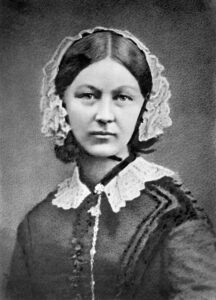
Florence Nightingale
Florence Nightingale 1820-1910
- Reduced the mortality rate at the British military hospital at Scutari from 42% to under 2% within six months of her arrival in November 1854 — by implementing strict sanitation protocols, reorganising hospital kitchens, establishing laundries and enforcing handwashing — then used the statistical evidence she had gathered at Scutari to persuade the Royal Commission on the Health of the Army to mandate systematic sanitary reform across all British military hospitals, producing a measurable and documented reduction in peacetime military deaths that saved thousands of lives.1Wikipedia — Florence Nightingale ↗
- Pioneered the use of statistical graphics as a tool for institutional reform — developing the coxcomb diagram to visualise the relative contribution of preventable disease versus battle wounds to Crimean War mortality, presenting this evidence to parliamentarians and army officials who would not have engaged with tabular data — and was elected the first female member of the Royal Statistical Society in 1858; her approach became the foundation of modern evidence-based public health policy and data visualisation.2Science Museum — Nightingale Statistician ↗
- Founded the Nightingale Training School for Nurses at St Thomas' Hospital in London in 1860 — the world's first professional nursing school — establishing a curriculum that combined practical clinical training with rigorous ethical standards, producing graduates who disseminated her methods across Britain and internationally and transforming nursing from a low-status, largely untrained occupation into a recognised profession with defined educational requirements and institutional accountability.3American Nurse — Florence Nightingale ↗
Florence Nightingale was born on 12 May 1820 in Florence, Italy, to wealthy British parents, educated in mathematics, languages and classical subjects at home — an unusually rigorous education for a Victorian woman of her class — and called to nursing in her early twenties over the sustained opposition of her family, who regarded the profession as beneath her social station.1Wikipedia — Florence Nightingale ↗ She trained in Germany, worked in Paris, became superintendent of a London hospital for distressed gentlewomen in 1853, and was recruited by Sidney Herbert, Secretary at War, to lead a nursing contingent to the Crimea in October 1854 with a staff of thirty-eight women nurses. The analytical profile of Florence Nightingale within the Influencers domain rests on three distinct institutional contributions that must be scored separately and then integrated: the operational leadership at Scutari, the statistical and policy advocacy that followed, and the institutional building of nursing as a profession. The Scutari operation is the analytically cleanest of the three. She arrived at a military hospital where mortality was running at 42%, medicines were absent, hygiene was non-existent, and the army's administrative culture was actively resistant to external interference from a civilian woman.4Leadership Story Bank — Nightingale ↗ She imposed sanitary standards, reorganised supply chains for food and medical material, established laundries, enforced handwashing, and within six months had reduced the mortality rate by approximately two-thirds. This is a Process variable achievement of the highest analytical order: a precisely defined problem, a systematic intervention, a measurable outcome, and a causal link between the leadership decision and the result. The statistical advocacy that followed Scutari is where Nightingale's profile diverges most sharply from the 'Lady with the Lamp' myth. She understood that Scutari was not the point. The point was the reform of British military and civilian hospital standards nationally. She spent the years following the Crimean War building the statistical case for that reform — gathering data, developing the coxcomb diagram, presenting evidence to the Royal Commission, lobbying the War Office — and she achieved it.2Science Museum — Nightingale Statistician ↗ The Army Medical College, established in 1857 partly in response to her evidence, is the institutional output of the advocacy campaign. The Nightingale Training School is the third and most durable institutional contribution. By establishing nursing education as a formal discipline with defined standards, she created the infrastructure through which her methods were replicated across healthcare institutions that she never personally visited. The Defined Output variable in this phase of her profile scores at its ceiling: she was trying to change the system, not just the hospital. She spent much of her life after 1856 largely bedridden, continuing to write, advise and lobby from her London home while rarely leaving it. She died on 13 August 1910, aged ninety. The international day of nursing, 12 May, is her birthday.
Score Comparison
Add up to 10 leaders. Click a name to visit their profile.
The 13 Equations
Scores for: Statistical Advocacy and Nightingale Training SchoolThe 22 Variables
Canonical scoresWhat changed: Scutari — Operational Hospital Reform → Statistical Advocacy and Nightingale Training School
Sources & Bibliography
The scores assigned to this leader are derived from publicly available sources. Variable inputs reflect documented behaviour, structural conditions, and historical record at the time of each snapshot.