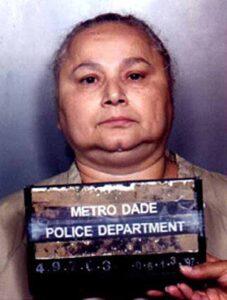
Griselda Blanco
Griselda Blanco (1943-2012)
- Built the first major cocaine distribution network between Colombia and the United States, pioneering smuggling techniques including human couriers with specially designed concealment garments, airport transit methods, and speedboat shipments — establishing supply chains into New York, Miami, Los Angeles and San Francisco that at their peak moved 1.5 tonnes of cocaine per month and generated an estimated $80 million monthly.1InSight Crime — Griselda Blanco ↗
- Commanded the Miami drug wars of the late 1970s and early 1980s through systematic use of motorcycle assassinations — a method she is credited with inventing, subsequently adopted as a hallmark of the Medellín Cartel — and is connected to over 200 murders, including all three of her husbands, a record that prompted Pablo Escobar to describe her as the only person he was ever afraid of.2National Geographic — Griselda Blanco ↗
- Arrested in 1985, convicted of drug trafficking and sentenced to fifteen years, she continued directing her operation from prison through her son Michael Corleone Blanco — was charged with three murders but the case collapsed due to a prosecution scandal — pleaded guilty to reduced charges, was deported to Colombia in 2004, and was killed on 3 September 2012 outside a Medellín butcher shop by a gunman on a motorcycle, the method she had made her own.3Britannica — Griselda Blanco ↗
Griselda Blanco was born on 15 February 1943 in Colombia — sources dispute whether in Cartagena or Santa Marta — and moved with her mother to Medellín as a child, entering a life of street crime before she was a teenager.4Biography.com — Griselda Blanco ↗ She grew up in a city being torn apart by La Violencia, the period of mass political violence that killed hundreds of thousands of Colombians between 1948 and 1958, and in the poverty-hardened neighbourhoods of Lovaina and Santísima Trinidad where survival required exactly the qualities the leadership equations would later measure at high values: Conviction, Confidence, Autonomy, and the willingness to use violence as a Process variable. She was a pickpocket before she was thirteen. By her own account she had committed murder before she was a teenager. The framework that would later produce a billion-dollar criminal empire was already fully formed. The Criminal domain requires the equations to operate differently from any other domain in the dataset. The Intent variable — the degree to which the people in the leader's environment understand and share the purpose — scores on purely internal terms: did her organisation understand what it was doing and why? It did. The Congruence variable — alignment between stated values and actual behaviour — scores against the values she actually held, not those of the society she operated in. Both score high. The Value variable requires separate treatment: what value did her leadership create, and for whom? The answer in her case is commercially measurable but socially negative in every direction — for the communities destroyed by the cocaine trade, for the people killed in the Miami drug wars, for the families of the hundreds of murder victims connected to her operation. The equations produce high scores. The bio must record what those scores mean. Blanco entered the cocaine trade through her second husband, Alberto Bravo, a Medellín Cartel smuggler, and by the early 1970s had established a substantial operation in New York City — at a point when cocaine distribution in the United States was still dominated by the Mafia, who had not yet understood the scale of what was coming.1InSight Crime — Griselda Blanco ↗ Her Process innovations were genuine and lasting: human couriers carrying cocaine through airports in specially designed concealment garments, false bottoms in luggage, dog crates, speedboat consignments — methods that predated and informed the full infrastructure of the Medellín Cartel. When federal charges forced her back to Colombia in 1975, she shot Alberto Bravo in the head, having concluded he was stealing from their operation, and continued alone. The Miami phase from the late 1970s to her arrest in 1985 is the canonical snapshot. She arrived in a city being flooded with cocaine demand and short on supply infrastructure, built an organisation that moved 1.5 tonnes of cocaine per month, and imposed her authority on competing traffickers through a campaign of systematic violence that transformed Miami's homicide rate and created what became known as the Cocaine Cowboy Wars.2National Geographic — Griselda Blanco ↗ The Dadeland Mall shooting of July 1979 — two men killed in broad daylight in Miami's largest shopping centre — is generally identified as the event that announced her dominance and the beginning of the wars. The motorcycle assassination method she pioneered became the signature operational tool of the Medellín Cartel. Pablo Escobar adopted it. She was his contemporary and, by his own account, the person in the drug world he most feared. She was arrested in California in February 1985, convicted of drug conspiracy charges, and sentenced to fifteen years — from which she continued to direct her operation through her son.3Britannica — Griselda Blanco ↗ The murder charges accumulated during her imprisonment collapsed when it emerged that the prosecution's key witness had been conducting a phone sex relationship with secretaries in the District Attorney's office. She pleaded guilty to three murders in exchange for a reduced sentence. She was released in 2004 and deported to Medellín. On 3 September 2012, aged 69, she walked out of a butcher shop on the corner of 29th Street in Medellín and was shot twice in the head by a man on a motorcycle. The method was her own.
Score Comparison
The 13 Equations
Scores for: New York and Miami — Building the EmpireThe 22 Variables
Canonical scoresSources & Bibliography
The scores assigned to this leader are derived from publicly available sources. Variable inputs reflect documented behaviour, structural conditions, and historical record at the time of each snapshot.