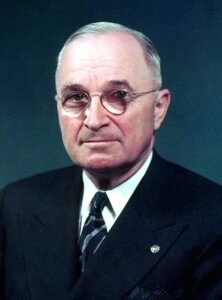
Harry Truman
- Harry S. Truman — haberdasher, artillery captain, Missouri county judge, US Senator, and Vice President for eighty-two days — was thrust into the presidency on 12 April 1945 upon Roosevelt's death, having been kept so thoroughly outside Roosevelt's inner circle that he did not know the Manhattan Project existed until his first full day as president, and proceeded to make more consequential decisions in his first six months in office than most presidents make in four years.1Britannica — Harry S. Truman
- His presidency from 1945 to 1953 encompassed the atomic bombing of Hiroshima and Nagasaki, the Marshall Plan, the Truman Doctrine, the Berlin Airlift, the recognition of Israel, the desegregation of the US military, the founding of NATO, and the decision to intervene in Korea — a sequence of foreign policy decisions that constructed the architecture of the postwar international order and defined the terms of the Cold War for the following four decades.2Miller Center — Harry Truman Key Events
- The man who made these decisions was a machine politician from Missouri with no college degree, no foreign policy experience, and approval ratings that fell to twenty-two percent — lower than any president before or since — yet whose historical reassessment has moved him consistently into the top tier of presidential rankings, making him the clearest case in the dataset of the gap between contemporary perception and long-run Value output.3US State Department — Truman Foreign Policy
Harry Truman is the most underrated profile in the American Political domain and the most instructive case of the Visibility variable distorting contemporary assessment of a leader whose actual output the equations capture more accurately than his polling numbers did. He was not impressive to look at, not eloquent to listen to, and not connected to the establishment networks that shaped reputation in his era. He was, by the measurable output of his decisions, one of the most effective executives the American system has produced.
The formation period is analytically essential and almost entirely overlooked. Truman's background — failed businessman, machine politician operating under the Pendergast organisation in Kansas City, undistinguished senator for most of his first term — reads as a catalogue of the variables that should predict mediocrity.1Britannica — Harry S. Truman The Truman Committee, which he chaired from 1941 to 1944 investigating waste and fraud in wartime defence contracting, is where the actual variable baseline was established. He saved an estimated fifteen billion dollars in waste, conducted the investigation without partisan theatrics, and demonstrated a Process and Defined Output capability that the haberdasher background had entirely concealed. That committee is where the presidency was made possible — and it is the analytical foundation for every subsequent snapshot.
The atomic bomb decision is the most consequential single executive decision in human history and the one that most directly tests the Decisiveness and Value variables in combination. Truman made it with incomplete information about casualties, genuine uncertainty about Japanese surrender intentions, and full knowledge of what the weapon would do.4Atomic Heritage Foundation — Decision to Drop the Bomb The historical debate has not resolved whether it was the right decision — the counterfactual invasion casualty estimates range so widely as to be analytically useless. What the equations record is that the Decisiveness variable scored at its ceiling: Truman made the decision, owned it completely, and never expressed regret in public or private. The Value variable is the most contested score in the profile — the outcome for the people of Hiroshima and Nagasaki scores at the floor; the outcome for the soldiers who did not have to invade Japan scores near the ceiling. Both are recorded.
The Marshall Plan is the most analytically unambiguous achievement of the presidency. Truman accepted George Marshall's proposal, fought it through a Republican Congress by framing it as containment of Soviet expansion rather than European charity, and committed four percent of American GDP to reconstructing the economies of nations including former enemies.5US State Department — Marshall Plan The Vision variable at this snapshot is operating well above the baseline that Truman's formation suggested — he understood that economic desperation was the condition on which Soviet influence fed, and that the only durable response was prosperity rather than military containment alone. The People variable is equally significant: Marshall, Acheson, Kennan, Harriman, and Lovett constitute the strongest foreign policy team in American presidential history, selected on capability and retained through political pressure that would have caused a less secure leader to replace them with loyalists.
The Truman Doctrine of 1947 — committing the United States to supporting free peoples resisting subjugation — established the framework for American Cold War foreign policy that every subsequent president inherited.6US State Department — Truman Doctrine Its immediate application was Greece and Turkey. Its structural implication was global. The Intent variable at this moment reflects a leader who understood he was setting a precedent rather than resolving a local problem, and phrased the doctrine accordingly — broadly enough to function as a framework, specifically enough to secure congressional support.
The desegregation of the US military by Executive Order 9981 in 1948 is the most morally precise decision of the presidency and the most politically costly in the short term.7Truman Library — Desegregation of the Military It cost Truman the Dixiecrat South in the 1948 election — which he won anyway, in the most improbable electoral outcome of the twentieth century. The Congruence variable at this snapshot is at its highest: his private views on race were complicated and sometimes inconsistent, but on the specific question of military service he concluded that men who fought for democracy were entitled to serve in a desegregated army, and he acted on that conclusion against his political interest. That is the Congruence variable functioning as it should.
The Korean War is the most analytically difficult period of the presidency. The decision to intervene was correct by the Truman Doctrine's own logic. The decision to advance to the Yalu River — against Chinese warnings — was an Adaptability failure that produced Chinese intervention and 36,000 additional American deaths.2Miller Center — Harry Truman Key Events The dismissal of MacArthur in April 1951 is the clearest expression of the Decisiveness variable in the entire profile: Truman fired the most popular military figure in America for insubordination, absorbed the political consequences, and was right on the constitutional principle. The approval rating fell to twenty-two percent. He did not reverse the decision.
The number that matters most across all four snapshots is Defined Output — the variable that measures whether decisions translate into concrete outcomes. Truman's decisions consistently did. The Marshall Plan was executed. NATO was formed. The military was desegregated. Korea was contained. The atomic decision was implemented. A leader who scores at the floor on Visibility and near the ceiling on Defined Output produces a profile that contemporary assessment consistently undervalues and historical reassessment consistently corrects. That is the Leaderment profile of Harry Truman.
Score Comparison
Add up to 10 leaders. Click a name to visit their profile.
The 13 Equations
Scores for: Post-Presidency and Historical ReassessmentThe 22 Variables
Canonical scoresWhat changed: Second Term — Korea, MacArthur and Desegregation → Post-Presidency and Historical Reassessment
Sources & Bibliography
The scores assigned to this leader are derived from publicly available sources. Variable inputs reflect documented behaviour, structural conditions, and historical record at the time of each snapshot.