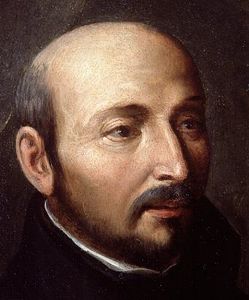
Ignatius of Loyola
Ignatius of Loyola (1491–1556)
- Ignatius of Loyola — born Íñigo López de Loyola into a minor Basque noble family in the castle of Loyola in Guipúzcoa, trained as a courtier and soldier, severely wounded at the siege of Pamplona in 1521 when a cannonball shattered his leg, underwent a prolonged convalescence during which he read the only books available — a life of Christ and a collection of saints' lives — experienced a conversion that redirected his entire variable profile from military ambition to religious mission, and founded the Society of Jesus in 1540 with ten companions, producing the most operationally effective religious organisation of the Counter-Reformation and the institutional framework that remains one of the largest Catholic religious orders in the world today.1Britannica — Ignatius of Loyola
- The Society of Jesus that he built from scratch between 1540 and his death in 1556 — without personal wealth, without inherited institutional structure, and against the sustained suspicion of the Inquisition and significant sections of the Catholic hierarchy — established universities, colleges, and missions across Europe, Asia, Africa, and the Americas within a generation of its founding, producing a global educational and missionary network whose reach, speed of deployment, and organisational coherence had no precedent in the history of religious institutions.2Jesuits Global — Our History
- The Spiritual Exercises — the structured four-week programme of meditation, prayer, and self-examination that Ignatius developed from his own conversion experience and refined across three decades — became the most widely used programme of directed spiritual formation in Catholic Christianity, the foundation document of Jesuit spirituality, and an instrument of personal transformation whose psychological structure anticipates elements of cognitive behavioural methodology by four centuries, making it analytically one of the most durable defined outputs in the Religious domain dataset.3Ignatian Spirituality — The Spiritual Exercises
Ignatius of Loyola is the most complete organisational builder in the Religious domain dataset and the profile that most precisely illustrates the relationship between personal transformation and institutional design. He built the Society of Jesus on the basis of his own conversion experience — not as a model for others to replicate internally, but as an operational framework that could be systematised, taught, and deployed at scale. The equations capture a leader whose Vision, Process, and Defined Output variables were operating simultaneously at their highest expression, producing an institution that outlasted every contemporary organisation in its domain.
The formation period contains the most analytically significant single event in the profile — the cannonball at Pamplona. Ignatius was thirty years old, a professional soldier with a courtier's formation and a military ambition that the subsequent career suggests would have produced a competent but not exceptional military record.1Britannica — Ignatius of Loyola The convalescence that the wound imposed — months of enforced immobility in the castle of Loyola, with no books available except the lives of Christ and the saints — produced a specific kind of reflection that the military career had not permitted. The Learning variable in this period is operating in its most concentrated form: a man with nothing to do but think, reading material that offered an alternative framework for ambition, and sufficient intelligence to recognise that the consolations he experienced reading about the saints were more durable than those he experienced imagining military glory. The conversion is not analytically miraculous — it is the Learning variable producing a fundamental update to the Conviction and Vision variables when the environmental conditions for that update were finally present.
The period of study and pilgrimage from 1521 to 1540 is the most analytically unusual formation phase in the Religious domain dataset — a man of thirty undergoing secondary education alongside boys, studying Latin grammar at Barcelona, philosophy at Alcalá and Salamanca, and theology at Paris, while simultaneously developing the Spiritual Exercises through direct application with individuals he was directing.1Britannica — Ignatius of Loyola The Humility variable at this snapshot is among the highest in the dataset — a former soldier and courtier sitting in a classroom with adolescents, absorbing the intellectual formation he had not received in youth, without the ego investment in his prior identity that most leaders of his age and background would have maintained. The Inquisition's multiple investigations of his activities during this period — he was examined and released without condemnation four times — reflect the Environment variable operating at its most hostile for a man whose activities were not yet institutionally protected.
The gathering of the first companions at Paris — Francis Xavier, Peter Faber, Diego Laínez, Alfonso Salmerón, Nicolás Bobadilla, and Simão Rodrigues among the original nine — is the People variable at its most consequential single expression in the Religious domain.2Jesuits Global — Our History Ignatius selected individuals of exceptional intellectual and apostolic capability, put them through the Spiritual Exercises, and built a shared commitment to a mission that none of them could have articulated precisely at the time of their initial vow at Montmartre in 1534. The subsequent careers of Xavier in Asia, Laínez at the Council of Trent, and Canisius in Germany reflect a People variable that had identified transformational capability across multiple domains and given it a shared institutional framework within which to operate. No other religious founder in the dataset assembled a founding cohort of equivalent collective capability.
The founding of the Society of Jesus in 1540 — receiving papal approval from Paul III through the bull Regimini militantis Ecclesiae — is the canonical institutional event of the career and the one that most precisely captures the Vision and Process variables in combination.4Britannica — Society of Jesus The Jesuit Constitutions that Ignatius spent the subsequent fifteen years developing — a document of extraordinary administrative sophistication that governed the formation, deployment, and governance of the order — reflect a Process variable operating at its highest expression: a leader who understood that the mission required an institutional framework capable of producing consistent output across diverse cultural contexts without direct supervision, and who designed that framework with a precision that the subsequent five centuries of Jesuit operation have validated.
The specific innovations of the Constitutions are the most analytically significant Process outputs in the Religious domain dataset. The fourth vow of special obedience to the Pope — making Jesuits available for deployment wherever the Church required without the territorial constraints of existing religious orders — is the Autonomy variable designed into the institutional structure rather than dependent on the personal authority of any individual leader.3Ignatian Spirituality — The Spiritual Exercises The extended formation period — two years of novitiate, years of philosophical and theological study, a tertianship period after ordination — is the People variable institutionalised: a systematic process for identifying, developing, and deploying human capability that produced consistent quality across a global organisation. The rejection of choir obligation and distinctive religious habit — departures from monastic tradition that the existing orders found scandalous — reflect an Adaptability variable operating against institutional convention in service of apostolic effectiveness.
The Spiritual Exercises are the most durable Defined Output in the profile and the one whose analytical significance extends beyond the Religious domain. Ignatius developed the four-week programme from his own conversion experience — the specific psychological mechanics of the Pamplona convalescence, refined through decades of directing others through the same process — into a structured methodology for fundamental personal reorientation.3Ignatian Spirituality — The Spiritual Exercises The programme's structure — a first week focused on sin and consequence, a second on the life of Christ, a third on the Passion, a fourth on the Resurrection — follows a psychological arc of confrontation, identification, suffering, and transformation that the subsequent history of directed retreat has validated across cultural contexts that Ignatius did not anticipate. The fact that the Exercises are still being given in substantially the same form nearly five centuries after their composition is the Defined Output variable producing its maximum possible score — an output that outlasts not only the leader but every institutional context the leader could have imagined.
The governance of the Society from Rome in the final fifteen years of his life reflects the Process and People variables maintaining their expression under conditions of increasing physical frailty.1Britannica — Ignatius of Loyola Ignatius ran the Society through correspondence — his surviving letters number nearly seven thousand — managing the deployment of companions across Asia, Africa, and the Americas with a directness and specificity that the distances involved made extraordinary. The letter to Francis Xavier in India, the instructions to the German Jesuits navigating the Reformation, the directives to the Roman College — each reflects a leader maintaining operational oversight of a global organisation through the only communication technology available, with a clarity of intent and precision of instruction that the subsequent Jesuit record validated.
The number that matters most across all three snapshots is the Defined Output variable — specifically its interaction with the Vision variable across the full arc of the career. Ignatius converted a personal religious experience into a systematic programme of spiritual formation, a programme of spiritual formation into an institutional framework, and an institutional framework into a global organisation operating simultaneously in twenty countries within fifteen years of its formal founding. That sequence — from personal experience to systematic output to institutional durability — is the Defined Output variable producing its maximum expression across the longest possible time horizon. It is the analytical signature of Ignatius of Loyola, and it is the reason the Society of Jesus is still operating in the same institutional form, in one hundred and twelve countries, nearly five hundred years after his death.
Score Comparison
Add up to 10 leaders. Click a name to visit their profile.
The 13 Equations
Scores for: Founding and Constitutions — Society of Jesus EstablishedThe 22 Variables
Canonical scoresWhat changed: Conversion, Formation and Paris — Pre-Founding → Founding and Constitutions — Society of Jesus Established
Sources & Bibliography
The scores assigned to this leader are derived from publicly available sources. Variable inputs reflect documented behaviour, structural conditions, and historical record at the time of each snapshot.