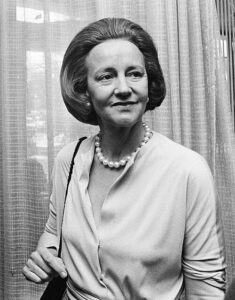
Katharine Graham
Katharine Graham 1917-2001
- Became the first female chief executive officer of a Fortune 500 company in 1972 as head of the Washington Post Company, having inherited the role in 1963 following her husband's suicide with no business training and no expectation that she was capable of performing it — then grew company revenue by more than one billion dollars across her tenure and transformed a mid-ranking Washington newspaper into one of the most influential news organisations in the United States.1Wikipedia — Katharine Graham ↗
- Authorised publication of the Pentagon Papers in 1971 — the 7,000-page classified study of US involvement in Vietnam — two days after taking the Post public on the stock exchange, with her legal team warning that the decision might jeopardise the stock offering and the company's broadcasting licences, and with the Nixon administration threatening criminal charges; then sustained the Watergate investigation for two years against direct government pressure, threats to the company's broadcasting properties, and a sustained White House campaign to discredit the paper.2Britannica — Katharine Graham ↗
- Faced and defeated a violent pressmen's strike in 1975 — in which union members vandalised the pressroom, attempted to set it on fire, and assaulted staff — sustaining the paper through four and a half months of disruption and ultimately hiring replacement workers, a decision she later regarded as the definitive test of her business leadership, and one that transformed the economics of the American newspaper industry by demonstrating that major newspapers could operate without the union manning arrangements that had governed their production for decades.3Graham Holdings — The Storied Mrs Graham ↗
Katharine Meyer was born on 16 June 1917 in New York City, the fourth of five children of Eugene Meyer — a financier, Federal Reserve chairman and first World Bank president — and Agnes Meyer, an educator and social reformer.1Wikipedia — Katharine Graham ↗ Her father purchased the Washington Post in 1933. She worked on the paper after graduating from the University of Chicago in 1938, married Philip Graham in 1940, and spent two decades raising four children and working on the paper's editorial and circulation departments while her husband ran the company. Philip Graham's suicide in August 1963 left her in charge of a business she had been systematically excluded from by the conventions of the era and by her own internalised sense that leadership was not something women did. The analytical profile of Katharine Graham is built around the Confidence variable, which begins near its floor and rises across her leadership career to something approaching its ceiling — a trajectory with no parallel in the Codex dataset. She arrived at the helm of the Washington Post Company with near-zero self-confidence, surrounded by male editors and executives who did not expect her to succeed, and operating without female peers in comparable positions whose example she could draw on.4Washington Post — Katharine Graham ↗ Her own memoir documents the degree to which she deferred to male colleagues through her first decade, ending directives with 'if it's alright with you' and consistently undervaluing her own judgement. The Pentagon Papers decision in 1971 is the first analytically significant Congruence event. The Post's stated institutional purpose — as articulated by her father when he purchased the paper — was that the newspaper's duty is to its readers and the public, not to the private interests of its owners. The decision to publish classified government material, at legal and financial risk to the company, against direct government pressure, was the first clear demonstration that Graham understood that Congruence and was willing to pay its cost.2Britannica — Katharine Graham ↗ The Watergate period elevated that Congruence from a single decision to a sustained institutional commitment. While the New York Times and other papers moved on from the story after the initial break-in reports, the Post maintained investigative coverage for two years — during which the Nixon administration challenged the company's broadcasting licences in an attempt to impose financial consequences for the reporting. Graham sustained the investigation. Nixon resigned. The Post's Watergate reporting is the most consequential single piece of journalism in twentieth-century American history, and Graham's leadership decision was the enabling condition for it being published. The 1975 pressmen's strike, which Graham described as the true test of her business career, produced the highest-stakes management decision of her tenure: she refused to capitulate to union demands, hired replacement workers, and survived the four-and-a-half-month disruption. Before the strike the Post had never been highly profitable. Afterwards, with reduced union manning requirements, profits rose significantly, and the Washington Star — the Post's main rival — folded in 1981. She received the Pulitzer Prize in 1998 for her memoir Personal History, which she wrote at the age of eighty. She died on 17 July 2001 after a fall in Sun Valley, Idaho.
Score Comparison
Add up to 10 leaders. Click a name to visit their profile.
The 13 Equations
Scores for: Pentagon Papers and Watergate — Peak Institutional LeadershipThe 22 Variables
Canonical scoresSources & Bibliography
The scores assigned to this leader are derived from publicly available sources. Variable inputs reflect documented behaviour, structural conditions, and historical record at the time of each snapshot.