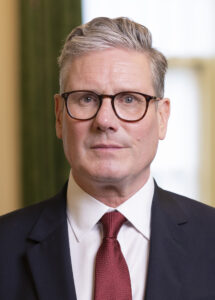
Keir Starmer
Keir Starmer (born 1962)
- Born in Southwark, London, son of a toolmaker and an NHS nurse, the first in his family to attend university — qualified as a barrister in 1987, took silk in 2002, and served as Director of Public Prosecutions from 2008 to 2013, receiving a knighthood for services to criminal justice before entering Parliament in 20151GOV.UK — Keir Starmer — then won the Labour leadership in April 2020 on a ten-pledge platform designed to appeal to the party's left wing, before moving the party systematically toward the political centre, expelling Jeremy Corbyn from the party he had championed, and abandoning position after position in what he described publicly as pragmatism.
- Led Labour to 412 seats on 33.7% of the popular vote in the July 2024 general election — the largest majority in parliamentary seats of any Labour government in history, and simultaneously the smallest vote share of any majority government since popular vote records began in 18302Wikipedia — Premiership of Keir Starmer — a result produced almost entirely by vote splitting between the Conservatives and Reform UK rather than by a resurgent Labour coalition.
- His first year in office was defined by fiscal constraint, a winter fuel payment cut that directly contradicted his pre-election positioning, a gift-acceptance controversy that The Guardian described as making things worse through defensiveness2Wikipedia — Premiership of Keir Starmer — and a communication style that polling consistently showed was failing to generate momentum, with his approval ratings among the lowest of any incoming Prime Minister in the modern era.
Keir Starmer became Prime Minister of the United Kingdom in July 2024, ending fourteen years of Conservative government. A former barrister and Director of Public Prosecutions, his career was built on legal precision and institutional process — a background that defines both his strengths and his limitations as a leader.
His political story begins not in 2024 but in 2018, when as Shadow Brexit Secretary he became the most prominent advocate for a second referendum on EU membership. He served loyally in Jeremy Corbyn's shadow cabinet, endorsed his leadership through two general elections, and built his political identity around a set of progressive commitments — on public ownership, workers' rights, and European alignment. When he ran for the Labour leadership in 2020, he won on ten specific pledges to the party's left wing.2Wikipedia — Premiership of Keir Starmer
What followed is the most significant say-do gap in recent British political history. Pledge by pledge, position by position, Starmer moved his party toward the political centre — justified publicly as pragmatism and the realities of inheritance. He expelled Corbyn from the party he had championed, abandoned the policy platform he had promised, and rebranded the entire exercise as political maturity.3Wikipedia — Keir Starmer The Codex records the distance between the person who made the pledges and the person who governed.
The 2024 election result requires careful reading. Labour's vote share increased by less than two percentage points compared to the 2019 election they lost heavily. The landslide in parliamentary seats was produced almost entirely by vote splitting between the Conservatives and Reform UK — a structural accident of first-past-the-post, not evidence of a resurgent Labour coalition.2Wikipedia — Premiership of Keir Starmer Starmer did not so much win the 2024 election as survive it while his opponents destroyed each other.
His first year in office has been defined by fiscal constraint, a winter fuel payment cut that directly contradicted his pre-election positioning, and a communication style that struggles to generate momentum. He holds the largest parliamentary majority of any Labour government in history, built on the thinnest genuine public support. The equations know the difference.
Starmer's Codex profile is defined by the tension between Process and Congruence. His Process score is among the highest of any current leader — he rebuilt a shattered party with exceptional organisational discipline, making it electable when it had been unelectable.4Britannica — Keir Starmer His Congruence score is among the lowest, reflecting a career-long pattern of stated positions that did not survive contact with political expedience.
He operates in a post-austerity Britain with broken public finances, a hostile press, and a deeply sceptical public. His Management score reflects genuine competence — the party he inherited was ungovernable and he made it electable. His Visibility score reflects a leader who has yet to find a compelling public voice. His Competition score reflects a parliamentary majority built not on strength but on the collapse of his opponents — a foundation that is structurally fragile.
Score Comparison
Add up to 10 leaders. Click a name to visit their profile.
The 13 Equations
Scores for: Prime MinisterThe 22 Variables
Canonical scoresWhat changed: Leader of the Opposition → Prime Minister
Sources & Bibliography
The scores assigned to this leader are derived from publicly available sources. Variable inputs reflect documented behaviour, structural conditions, and historical record at the time of each snapshot.