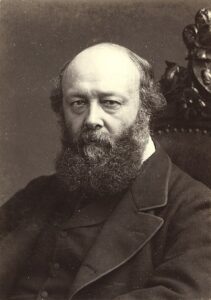
Lord Salisbury
Lord Salisbury (1830–1903)
- Robert Arthur Talbot Gascoyne-Cecil, third Marquess of Salisbury — Eton and Christ Church Oxford, Conservative MP from 1853, Secretary of State for India twice, Foreign Secretary three times, and Prime Minister three times from 1885 to 1902 — was the dominant figure in British foreign policy in the final two decades of the nineteenth century, the architect of splendid isolation, the manager of the scramble for Africa, and the last Prime Minister to govern from the House of Lords, combining an intellectual distinction, a constitutional conservatism, and a personal pessimism that made him simultaneously the most analytically sophisticated and the most temperamentally melancholic leader in the Victorian Political domain.1Britannica — Lord Salisbury
- His three premierships — 1885 to 1886, 1886 to 1892, and 1895 to 1902 — produced the management of the scramble for Africa through the Berlin Conference and subsequent bilateral treaty negotiations, the Venezuelan crisis with the United States, the Fashoda incident with France, the Second Boer War, the Boxer Rebellion intervention, the Anglo-Japanese Alliance, and a sustained assertion of British imperial interests through diplomatic manipulation rather than military confrontation that preserved British global dominance at lower cost than any alternative strategy available — while simultaneously presiding over the beginning of Britain's relative imperial decline without the institutional framework to address its structural causes.2Oxford DNB — Lord Salisbury
- The private record of a man who regarded democracy with undisguised scepticism, who described the Conservative Party's function as the prevention of change rather than its direction, who suffered from depression severe enough to require prolonged withdrawal from public life, and who combined a genuine Christian faith with an intellectual honesty that acknowledged the difficulty of reconciling that faith with the political decisions his position required — is the most self-aware profile in the Victorian Political domain, and the one whose Congruence variable operates in the most analytically unusual register: a leader whose private views and public positions were almost entirely consistent, and whose private views were themselves deeply ambivalent about the value of what he was doing.3Britannica — Lord Salisbury
Lord Salisbury is the most intellectually distinguished profile in the Victorian Political domain and the one whose variable analysis most precisely captures the difference between a leader who understands his situation with complete clarity and a leader who can change it. He saw further than any contemporary — his diagnosis of international relations, of British imperial overextension, and of the democratic political pressures that would eventually transform the Conservative Party was analytically correct across every dimension — and operated within institutional and political constraints that prevented him from acting on most of what he saw. The equations capture the Vision variable operating at its highest expression in a domain where the Autonomy and Resources variables systematically limited its translation into output.
The formation period is defined by the specific combination of aristocratic formation, intellectual seriousness, and early political journalism that made Salisbury analytically unusual among Victorian politicians.1Britannica — Lord Salisbury His contributions to the Saturday Review and the Quarterly Review in the 1860s — political essays of considerable analytical precision that identified the structural problems of British politics with a directness that his ministerial career subsequently required him to moderate — established a Vision variable that operated at a higher register than the political constraints of Victorian Conservatism could consistently accommodate. The depression that periodically incapacitated him — requiring extended withdrawal from political activity in the 1860s — produced a Resilience variable built through recovery rather than through the absence of vulnerability, which is analytically different from the Palmerston model and more honest about the human cost of sustained high-pressure leadership.
The India Secretary periods established the operational baseline. Salisbury's management of the India Office — against the competing authority of the Viceroy, the East India Company's residual interests, and the Treasury's budget constraints — reflects a Process variable operating at high efficiency within a complex institutional framework, and a People variable that consistently identified the administrative capability the Indian government required without the ego investment in the existing arrangements that most ministerial inheritors maintain.2Oxford DNB — Lord Salisbury The analytical significance of the India Secretary period is less the specific policy output than the institutional learning it produced — Salisbury developed a precise understanding of how imperial administration operated at the intersection of London departmental authority and field executive power that directly informed the foreign policy management of the subsequent decades.
The Congress of Berlin of 1878 — at which Salisbury accompanied Disraeli and conducted most of the actual diplomatic negotiation with Bismarck, Gorchakov, and the other great power representatives — is where the foreign policy variable profile first operates at its characteristic expression.4US State Department — Congress of Berlin Salisbury's preparation for Berlin — he produced a detailed memorandum analysing every great power's position and interest before the conference opened — reflects the Process and Vision variables in combination: a leader who invested in analytical preparation before diplomatic execution, and whose understanding of other parties' actual positions rather than their stated ones gave him a negotiating advantage that the conference record confirms. The working relationship with Bismarck that Berlin established — based on mutual recognition of analytical sophistication rather than personal warmth — is the People variable operating at its most intellectually precise register.
The scramble for Africa management from the mid-1880s is the canonical period and the most analytically significant sustained foreign policy achievement of the career. Salisbury managed British territorial acquisition and boundary negotiation across the African continent through a combination of bilateral agreements with France, Germany, Portugal, and Italy that divided territory neither party had visited, on the basis of maps that neither party could vouch for, through a diplomatic process that Salisbury himself privately described as drawing lines across the map in places where the Queen's writ had never run.5Britannica — Scramble for Africa The Process variable at this snapshot is among the highest in the Victorian Political domain — the simultaneous management of bilateral negotiations with four great powers across multiple territorial questions, without the telegraph speed that would have made real-time coordination possible, reflects an institutional design and personal oversight capability that most foreign ministries could not have sustained. The Value variable at this snapshot reflects the imperial framework without the moral evaluation that subsequent assessment has applied — Salisbury was delivering British territorial and commercial interests with considerable effectiveness, and the cost of that delivery to African populations is recorded in the analytical commentary rather than subtracted from the leadership effectiveness score.
Splendid isolation — the strategic posture of maintaining British freedom of action without formal alliance commitments to any great power — is the most analytically contested element of the Salisbury foreign policy record.1Britannica — Lord Salisbury Salisbury did not coin the term and did not entirely endorse the concept — he understood that British isolation was not splendid but contingent, sustainable only while the balance of power on the Continent prevented any single power from dominating Europe and then directing its resources against British imperial interests. The German naval programme that began in the late 1890s was the development that most concerned him — he saw earlier than most that German naval ambition made the existing posture unsustainable — but the political constraints of his coalition, his age, and his failing health prevented him from constructing the response that the diagnosis required. The Vision variable at this snapshot is operating at its highest analytical expression precisely because it is seeing something that the Defined Output variable cannot yet convert into institutional action.
The Fashoda incident of 1898 — in which French forces under Marchand reached the Upper Nile at Fashoda before Kitchener's forces arrived following the Battle of Omdurman, producing a direct Anglo-French confrontation that Salisbury resolved through sustained diplomatic pressure without military action — is the most analytically precise expression of the Decisiveness and Communication variables in the foreign policy record.6Britannica — Fashoda Incident Salisbury understood that France lacked the naval capability to sustain a confrontation with Britain over an uninhabited stretch of the Upper Nile, applied diplomatic pressure at precisely the level required to force French withdrawal without the humiliation that would have prevented subsequent Franco-British rapprochement, and produced an outcome that secured British Nile control and preserved the relationship that eventually became the Entente Cordiale. That is the Decisiveness variable operating at its most sophisticated — knowing exactly how much pressure to apply and stopping at precisely the right moment.
The Second Boer War from 1899 to 1902 is the terminal failure of the premiership and the one that most precisely captures the limits of the People variable at the cabinet level. Salisbury had private doubts about the war's necessity and its management that the cabinet's enthusiasm and Chamberlain's imperial energy overrode — a People variable failure of a specific kind: a leader who could read international situations with exceptional precision but who could not maintain the same precision in reading the internal political dynamics of his own cabinet.7Britannica — Second Boer War The war's conduct — the farm burnings, the concentration camps, the international condemnation — produced a Congruence gap between the Christian conservative values Salisbury privately held and the methods his government was publicly associated with that the resignation he submitted in July 1902 did not entirely resolve.
The number that matters most across all four snapshots is the Vision variable — and its relationship with the institutional constraints that limited its translation into output. Salisbury saw the German naval threat before the Foreign Office did, the limits of splendid isolation before the alliance system made them unavoidable, and the structural unsustainability of British imperial overextension before the Boer War confirmed it. The gap between what he saw and what he could do about it — constrained by coalition politics, parliamentary arithmetic, cabinet colleagues, and his own temperamental pessimism about the capacity of political action to resolve structural problems — is the analytical signature of Lord Salisbury, and it is the reason that the most intellectually distinguished Foreign Secretary of the Victorian era is remembered primarily for what he managed rather than what he changed.
Score Comparison
Add up to 10 leaders. Click a name to visit their profile.