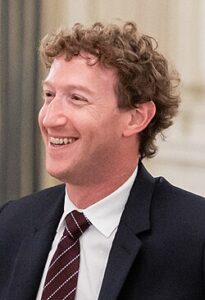
Mark Zuckerberg
Mark Zuckerberg (born 1984)
- At eleven wrote a messaging system connecting his family home to his father's dental practice, launched Facebook from his Harvard dormitory room at nineteen in February 2004, and within six days was accused by three fellow students of stealing their idea — settling for 1.2 million Facebook shares and sixty-five million dollars1Supermoney — Mark Zuckerberg — before dropping out, moving to Palo Alto, and retaining permanent control of the company through a dual-class share structure no shareholder vote could override.2Wikipedia — Mark Zuckerberg
- Acquired Instagram in 2012 for one billion dollars and WhatsApp in 2014 for nineteen billion dollars — both purchases the Federal Trade Commission subsequently argued constituted illegal monopoly maintenance3Britannica — Mark Zuckerberg — while testifying before the United States Senate in 2018 on the Cambridge Analytica scandal, in which data on up to eighty-seven million users was harvested without meaningful consent, describing the affair as a breach of trust between the researcher and Cambridge Analytica.2Wikipedia — Mark Zuckerberg
- In 2024 and 2025, progressively repositioned himself toward the incoming Trump administration — attending the inauguration, donating to Trump's inaugural fund, removing fact-checkers from Meta platforms, and publicly describing the administration as one that would defend American technology's interests abroad2Wikipedia — Mark Zuckerberg — seven years after a Harvard commencement speech calling for action on global warming, and while operating a $300 million superyacht tracked at Svalbard as environmental activists protested its emissions.
Mark Elliot Zuckerberg was born in 1984 in White Plains, New York, the son of a dentist and a psychiatrist. He was writing software before he was a teenager — at eleven he built a messaging system connecting his family home to his father's dental practice, and by high school had produced a music player sophisticated enough to attract attention from major technology companies.4Tech News Junkies — Mark Zuckerberg He arrived at Harvard in 2002 already carrying a reputation as a programming prodigy, studied psychology alongside computer science, and launched Facebook from his dormitory room in February 2004. He was nineteen years old.
Within six days of launch he was accused by three fellow students of stealing their idea. The lawsuit was settled for Facebook shares and sixty-five million dollars. A second co-founder sued him for misappropriating funds and was settled out of court. A film was made about it. Zuckerberg described the film as interesting.5Biography.com — Mark Zuckerberg
He dropped out of Harvard, moved to Palo Alto, and did not look back. By 2010 Facebook had half a billion users. By 2012 he had taken it public with majority shares, retaining effective control of the company through a dual-class share structure that meant no vote of shareholders could remove him. By 2018 he was testifying before the United States Senate. By 2024 he was among the two richest people in the world.3Britannica — Mark Zuckerberg
The business arc is one of the most extraordinary in modern commercial history. Facebook became Instagram became WhatsApp became Meta — a portfolio of social communication platforms with billions of users across every significant market on earth. The acquisitions were well-timed and defensively motivated: Instagram purchased in 2012 for one billion dollars before it became a genuine competitive threat, WhatsApp purchased in 2014 for nineteen billion dollars for the same reason.5Biography.com — Mark Zuckerberg The Federal Trade Commission subsequently argued that both acquisitions were illegal monopoly maintenance. The antitrust case remained unresolved as of the time of this profile, with Zuckerberg reportedly working his relationship with the incoming Trump administration to influence the outcome.2Wikipedia — Mark Zuckerberg
The Congruence picture is the most analytically significant aspect of his leadership record and the one the equations register most clearly. Zuckerberg has stated commitments to privacy, user safety, democratic integrity, and the wellbeing of young people on his platforms. The documented record runs in a different direction. Court documents allege he personally rejected Meta's own proposals to improve teenagers' mental health, overriding senior executives. The Cambridge Analytica scandal, in which data on up to eighty-seven million users was harvested without meaningful consent, he described as a breach of trust — between the researcher and Cambridge Analytica, implicitly placing Facebook at a remove from the outcome.2Wikipedia — Mark Zuckerberg In 2024 he told the House Judiciary Committee he regretted not resisting Biden administration pressure to censor COVID-related content — a statement that reframed a content moderation decision as a political alignment signal rather than an editorial judgment.
The political repositioning from 2024 onwards is the most analytically revealing recent development. A man who had supported progressive causes through his twenties, donated to election infrastructure, and spoken publicly against Trump's immigration policies progressively moved towards the new political centre of gravity in American technology. Meta donated to Trump's inaugural fund. Zuckerberg was positioned prominently at the inauguration. He announced the removal of fact-checkers from Meta platforms and their replacement with a community notes system.2Wikipedia — Mark Zuckerberg The yacht — three hundred million dollars, one hundred and nineteen metres, tracked at Svalbard while environmental activists protested its emissions, purchased seven years after a Harvard commencement speech calling for action on global warming — is not an outlier in this pattern. It is consistent with it.
The equations capture a leader of exceptional structural power — near-monopoly positions across multiple platforms, effectively unchallenged control through share structure, extraordinary Resources, strong Process architecture — whose Congruence gap is sustained and documented rather than episodic, and whose Ego and Pride scores reflect a man who has systematically reframed every significant failure as someone else's responsibility while constructing an environment in which challenge to his judgement is structurally limited by his voting control.
He has pledged 99% of his Facebook shares to the Chan Zuckerberg Initiative over his lifetime. His net worth as of December 2025 stands at over two hundred billion dollars. He is forty-one years old.
Score Comparison
Add up to 10 leaders. Click a name to visit their profile.
The 13 Equations
Scores for: AI and Threads 2022–presentThe 22 Variables
Canonical scoresWhat changed: Meta and the Pivot 2018–2022 → AI and Threads 2022–present
Sources & Bibliography
The scores assigned to this leader are derived from publicly available sources. Variable inputs reflect documented behaviour, structural conditions, and historical record at the time of each snapshot.