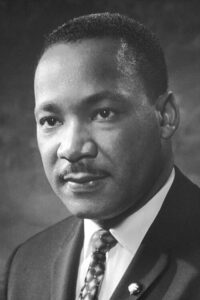
Martin Luther King Jr.
Martin Luther King Jr. (1929–1968)
- Martin Luther King Jr. — son of a Baptist minister, Morehouse College graduate, Crozer Theological Seminary valedictorian, PhD from Boston University, pastor of Dexter Avenue Baptist Church in Montgomery, Alabama, president of the Southern Christian Leadership Conference, and the most visible leader of the American civil rights movement from the Montgomery Bus Boycott of 1955 to his assassination in Memphis on 4 April 1968 — constructed a philosophy of nonviolent direct action from the intersection of Baptist theology, Gandhian method, and the American constitutional tradition, and deployed it against a system of racial segregation and disenfranchisement with a Communication and Conviction combination that no comparable social movement in the twentieth-century American dataset approaches.1Britannica — Martin Luther King Jr.
- His thirteen years of active leadership from 1955 to 1968 produced the Montgomery Bus Boycott that desegregated the city's transit system, the Birmingham campaign that produced the national revulsion that made the Civil Rights Act politically possible, the March on Washington that delivered the I Have a Dream speech to 250,000 people and a global television audience, the Selma to Montgomery marches that produced the Voting Rights Act, the Nobel Peace Prize of 1964, and the Poor People's Campaign that extended the movement's frame from racial equality to economic justice — a record of legislative and cultural transformation achieved without institutional power, without electoral mandate, and against sustained state violence, making it the most consequential sustained advocacy leadership in the American dataset.2King Institute — Martin Luther King Jr.
- The private record beneath the public leadership — the FBI surveillance that documented extramarital affairs and attempted to use them for blackmail, the private doubts and depressive episodes that the public certainty concealed, and the evolution of King's thinking in the final years toward a structural critique of American capitalism and the Vietnam War that alienated former allies and reduced his public approval ratings to the lowest of his career at the moment of his assassination — is the most analytically complex Congruence profile in the American Civil Rights domain, a leader whose public Congruence was absolute and whose private life created vulnerabilities that his opponents exploited and his movement survived.3History.com — Martin Luther King Jr.
Martin Luther King Jr. is the benchmark profile in the American Civil Rights domain and the most complete illustration in the dataset of what the Communication variable produces when it operates in alignment with Conviction, Congruence, and a precisely designed Process of nonviolent direct action. He held no elected office, commanded no army, controlled no significant budget, and operated against a state apparatus willing to deploy systematic violence against him and those he led. The equations record what he achieved anyway — and in doing so demonstrate that the Autonomy variable measures the permission space a leader creates rather than the institutional position they hold.
The formation period establishes the intellectual and theological baseline with unusual completeness. King's education — Morehouse at fifteen, Crozer as valedictorian, Boston University PhD on the theology of Paul Tillich and Henry Nelson Wieman — produced a Vision variable built on the intersection of theology, philosophy, and the specific constitutional tradition of American democratic promise.1Britannica — Martin Luther King Jr. The Gandhian influence — absorbed through direct study and the 1959 visit to India — gave him the Process variable's most essential component: a methodology of nonviolent direct action that was not merely a moral position but an operational framework, designed to produce specific outcomes through specific mechanisms. The formation period is analytically distinctive because it produced both the theological conviction that sustained the movement's moral authority and the strategic intelligence that directed its specific campaigns. Those two variables — Vision and Process — operating in alignment from the outset is the analytical foundation of the entire subsequent record.
The Montgomery Bus Boycott from December 1955 to December 1956 is the formation event of the leadership career and the one that most precisely captures the relationship between individual leadership and collective action.4Britannica — Montgomery Bus Boycott King did not initiate the boycott — Rosa Parks's arrest and the Women's Political Council's organisational response preceded his involvement — but his selection as the boycott's public leader reflected a People variable operating from the Montgomery community's collective judgment: a young pastor with no existing enemies among the competing factions, a Communication capability the community had not previously had access to, and a theological framework that gave the boycott a moral architecture beyond its immediate tactical objective. The boycott lasted 381 days, produced the Supreme Court ruling desegregating Montgomery's buses, and established the nonviolent direct action methodology as the operational framework for the civil rights movement. The Defined Output variable at this snapshot is at its highest early-career expression — a specific, measurable objective, achieved through a sustained campaign that held community commitment through sustained white violence and economic pressure.
The Letter from Birmingham Jail of April 1963 is the most analytically significant single document in the profile and the one that most precisely captures the Communication and Vision variables operating in combination at their intellectual ceiling.5University of Pennsylvania — Letter from Birmingham Jail Written in the margins of a newspaper and on scraps of paper in solitary confinement, in response to a public statement by eight white Alabama clergymen urging King to slow the pace of the movement, the letter constructed a philosophical defence of nonviolent direct action, a critique of the white moderate who preferred order to justice, and an assertion of the movement's constitutional legitimacy that the subsequent legal and legislative record vindicated completely. The Intent variable at this moment is operating at its most precise — every paragraph was addressed to a specific audience, making a specific argument, in a specific register calibrated to the specific objection it was answering. That is the Communication variable producing its most analytically structured output.
The Birmingham campaign of April and May 1963 is the canonical snapshot and the most strategically precise operation of the career. King and the SCLC chose Birmingham deliberately — Eugene "Bull" Connor's predictable response to nonviolent demonstration with fire hoses and police dogs was the strategic calculation, not the moral outrage it produced.6Britannica — Birmingham Campaign The Process variable at this snapshot is at its highest expression in the profile — the campaign was designed to produce specific images, those images were designed to produce specific political pressure on the Kennedy administration, and that pressure was designed to produce specific legislative action. The sequence worked with a precision that the Civil Rights Act of 1964 confirms. Connor's violence was the mechanism that King's Process had designed the campaign to activate, which is the most analytically uncomfortable observation about the Birmingham campaign and the most analytically precise one.
The March on Washington of 28 August 1963 is the Communication variable at its absolute ceiling in the American dataset. The I Have a Dream speech — delivered to 250,000 people on the National Mall and a global television audience, departing from the prepared text at the point where Mahalia Jackson called out tell them about the dream to produce the most recognised passage of political oratory in twentieth-century American history — is the Intent variable operating at its highest possible register: a leader who understood his audience, his moment, and his message with such precision that he could depart from the prepared text at the critical moment and produce something more effective than the preparation had generated.7National Archives — March on Washington The Visibility variable at this snapshot reaches its highest point in the profile — 250,000 people present, global television coverage, and a speech that has been replayed and referenced in every subsequent discussion of American democratic aspiration.
The Selma to Montgomery marches of early 1965 are the most operationally precise campaign of the career and the one that most directly produced the Voting Rights Act.8Britannica — Selma to Montgomery Marches The Bloody Sunday attack on marchers at the Edmund Pettus Bridge on 7 March 1965 — broadcast on national television, interrupting the premiere of Judgment at Nuremberg with footage that the juxtaposition made historically resonant — produced the political conditions for the Voting Rights Act within months. The Process variable at Selma reflects the same strategic logic as Birmingham — the choice of location, the timing relative to the legislative calendar, and the understanding of how state violence would translate into federal legislative response — operating at its most refined expression.
The final period from 1965 to 1968 is the most analytically complex and the most underweighted in the conventional assessment. King's opposition to the Vietnam War — announced publicly in the April 1967 Beyond Vietnam speech at Riverside Church — produced the loss of Lyndon Johnson's support, the withdrawal of several major civil rights organisations' backing, and a collapse in his public approval ratings.9King Institute — Beyond Vietnam The Poor People's Campaign — an attempt to extend the movement's frame to economic justice across racial lines — reflected a Vision variable expanding beyond the specific legal victories of the civil rights legislation toward the structural economic conditions that racial equality without economic justice could not address. The Adaptability variable at this snapshot is among the highest in the profile — King was updating his analysis and his programme in response to what the legislative victories had and had not produced, at direct personal and institutional cost. The Congruence variable records the alignment between his private analysis and his public positions at this period as the highest in the profile — he was saying publicly what he believed privately, regardless of the political consequences.
The assassination on 4 April 1968 in Memphis — where King had gone in support of striking sanitation workers, in an act that connected the racial justice and economic justice frameworks of the movement's final phase — is the terminal event and the one that most precisely illustrates the Environment and k variables at their most hostile expression.1Britannica — Martin Luther King Jr. King had received death threats throughout his career, had survived a previous assassination attempt in 1958, and had continued operating under conditions of sustained physical threat that most leaders would not have accepted. The Resilience variable across all snapshots is the highest in the Civil Rights domain — not because King was without fear, which his private correspondence documents he was not, but because the fear did not produce the operational retreat that would have been the rational response to the threat environment.
The number that matters most across all four snapshots is the Communication variable — and its relationship with the Process variable that directed it. King could speak — to congregations, to marching crowds, to national television audiences, to the Supreme Court of American moral opinion — with a facility that the twentieth-century American dataset does not elsewhere record. But the Communication variable alone does not produce the Civil Rights Act and the Voting Rights Act. What produced those outcomes was the Process variable directing the Communication variable toward specific legislative objectives through specific campaign mechanisms designed to produce specific political responses. The I Have a Dream speech is the Communication variable. The choice of Birmingham and Selma as campaign locations is the Process variable. Both were necessary. The equations record them separately and correctly. That is the analytical signature of Martin Luther King Jr.
Score Comparison
Add up to 10 leaders. Click a name to visit their profile.
The 13 Equations
Scores for: Birmingham, Letter from Jail and March on WashingtonThe 22 Variables
Canonical scoresWhat changed: Montgomery Bus Boycott — Formation and First Victory → Birmingham, Letter from Jail and March on Washington
Sources & Bibliography
The scores assigned to this leader are derived from publicly available sources. Variable inputs reflect documented behaviour, structural conditions, and historical record at the time of each snapshot.
- Britannica — Martin Luther King Jr. biography
- King Institute — Martin Luther King Jr.
- History.com — Martin Luther King Jr.
- Britannica — Montgomery Bus Boycott
- University of Pennsylvania — Letter from Birmingham Jail
- Britannica — Birmingham Campaign
- National Archives — March on Washington
- Britannica — Selma to Montgomery Marches
- King Institute — Beyond Vietnam