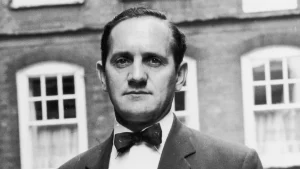
Nipper Read
Nipper Read (1925-2020)
- Led the Metropolitan Police investigation that arrested Ronnie and Reggie Kray and fifteen members of the Firm on 8 May 1968, after four years of evidence gathering against the most feared criminal organisation in post-war London — operating out of a secret office at Tintagel House, selecting only officers he personally trusted from different divisions precisely because corrupt officers were on the Kray payroll, and building an evidential case strong enough to produce life sentences at the longest murder trial in British criminal justice history at that point.1Wikipedia — Nipper Read ↗
- Operated in a Metropolitan Police culture riven with corruption — the Krays employed bent coppers as a structural part of their operation, and a previous investigation into their activities in 1964 had been publicly compromised by political interference involving Lord Boothby — maintaining personal integrity throughout by selecting his team from officers he had worked with directly, keeping their assignment secret until they were locked in a room together, and refusing every form of personal dealing with the Firm that would have given the Krays' defence lawyers grounds for challenge.2Left Lion — Nipper Read ↗
- Secured convictions through witness testimony obtained under conditions of extreme intimidation — the East End wall of silence was not a cliché but an operational fact underpinned by the Krays' documented willingness to murder anyone who spoke to police — persuading the barmaid who witnessed Ronnie's shooting of George Cornell at the Blind Beggar, the woman in whose flat Reggie murdered Jack McVitie, and multiple Firm members to give evidence, including by posing as a vicar to visit one witness in Brixton prison to secure testimony on a third murder.3Kray Twins Wiki — Nipper Read ↗
Leonard Ernest Read was born on 31 March 1925 in Nottingham, the son of a leather company employee, lost his mother when he was four, grew up in poverty, excelled academically but could not afford the fees for Nottingham High School, and learned to box at Grundy's club — earning the nickname Nipper for his diminutive stature and speed — before joining the Metropolitan Police in 1947 after service in the Royal Navy during the war.1Wikipedia — Nipper Read ↗ He rose steadily through the ranks over twenty years, working on the periphery of the Great Train Robbery investigation in 1963, before being assigned to investigate the Krays in 1964 as a Detective Inspector and given the definitive brief as Detective Chief Superintendent of the Murder Squad in 1967. The analytical profile of Nipper Read within the Law Enforcement domain is a study in Conviction and Process under conditions of extreme institutional adversity. The Kray investigation was not simply a difficult case — it was a case that had already failed once, in 1964, when political intervention around Lord Boothby's relationship with Ronnie Kray made the evidence Read had gathered unusable and the investigation was quietly discontinued.3Kray Twins Wiki — Nipper Read ↗ The first attempt taught Read precisely what the second attempt would require: a team entirely of his own selection, a secret operational base outside Scotland Yard's normal channels, and a strategy built on building an evidential case robust enough to survive the intimidation of witnesses that the Krays would inevitably attempt. The People variable in his profile is where the most analytically precise judgment is required. He operated within a police force where corruption was structural rather than incidental — officers on the Kray payroll were not a rumour but a documented operational reality.2Left Lion — Nipper Read ↗ Read's response was not to work around the corruption but to design an investigative structure that made it irrelevant: ten officers drawn from different divisions, none of whom were told what they were working on until they were assembled in a locked room together, all of whom had earned Read's personal trust through prior direct working relationships. This is a People score that reflects not the management of a willing team but the construction of a trustworthy team from institutional material that contained significant proportion of bad actors. The Defined Output in his profile is unusually clean for a detective investigation: bring the Krays to trial on murder charges. The difficulty was the gap between the output and the means available. The Krays had operated with impunity for twelve years, in part because anyone with evidence against them understood what had happened to those who had previously spoken to police or shown insufficient respect for the Firm. Read's innovation was to arrest the Krays first — on the evidence already assembled — and then rely on the logic that witnesses who had been afraid to speak while the Firm was operational would talk once the Krays were in custody.4Wikipedia — Kray Twins ↗ The strategy worked. Ronnie and Reggie were each sentenced to life imprisonment in 1969 with a recommendation of thirty years minimum. Read said in later interviews that the label 'the man who brought down the Krays' would follow him until he died, and it did. He was portrayed by Christopher Eccleston in the 2015 film Legend. He served as chairman of the British Boxing Board of Control and vice-president of both the World Boxing Council and the World Boxing Association. He died on 7 April 2020, one week after his ninety-fifth birthday, having contracted COVID-19 while hospitalised for a foot infection.
Score Comparison
Add up to 10 leaders. Click a name to visit their profile.
The 13 Equations
Scores for: Murder Squad — Kray Arrests and ConvictionsThe 22 Variables
Canonical scoresWhat changed: First Kray Investigation — 1964 → Murder Squad — Kray Arrests and Convictions
Sources & Bibliography
The scores assigned to this leader are derived from publicly available sources. Variable inputs reflect documented behaviour, structural conditions, and historical record at the time of each snapshot.