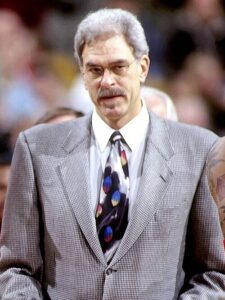
Phil Jackson
Phil Jackson (Born 1945)
- Won eleven NBA championships as head coach — six with the Chicago Bulls (1991-93, 1996-98) and five with the Los Angeles Lakers (2000-02, 2009-10) — the most championships won by any head coach in the history of professional basketball, surpassing Red Auerbach's record of nine, achieved across two entirely different rosters with two entirely different superstar configurations, making him the only coach to have won multiple three-peats in NBA history.1Wikipedia — Phil Jackson ↗
- Installed Tex Winter's triangle offense at Chicago in 1989 — a system designed to distribute offensive responsibility across all five players and eliminate the isolation-heavy approach that had made the Bulls defensively predictable — convincing Michael Jordan to reduce his individual scoring output in exchange for a system that made his teammates co-invested in the team's success, and winning the first championship in 1991 in Jordan's fifth professional season.2Britannica — Phil Jackson ↗
- Applied Eastern philosophy, Native American spiritual practices, group meditation and individually assigned reading — including distributing books to players tailored to their specific psychological situations — as tools for managing a roster of elite athletes with extreme individual egos, creating a team culture that sustained collective performance across six championship-winning seasons with the Bulls and five more with the Lakers, a record of sustained elite performance in the highest-ego environment in professional sport.2Britannica — Phil Jackson ↗
Philip Douglas Jackson was born on 17 September 1945 in Deer Lodge, Montana, the son of two Pentecostal ministers who had sworn an oath of poverty, grew up in rural North Dakota, played basketball at the University of North Dakota, was drafted by the New York Knicks in 1967, and spent twelve seasons in the NBA as a power forward — winning championships with the Knicks in 1970 and 1973 — before beginning a coaching career that started in the lower leagues of American basketball and only entered the NBA mainstream when he was hired as an assistant coach by the Chicago Bulls in 1987.1Wikipedia — Phil Jackson ↗ The analytical entry point for Jackson's profile is the question of what he actually did. The eleven championships are documented. The triangle offense is documented. The Zen Master nickname is documented. The more analytically interesting question is how a coach whose primary method was the systematic distribution of offensive responsibility and the application of group psychological practices to roster management — neither of which is intuitively what NBA coaching is supposed to look like — produced a record of sustained championship success that no other coach in the history of professional basketball has matched. The People variable in Jackson's profile earns its highest score of any variable. He inherited Jordan in 1989 — the most dominant individual in the history of the sport, playing in a system designed around his individual brilliance, producing brilliant individual statistics and first-round playoff exits.2Britannica — Phil Jackson ↗ He persuaded Jordan to accept a system that would distribute the ball more widely, reduce his scoring totals, and make his teammates responsible co-participants in the offence rather than supporting cast members of a star vehicle. The trust required for that persuasion, and the consistency with which Jackson sustained it across six championship-winning seasons, is the analytically significant People achievement. He then replicated it with Shaquille O'Neal and Kobe Bryant — two players whose relationship deteriorated to the point of public mutual hostility — and won three consecutive championships during their partnership. The Ego and Pride variables score high in Jackson's profile, but they require precise analytical handling. Jackson's ego was not expressed through dominance or confrontation in the Lombardi mode — it was expressed through an absolute certainty about the validity of his approach that enabled him to hold his position against the most powerful athletes in the world when they pushed back against his system.1Wikipedia — Phil Jackson ↗ His failure at the New York Knicks as team president from 2014 to 2017 — a period of poor personnel decisions, high coaching turnover and losing records — is the analytical counterweight: the systems and relationships that produced championships as a coach did not transfer to an executive role, suggesting that his leadership genius was specifically calibrated to the coach-to-player dynamic rather than to general management. He was inducted into the Naismith Memorial Basketball Hall of Fame in 2007 and named one of the ten greatest coaches of all time in 1996. He holds numerous NBA coaching records including most postseason wins (229) and most conference titles (thirteen). His autobiography, Eleven Rings (2013), documents his philosophy in his own words.
Score Comparison
The 13 Equations
Scores for: Chicago Bulls — First Three-PeatThe 22 Variables
Canonical scoresSources & Bibliography
The scores assigned to this leader are derived from publicly available sources. Variable inputs reflect documented behaviour, structural conditions, and historical record at the time of each snapshot.