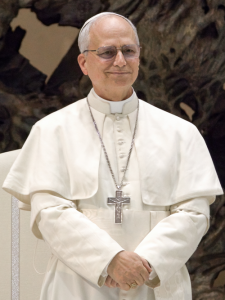
Pope Leo XIV
Pope Leo XIV — Robert Francis Prevost (born 1955)
- The first pope born in the United States, elected on the fourth ballot of the second day of the 2025 conclave1Wikipedia — 2025 Papal Conclave, having spent the majority of his priestly career as a missionary in Peru rather than in Rome — a background that neutralised the long-standing assumption that an American could never hold the papacy.
- Earned a Doctor of Canon Law from the Pontifical University of St. Thomas Aquinas in Rome in 19872Wikipedia — Pope Leo XIV, later serving as Bishop of Chiclayo in Peru before Pope Francis brought him to Rome as Prefect of the Dicastery for Bishops — the office responsible for evaluating and recommending episcopal candidates worldwide.
- Faces unresolved allegations that, as Bishop of Chiclayo, he failed to open a formal investigation after three women filed complaints in 2022 accusing two priests of sexual abuse beginning in 2007, when they were minors3CNN — Abuse allegations, May 2025. The case remains contested: the Vatican stated that Prevost had done more than was required in at least one of the cases3CNN — Abuse allegations, May 2025, while independent observers noted he was among the more proactive bishops in Peru on abuse matters. The investigation was reopened by his successor in 2023 and is ongoing.
Robert Prevost did not seek the papacy. He told a friend by text message during the conclave that he could not be elected because he was American.2Wikipedia — Pope Leo XIV The College of Cardinals elected him on the fourth ballot of the second day.1Wikipedia — 2025 Papal Conclave The equations begin there — with a leader whose Ego is among the lowest in the dataset, whose self-concept is sufficiently stable that it does not require the validation of the position it now occupies.
The Augustinian formation is not incidental to the variable profile. The doctoral thesis Prevost submitted in 1987 contains his theology of leadership in its clearest form: the superior's role is to obey — to listen to what the Spirit is saying in the community, so that direction can be discerned and implemented freely rather than imposed. Authority as service is not a communication strategy in this framework. It is a premise that precedes every operational decision. The Humility score reflects decades of lived consistency with that premise — in the seminary in Trujillo, on horseback reaching isolated communities in the valleys of Lambayeque, in the diocese of Chiclayo where he was remembered for listening before acting.
The Pride variable requires careful reading. Leo will not change Church teaching on the ordination of women, on LGBTQ+ doctrine, or on any position that defines the institutional identity he serves. This is not the Pride of self-preservation — the Ego score rules that out. It is the Pride of identity stability: the settled conviction of someone whose self-concept is built on something larger than personal reputation. The floor of three established for Pride and Ego elsewhere in the framework was partly drawn from this phenomenon. Leo scores well above the floor because the identity-based rigidity is documented, deliberate, and theologically grounded.
The most analytically distinctive feature of this profile is the gap between Chaos and Administrative Impotence. The Catholic Church is one of the most complex institutions in human history2Wikipedia — Pope Leo XIV, with two thousand years of accumulated procedural inertia that no individual, regardless of formal authority, can rapidly reduce. Leo's exceptional personal variables — Humility, Conviction, Ability, Congruence — are operating against an institutional denominator that was built long before he arrived and will persist long after he departs. The Leaderment Score of 67 and Effective Power of 67.2% are not a verdict on the man. They are a verdict on the system he inherited.
The Congruence score carries one documented qualification. Prevost told a Peruvian newspaper in 2019 that "we reject cover-ups and secrecy" about sexual abuse, stating that "they cause a lot of harm."4Chicago Sun-Times — Abuse allegations, December 2025 The Chiclayo case — in which three victims allege they were never interviewed by church investigators despite filing a formal complaint — represents a gap between that stated standard and documented administrative outcome. The Vatican disputes the characterisation. The case is ongoing. The equations record the gap honestly without resolving the dispute.
What the profile cannot yet show is whether exceptional personal variable quality can overcome the institutional denominator over time. The Administrative Impotence of the Catholic Church has consumed leaders of comparable personal quality before. The equations are patient. They will record what this papacy produces, not merely what it intends.
Score Comparison
The 13 Equations
Scores for: Pope — Currently ServingThe 22 Variables
Canonical scoresSources & Bibliography
The scores assigned to this leader are derived from publicly available sources. Variable inputs reflect documented behaviour, structural conditions, and historical record at the time of each snapshot.