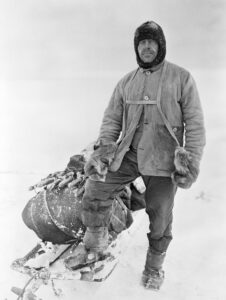
Robert Falcon Scott
Robert Falcon Scott (1868-1912)
- Led the Discovery Expedition of 1901–04, establishing the first extensive land exploration of Antarctica, reaching a new farthest south record of 82°17'S, and producing significant scientific results that opened a century of British Antarctic research.1Scott Polar Research Institute — Robert Falcon Scott ↗
- Reached the South Pole on 17 January 1912 with four companions — Wilson, Bowers, Oates and Evans — to find that Roald Amundsen had preceded them by thirty-four days, then began a return journey of over 800 miles in deteriorating conditions with failing equipment, dwindling rations and no functioning dog teams.2Britannica — Robert Falcon Scott ↗
- Died with Wilson and Bowers in their tent on or around 29 March 1912, eleven miles from the next supply depot, having made the final entry in his diary and written letters of extraordinary composure to the families of his men — documents found eight months later by a search party alongside 35 pounds of Glossopteris fossils the dying men had dragged on their sledges.3Wikipedia — Robert Falcon Scott ↗
Robert Falcon Scott was born in Devon in June 1868, entered the Royal Navy at thirteen, and had no connection to polar exploration until 1899 when he met Clements Markham of the Royal Geographical Society and applied within two days to lead the proposed British Antarctic expedition.1Scott Polar Research Institute — Robert Falcon Scott ↗ The speed of that decision and the nature of the meeting capture something essential about Scott — a naval officer looking for a vehicle for distinction, finding one, and committing to it without hesitation. The Discovery Expedition of 1901–04 was by any reasonable measure a success: extensive scientific work, a new farthest south record, the first serious land exploration of the continent. Scott returned a decorated captain and published his account to wide acclaim. The problem was that Shackleton had been on the same expedition, had been sent home early due to illness, and had returned in 1909 to reach within 97 miles of the Pole before turning back. The comparison was pointed, and Scott felt it. The Terra Nova Expedition of 1910–13 was designed to settle the question. Scott planned meticulously — scientific programme, motor sledges, ponies, a carefully staged support system to carry the polar party as far as possible before man-hauling began.4Antarctic Heritage Trust — Scott's Expedition ↗ The planning was not without analytical problems. Motor sledges were experimental technology that had never been tested in polar conditions. Ponies were manifestly less suited to the terrain than dogs, as Shackleton had already demonstrated. The decision not to rely primarily on dogs — a choice Amundsen had made precisely the opposite of — was the central Process failure of the expedition, and it became visible at almost every stage of the journey south.5Cool Antarctica — Robert Falcon Scott ↗ The motors broke down early. The ponies were shot before the Beardmore Glacier. From there the five men who would reach the Pole man-hauled their sledges across the plateau — a decision that placed the entire success of the expedition on human physical capacity in conditions designed to exhaust it.2Britannica — Robert Falcon Scott ↗ They reached the South Pole on 17 January 1912. Amundsen's tent was already there. The Norwegian had arrived thirty-four days earlier, using dogs throughout, losing not a man, and returning to his base camp in good health and on schedule. The return journey is where the leadership equations produce their most analytically specific output for Scott's profile. The k variable — external conditions — was genuinely terrible: temperatures far below seasonal averages, blizzards of unusual duration and intensity. But the Process variable had been compromised before the journey began. Depots were poorly placed. The planned meeting with dog teams failed. Edgar Evans died on the Beardmore Glacier. Lawrence Oates, suffering from severe frostbite, walked out of the tent on 17 March saying he might be some time — a deliberate act of self-sacrifice to reduce the burden on his companions that Scott recorded in his diary with the composure of a man still leading.3Wikipedia — Robert Falcon Scott ↗ Scott, Wilson and Bowers were trapped by blizzard eleven miles from One Ton Depot. They died there. The search party found the tent in November 1912. They found the diaries, the letters, and the fossils. The fossils are the detail that the equations cannot capture but that the bio must record — three dying men in a blizzard dragging thirty-five pounds of Glossopteris specimens because Scott had insisted the scientific work continue to the end.3Wikipedia — Robert Falcon Scott ↗ Whatever the analytical verdict on his Process and Defined Output scores, the Congruence variable in Scott's final snapshot scores at its ceiling. He died exactly as he had led.
Score Comparison
Add up to 10 leaders. Click a name to visit their profile.
The 13 Equations
Scores for: Discovery ExpeditionThe 22 Variables
Canonical scoresSources & Bibliography
The scores assigned to this leader are derived from publicly available sources. Variable inputs reflect documented behaviour, structural conditions, and historical record at the time of each snapshot.