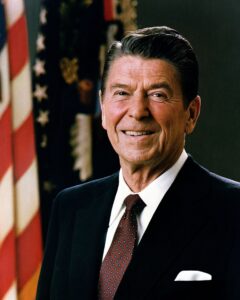
Ronald Reagan
Ronald Reagan (1911–2004)
- Born in Tampico, Illinois, to a shoe salesman and his wife, worked his way through Eureka College, became a radio sports announcer and then a Hollywood actor appearing in 53 films, before serving as president of the Screen Actors Guild and subsequently as Governor of California — winning the presidency in 1980 in a landslide of 489 electoral votes, surviving an assassination attempt in March 1981, and implementing the economic deregulation programme known as Reaganomics.1White House Historical Association — Ronald Reagan
- Won re-election in 1984 by one of the largest landslides in American presidential history — carrying 49 states and 525 electoral votes against Walter Mondale's 132Britannica — Reagan Iran-Contra — while the national debt nearly tripled across his two terms and by 1986 his National Security Council had secretly sold over 1,500 missiles to Iran in violation of the arms embargo, with proceeds illegally diverted to the Nicaraguan Contras in violation of the Boland Amendment.3Wikipedia — Ronald Reagan
- The Tower Commission concluded that Reagan had "created the conditions which made possible the crimes committed by others" — his inability to recall basic facts about administration policies during commission meetings leading investigators and critics to question whether the management failures reflected deliberate evasion or early cognitive decline4Bill of Rights Institute — Iran-Contra Affair — a question that his 1994 announcement of an Alzheimer's diagnosis did not resolve and that the Codex cannot fully adjudicate.
Ronald Reagan arrived at the presidency in 1981 as something the system had no prior template for: a man of absolute conviction who was also genuinely comfortable in his own skin. Where most leaders in this dataset fuse identity with position — Nixon, Johnson, Blair — Reagan wore the presidency lightly. That psychological ease is not a trivial variable. It is the reason his Ego and Pride scores sit well below the dataset average for leaders of equivalent Visibility, and it is the variable that kept his Chaos equation from compounding during the crises that would have destroyed less stable operators.
His first term was built on a single structural bet: that Conviction, held against institutional resistance and short-term economic pain, would eventually produce compounding returns. Reaganomics was not universally effective — the national debt nearly tripled across his two terms, a persistent say-do gap on fiscal conservatism that sits in the Congruence variable throughout.5Britannica — Reagan Presidency But the directional energy was real, the outputs were measurable, and by 1984 the economic recovery was sufficiently tangible to produce a 49-state landslide. First-term Reagan represents one of the cleaner examples in this dataset of Conviction functioning as designed: absorbing hostile Environment conditions and converting them into political capital.
The Cold War posture is analytically separable from the economic record. Reagan's decision to abandon détente and treat the Soviet Union as a system under pressure — rather than a permanent adversary to be managed — was contrarian at the highest level. SDI was widely dismissed as fantasy. The Reykjavik walkaway, refusing a deal most advisors considered acceptable, was a demonstration of Conviction functioning at maximum. Whether it accelerated Soviet collapse or merely coincided with structural forces already in motion is a k variable question, not a personal Value question. The framework separates these correctly.6Reagan Library — The Reagan Presidency
The second term introduced the variable that would define Reagan's legacy in the Codex: Process. The Iran-Contra affair was not a failure of character in the Nixon sense. Reagan did not personally direct illegal operations from the Oval Office. What happened was structurally different and, in some ways, more instructive: a principal so comfortable with delegation that his organisation ran away from him. The NSC operated outside legal channels not because Reagan instructed it to, but because the system had insufficient oversight architecture.7PBS American Experience — Iran-Contra Process scored at its floor in the Iran-Contra snapshot. That is an organisational failure, not a moral one — and the Codex distinguishes them. Nixon's collapse is a Pride and Ego story. Reagan's is a Process story. Same outcome category, entirely different mechanism.
The Congruence damage from Iran-Contra is severe regardless of intent. Arms sold to Iran directly contradicted stated policy on hostage negotiation — Secretary of State George Shultz described the exchange as "a hostage bazaar." The say-do gap in the final snapshot is one of the clearest in the dataset. The subsequent "I don't recall" testimony — later reframed by his 1994 Alzheimer's diagnosis — adds a further layer of analytical complexity. The framework cannot fully resolve whether the gaps were deliberate evasion or early cognitive decline. Both explanations produce the same Congruence score. The mechanism differs; the output does not.
Reagan left office in 1989 with the economy expanded, inflation tamed, and the Soviet Union three years from dissolution. His post-presidential approval ratings remain high. The Codex scores him at his first-term peak as one of the higher-performing leaders in the dataset — not because the framework endorses his politics, but because the variables that drive positive outputs — Conviction, Confidence, Value, managed Ego and Pride — were present in unusually clean combination during 1981–84. The Iran-Contra snapshot illustrates with equal precision what happens when Process degrades in a high-Conviction, low-oversight system.
The lesson is not that Reagan was a good or bad president. The lesson is that Conviction without Process architecture is a system waiting for its operator to look away.
Score Comparison
Add up to 10 leaders. Click a name to visit their profile.
The 13 Equations
Scores for: First Term 1981–84The 22 Variables
Canonical scoresSources & Bibliography
The scores assigned to this leader are derived from publicly available sources. Variable inputs reflect documented behaviour, structural conditions, and historical record at the time of each snapshot.