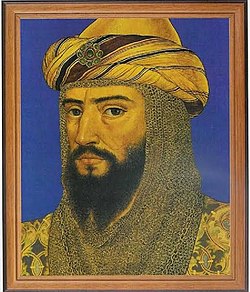
Saladin
Saladin (c.1137–1193)
- Appointed vizier of Egypt in 1169 when al-Adid's advisers told the caliph there was no one weaker or younger,1Wikipedia — Saladin Saladin spent twenty years building the administrative, military and diplomatic foundation that made everything subsequent possible — unifying Egypt, Syria, Upper Mesopotamia and Arabia through a combination of warfare, negotiation and the appeal of holy war.2History.com — Saladin
- At Hattin on 4 July 1187, cut off the Crusader army from water, manoeuvred them into terrain they could not survive, and annihilated the field force that had been the Kingdom of Jerusalem's military foundation — capturing Jerusalem three months later after 88 years of Crusader occupation, allowing its Christian inhabitants to leave safely and inviting the Jewish population to resettle.3Britannica — Saladin
- Died with one gold coin and forty pieces of silver, having given his wealth to his subjects. There was nothing left to pay for his funeral.4World History Encyclopedia — Saladin The empire he built survived him by over fifty years. His name was adopted as a symbol of Arab unity eight centuries later.
Saladin's variable profile is built on a foundation the dataset rarely sees in the Military domain: Chaos near its floor across all snapshots, produced by an Ego and Pride combination that sits at or near minimum throughout a twenty-four year career of independent command. He died with one gold coin and forty pieces of silver, having given his wealth to his subjects. He left nothing to pay for his funeral.4World History Encyclopedia — Saladin The equations begin there — with a leader whose personal accumulation was effectively zero against Resources that at peak were among the highest in the medieval world — and build outward from it.
The Vizier of Egypt period is analytically undervalued precisely because it looks like consolidation rather than achievement. It was both. Appointed to a position nobody expected to matter — al-Adid's advisers told the caliph there was no one weaker or younger — Saladin spent five years building the administrative, financial and military base that made everything subsequent possible.1Wikipedia — Saladin The abolition of the Fatimid Caliphate in 1171 was not a military act. It was a Process and Defined Output event — the precise application of religious and institutional leverage to achieve a political realignment without triggering the internal conflict that a less careful leader would have produced. He had already crushed the military revolt of the Black African regiments before it could develop into something the Zengids could exploit. He was building colleges, fortifying Cairo, commissioning the Citadel, and conducting forays against the Crusaders simultaneously.5History Learning — Saladin The Corporate Drag in this period reflects the genuine difficulty of operating within the residual Fatimid institutional structure and the nominal suzerainty of Nur ad-Din. What it does not reflect is any failure of personal leadership quality. The suppression is structural, not personal.
The Syrian conquest period is where Process and Defined Output reach their operational peak as strategic rather than tactical variables. Over twenty-four years as an independent commander, Saladin fought just a handful of pitched battles, only two of which could be called decisive. His success was a product of carefully-planned campaigns fought year after year, which steadily improved his own position while manoeuvring his enemies into a corner.3Britannica — Saladin The capture of Damascus — riding across the desert with picked horsemen, arriving amid general acclamation — was achieved without a battle because the diplomacy had already made the military outcome inevitable. When the Zengid coalition refused to accept the terms that would have made fighting unnecessary, he fought and won decisively. When negotiated settlement could achieve the objective, he negotiated. That is not weakness. It is Humility and Process operating at their documented maximum — a leader who understood that the conservation of force was a strategic asset, not a tactical concession.
The Hattin and Jerusalem period is the profile's peak and the most precise record of long-term Defined Output in the medieval dataset. The assault on Jerusalem was not an improvised response to opportunity. It was the conclusion of a twenty-year strategic programme, executed with the precision that only a leader who had spent two decades building the conditions for it could achieve.2History.com — Saladin The battle of Hattin — cutting off the Crusader army from water, manoeuvring them into the terrain they could not survive, annihilating the field force that had been the Kingdom of Jerusalem's military foundation — was tactical genius in service of a strategic objective defined at the beginning of his career.3Britannica — Saladin The vow sworn over the execution of Raynald de Châtillon was kept. Defined Output records a leader who delivered precisely what he said he would.1Wikipedia — Saladin
The Congruence score at the Jerusalem snapshot sits high but not at its ceiling because the historical record contains one documented departure from his stated values — replacing the Hanafi courts with Shafi'i administration in Aleppo despite a promise not to interfere in the city's religious leadership. One broken promise against a career of extraordinary consistency between stated values and actual behaviour. The treatment of Jerusalem's civilian population after the capture — the ransoms personally funded for those who could not pay, the Jews invited to resettle in the city, Richard's acknowledgement of his generosity — is Congruence at its documented maximum.6Wikipedia — Siege of Jerusalem (1187) The contrast with 1099 was explicit and deliberate.
The Third Crusade and final period record a genuine Defined Output reduction that reflects the one strategic lapse his contemporaries and historians have consistently identified. The failure to take Tyre before Jerusalem was a decision made on religious grounds, prioritising the holy city over the strategically essential coastal fortress. Tyre became the rallying point for the Latin counterattack.3Britannica — Saladin The Third Crusade assembled partly because of the depth of the shock that Jerusalem's fall produced in the West. The equations record the cost of that decision honestly in the subsequent snapshot while maintaining the personal variable quality that had defined every earlier period. He fought Richard I to a stalemate, negotiated the Treaty of Jaffa from a position of genuine strategic strength, and died four months later.2History.com — Saladin
The Value variable sits high across the final two snapshots. A leader who spent twenty-four years building an empire that would survive him by over fifty years and whose name was adopted as a symbol of unity by Arab nationalist movements eight centuries later — against personal assets at death of one gold coin and forty pieces of silver — is a leader whose Value score the equations can calculate with precision. He kept nothing. He gave everything.4World History Encyclopedia — Saladin The low Chaos across every snapshot is the mechanism that made that possible.
Score Comparison
Add up to 10 leaders. Click a name to visit their profile.
The 13 Equations
Scores for: Hattin — JerusalemThe 22 Variables
Canonical scoresWhat changed: Conquest of Syria — Zengids → Hattin — Jerusalem
Sources & Bibliography
The scores assigned to this leader are derived from publicly available sources. Variable inputs reflect documented behaviour, structural conditions, and historical record at the time of each snapshot.