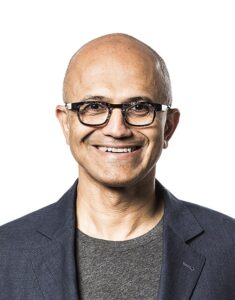
Satya Nadella
Satya Nadella (Born 1967)
- Was appointed third Chief Executive Officer of Microsoft Corporation on 4 February 2014 — succeeding Steve Ballmer to lead a company that had been widely characterised in the business press as a declining technology incumbent dependent on a Windows-and-Office monopoly under structural threat from cloud computing, mobile platforms, and the open-source software movement, having previously served as Executive Vice President of Microsoft's Cloud and Enterprise group from 2011 where he led the development of Microsoft Azure into a credible competitor to Amazon Web Services.1Wikipedia — Satya Nadella ↗
- Has overseen a tenfold increase in Microsoft's market capitalisation from approximately $300 billion at his February 2014 appointment to over $3 trillion at peak in 2024 — making Microsoft briefly the most valuable publicly-listed company in human history, executing the largest technology acquisition in history with the $68.7 billion Activision Blizzard purchase completed October 2023, and committing approximately $80 billion of capital expenditure for fiscal year 2025 toward AI infrastructure and data centre build-out at a scale unprecedented in corporate history.2Microsoft FY2024 earnings ↗
- Initiated and has sustained the Microsoft-OpenAI partnership from July 2019 — beginning with a $1 billion initial investment that was widely characterised at the time as a speculative bet on a research laboratory, scaled to a multi-year multi-billion dollar commitment that positioned Microsoft as the principal corporate beneficiary of the November 2022 ChatGPT public moment and the subsequent generative AI investment cycle, integrated through the launch of Microsoft 365 Copilot in March 2023, the launch of Bing+ChatGPT integration in February 2023, and the deployment of Azure OpenAI Service as the principal enterprise AI platform across Microsoft's customer base.3Wikipedia — Microsoft and OpenAI ↗
Satya Narayana Nadella was born on 19 August 1967 in Hyderabad, India, the son of Bukkapuram Nadella Yugandhar, a senior Indian Administrative Service civil servant, and Prabhavati, a Sanskrit lecturer.1Wikipedia — Satya Nadella ↗ He was educated at Hyderabad Public School Begumpet, earned a Bachelor of Engineering in electrical engineering from the Manipal Institute of Technology in Karnataka in 1988, and emigrated to the United States to complete a Master of Science in computer science at the University of Wisconsin–Milwaukee in 1990 followed by a Master of Business Administration from the University of Chicago Booth School of Business in 1997. He joined Sun Microsystems briefly before joining Microsoft in 1992 as a member of the Windows Developer Relations group. He has been married to Anupama Priyadarshini Venugopal since 1992; they have three children, the eldest of whom Zain Nadella died in February 2022 at age twenty-six after living with cerebral palsy from birth. The framework reads three distinct phases of his Microsoft career. The analytical context for scoring Satya Nadella is that the canonical leadership system being scored operates at the largest scale of any business profile in the dataset and at one of the largest scales of any leader in the dataset across all domains. Microsoft under Nadella's CEO tenure since February 2014 employs approximately 228,000 people, generates annual revenue of approximately $245 billion (FY2024), has held a market capitalisation of over $3 trillion at peak, and operates as one of the principal commercial vehicles through which the contemporary AI investment cycle is being conducted. The variable readings should reflect this scale honestly, which means certain variables (Resources, Defined Output) reach the upper register of the framework's calibration discipline. The framework's calibration rule that 9 represents transcendent within field, rare, applies — and Nadella's canonical period genuinely warrants 9 on Defined Output and Resources because the operational scale is genuinely distinguished from contemporary peers and from the broader CEO field. The pre-CEO Microsoft career phase from 1992 to 2014 covers Nadella's first twenty-two years at Microsoft. He worked the Windows Server group through the 1990s, moved to Microsoft's Online Services Division in 2007 where he led Microsoft Bing engineering through its 2009 launch as the first credible Google search competitor in fifteen years, became President of the Server and Tools division in 2011 where he led Microsoft Azure development, and reached Executive Vice President of the Cloud and Enterprise group from 2011 through to his February 2014 CEO appointment. The Defined Output during this phase reads modestly because executive-level outputs at the divisional scale are real but bounded relative to CEO-level outputs at the corporate scale. The Conviction variable reads strong reflecting twenty-two years of sustained directional energy through Microsoft's product cycles. The Ability variable reads at upper-mid levels reflecting the operational competence required to advance through the engineering-and-product hierarchy of Microsoft during the period including the Bing engineering transition, the Server and Tools division leadership, and the Azure foundational period that built the technical capacity Microsoft would scale into the cloud-platform business under his subsequent CEO tenure. The early CEO transformation phase from 2014 to 2018 produced the structural reorientation of Microsoft from Windows-and-Office incumbent to cloud-and-platform challenger.2Microsoft FY2024 earnings ↗ The substantive Defined Output across this period was substantial: the strategic repositioning under the "mobile-first, cloud-first" framing, the $7.6 billion Nokia write-down that closed Ballmer's mobile strategy in summer 2015, the GitHub acquisition for $7.5 billion in October 2018 that signalled Microsoft's open-source pivot to a developer community that had spent two decades regarding Microsoft as a hostile actor, the LinkedIn acquisition for $26.2 billion in December 2016, the cultural transformation programme around growth mindset documented in his 2017 book Hit Refresh, the Linux Foundation membership in November 2016, and the SQL Server port to Linux that became operational from 2017. The Recognition variable reads at upper-mid levels reflecting growing technology-press and financial-market acknowledgment that Microsoft was operating a different strategic profile than had been widely projected at his 2014 appointment. The Resources variable reads at upper-mid levels reflecting Microsoft's substantial but pre-trillion-dollar scale during the period. The Conviction variable reads strong reflecting sustained directional energy through major strategic decisions including the abandonment of mobile, the open-source pivot, and the cultural transformation programme that required substantial internal political capital across a 100,000+ employee organisation. The AI/Cloud Dominance phase from 2019 to the present is the canonical snapshot under the framework rule that canonical equals the latest snapshot for living and currently active leaders.3Wikipedia — Microsoft and OpenAI ↗ The defining strategic decision of the canonical period was the OpenAI partnership announced in July 2019 with an initial $1 billion investment, scaled through subsequent commitments to a multi-year multi-billion dollar commitment that positioned Microsoft as the principal corporate beneficiary of the November 2022 ChatGPT public moment. The cumulative Phase 3 Defined Output reads at substantial levels: market capitalisation increase from approximately $1 trillion at phase opening to over $3 trillion at peak, the Activision Blizzard $68.7 billion acquisition completed October 2023 against substantial regulatory resistance from the UK Competition and Markets Authority and the US Federal Trade Commission, the Microsoft 365 Copilot launch of March 2023, the Bing+ChatGPT integration of February 2023, the deployment of Azure OpenAI Service as the principal enterprise AI platform, sustained quarterly earnings outperformance across more than twenty-four consecutive quarters, the approximately $80 billion of fiscal year 2025 capital expenditure committed to AI infrastructure, and the November 2023 management of the Sam Altman ouster crisis at OpenAI that demonstrated Microsoft's structural position in the partnership without rupturing the relationship. The Defined Output variable in the canonical snapshot reads at the framework level reserved for transcendent within field, rare, because the operational scale and strategic consequence of the Phase 3 outputs genuinely distinguishes Nadella from the contemporary CEO field. The honest comparison points are limited — Steve Jobs returning to Apple from 1997 to 2011, Jeff Bezos building Amazon from 1997 to 2021, Jensen Huang transforming NVIDIA's strategic positioning from 2022 onwards. That is the company. The Resources variable similarly reads at the upper register reflecting Microsoft's institutional resources at canonical-period peak — annual revenue of approximately $245 billion, peak market capitalisation over $3 trillion, 228,000 employees, the AI infrastructure capital expenditure programme at unprecedented corporate scale. The Recognition variable reads at the upper band reflecting sustained acknowledgment from the technology industry, the financial markets, and the broader business press as one of the most successful contemporary corporate leaders. The character cluster of variables produces the analytically distinctive Nadella profile. The Congruence variable reads in the upper band reflecting strong alignment between Nadella's stated values across his tenure (growth mindset, empathy-driven leadership, customer obsession, partnership orientation, cultural transformation) and his observable conduct over a decade of public CEO presence. The Microsoft of 2025 is genuinely a different cultural operation than the Ballmer-era Microsoft of 2013 in ways that match the stated values. The acquisitions strategy reflects the partnership orientation. The open-source pivot is substantively real. The November 2023 Sam Altman ouster crisis tested the stated "partner not parent" framing of the OpenAI relationship and produced moments where stated and operational reality diverged, which is the principal reason the framework reads Congruence at 8 rather than at the higher levels reserved for figures whose say-do alignment was tested under maximum pressure across decades and held at near-perfect consistency. The Humility variable reads in the upper-mid band and is one of the variables on which Nadella distinguishes himself sharply from most contemporary Big Tech CEOs. His public communication style is consistently humble — citing partnerships, attributing wins to teams, acknowledging the Tay chatbot incident and the Cortana retreat as specific failures, documenting the bereavement of his son Zain in 2022 with substantial public openness. The growth mindset cultural framing centres learning-from-failure as a stated organisational value, and the visible operational behaviour through eleven years has substantially honoured that stated framing. The Pride variable reads at lower levels reflecting selective rigidity on the strategic core (cloud-first, AI-first, partnership orientation) without Pride-driven failure patterns. The Activision acquisition fight showed sustained Conviction without Pride-driven rigidity — Microsoft adjusted strategy through regulatory negotiation including divestiture of cloud streaming rights to Ubisoft rather than refusing to climb down. The Ego variable reads at mid-band — visible identity-fusion with the Microsoft transformation project but personal-presentation Ego unusually modest by Big Tech CEO standards. The k variable for the canonical snapshot scores at substantial positive levels reflecting the genuinely externally arriving favourable events of the period. The defining external arrival was OpenAI itself — the GPT breakthrough was a research-line outcome that no reasonable Microsoft strategic plan in 2014 had priced in at the scale it would reach, and the November 2022 ChatGPT public moment produced exponential value to Microsoft that was substantially externally arriving in its specific timing and intensity. Microsoft's 2019 partnership decision positioned them to capture the upside, but the upside itself was externally generated. The COVID cloud acceleration of 2020-2022 was partial positive k — partly foreseeable as digital-transformation acceleration but exceeding median expectations in scale and timing. The framework reads k at the upper register honestly, registering that some leaders genuinely operate in periods of substantial external favourable arrival as a feature of the system's performance reading. The framework's reading of Nadella overall is that of a leader whose canonical Phase 3 system has produced substantial Defined Output through the combination of disciplined Conviction, high Congruence, sustained operational competence, and genuinely favourable external k that the leader's strategic positioning had earned the right to capture. The post-canonical phase will be substantially defined by whether the AI investment cycle continues to deliver returns proportionate to the $80 billion+ annual capital expenditure programme — a question that lies beyond the canonical snapshot's current horizon.
Score Comparison
The 13 Equations
Scores for: AI/Cloud Dominance Era — 2019 to PresentThe 22 Variables
Canonical scoresWhat changed: Early CEO Transformation — 2014 to 2018 → AI/Cloud Dominance Era — 2019 to Present
Sources & Bibliography
The scores assigned to this leader are derived from publicly available sources. Variable inputs reflect documented behaviour, structural conditions, and historical record at the time of each snapshot.