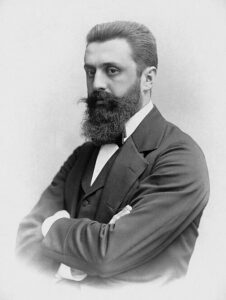
Theodor Herzl
Theodor Herzl (1860-1904)
- Published Der Judenstaat — The Jewish State — in February 1896, a forty-six-page pamphlet that transformed the scattered and contested idea of Jewish national restoration into a concrete political programme, arguing that antisemitism was not a social prejudice that could be overcome through assimilation but a permanent political condition that required a national solution — a document described in Israel's Declaration of Independence as 'the author of the vision of the Jewish state.'1Wikipedia — Theodor Herzl ↗
- Convened the First Zionist Congress in Basel in August 1897 — drawing approximately 200 delegates from across Europe and establishing the World Zionist Organization, of which he became the first president — creating the institutional framework for Jewish political nationalism within a single year of publishing his manifesto, and recording in his diary afterwards: 'At Basel I founded the Jewish State. If I said this out loud today, I would be greeted by universal laughter. In five years perhaps, and certainly in fifty years, everyone will perceive it.'2Herzl Institute — Theodor Herzl ↗
- Conducted a diplomatic campaign across seven years that brought him audiences with Kaiser Wilhelm II, Ottoman Sultan Abdulhamid II, Pope Pius X, the British Colonial Secretary Joseph Chamberlain, and the Russian Interior Minister Plehve — establishing Zionism as an internationally recognised political movement before his death of cardiac exhaustion at the age of forty-four on 3 July 1904, forty-four years before the State of Israel declared independence and named its national cemetery after him.3Britannica — Theodor Herzl ↗
Theodor Herzl was born on 2 May 1860 in Pest — then the Hungarian half of the Austro-Hungarian Empire, now Budapest — into a prosperous, assimilated Jewish family, grew up in Vienna, studied law, practised briefly, abandoned it for journalism, and became the Paris correspondent of the Neue Freie Presse in 1891.1Wikipedia — Theodor Herzl ↗ He had little connection to Jewish religious practice and had spent much of his young life attempting to assimilate into Viennese cultural and intellectual life. The Dreyfus Affair — which he covered as a journalist from the streets of Paris in 1894, watching crowds shout 'Death to the Jews' as a Jewish army officer was publicly stripped of his rank on false charges of treason — is the conventional explanation for his conversion to Zionism. Later historians have argued the conversion was more gradual and that Herzl amplified the Dreyfus connection retrospectively. The effect, however, was the same: a man who had believed in assimilation concluded that antisemitism was ineradicable, that Jews would never be secure in any European state, and that the only solution was a state of their own. The analytical profile places Herzl in the Cultural domain because his primary leadership act was the transformation of an ancient religious longing into a modern political movement with institutional infrastructure — founding a newspaper, establishing a bank, convening annual congresses, creating a constitution for an organisation that did not yet govern a territory, and conducting diplomacy on behalf of a people who had no recognised standing in international law.4Herzl Online — Short Biography ↗ His Vision variable scores at the ceiling: he wrote in his diary after the First Zionist Congress that a Jewish state would exist within fifty years, and he was correct to within twelve months. The Process variable reflects the extraordinary compression of his institutional achievement. Between the publication of Der Judenstaat in February 1896 and his death in July 1904 — eight years — he established the World Zionist Organization, convened six annual congresses, founded the Zionist newspaper Die Welt, created the Jewish Colonial Bank, established hundreds of local chapters across Europe and America, and conducted personal diplomatic missions to heads of state and government across the continent.2Herzl Institute — Theodor Herzl ↗ He did all of this while continuing to work as a journalist, maintaining his position at the Neue Freie Presse, and dealing with the progressive deterioration of his health from the cardiac disease that would kill him at forty-four. The Resources variable in his profile reflects the fundamental constraint of his enterprise: he was attempting to secure international recognition for a state that did not exist, for a people who had no territory and no formal legal standing in the international order, operating without institutional backing and dependent entirely on his own authority, reputation and relentless energy.3Britannica — Theodor Herzl ↗ Baron de Hirsch refused to hear him out at their first meeting. Baron Rothschild declined to support the political programme. The wealthy Jewish establishment of Western Europe was largely hostile — they feared that a Jewish state would undermine their position in the societies they had spent generations assimilating into. Herzl's support came primarily from the poorer Jewish communities of Eastern Europe, who had no assimilationist illusions to protect. He died on 3 July 1904 of cardiac failure, aged forty-four, his health destroyed by the strain of the previous eight years. He was buried in Vienna. His remains were reinterred on Mount Herzl in Jerusalem in 1949, the year after the State of Israel declared independence. Israel's Declaration of Independence is the only founding document of a nation-state that names a specific individual — Herzl — as the visionary of the state it is declaring. His Defined Output was a state. He did not live to see it. The equations measure what he built toward it.
Score Comparison
Add up to 10 leaders. Click a name to visit their profile.
The 13 Equations
Scores for: Der Judenstaat and the First CongressThe 22 Variables
Canonical scoresSources & Bibliography
The scores assigned to this leader are derived from publicly available sources. Variable inputs reflect documented behaviour, structural conditions, and historical record at the time of each snapshot.