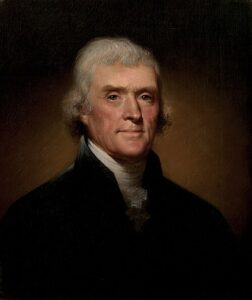
Thomas Jefferson
Thomas Jefferson (1743–1826)
- Thomas Jefferson — lawyer, planter, philosopher, and architect of the American republic — drafted the Declaration of Independence in 1776, served as Governor of Virginia, Minister to France, first Secretary of State, second Vice President, and third President of the United States, building a intellectual and political career of extraordinary breadth across six decades of public life.1Britannica — Thomas Jefferson
- His presidency from 1801 to 1809 combined the Louisiana Purchase — doubling the territorial extent of the republic in a single transaction — with a governing philosophy of minimal federal power that sat in permanent tension with the executive authority he was simultaneously expanding, producing the central contradiction of his political career and the most analytically interesting Congruence problem in the American presidential dataset.2Miller Center — Thomas Jefferson Key Events
- The private life that Jefferson constructed at Monticello — philosopher, architect, inventor, viticulturalist, and enslaver of over six hundred human beings across his lifetime — embodies the most consequential say-do gap in the Leaderment historical record, a man who wrote that all men are created equal and never resolved that declaration with the institution on which his entire existence depended.3Monticello — Jefferson and Slavery
Thomas Jefferson is the most intellectually complex profile in the American Political domain and the most analytically demanding Congruence case in the dataset. He was a philosopher of liberty who owned people. He was a small-government constitutionalist who executed the largest unilateral executive action in American history. He was a man of extraordinary Vision whose personal life systematically contradicted his public principles. The equations do not resolve this — they record it.
The pre-presidential period establishes the variable baseline. Jefferson's Vision score is among the highest in the Political domain across any era — the Declaration of Independence is not merely a political document but a philosophical framework that restructured how democratic legitimacy was understood globally.4Library of Congress — Declaration of Independence His time in France from 1784 to 1789 deepened his intellectual formation and gave him direct exposure to Enlightenment thought at its peak, raising the Innovation variable and reinforcing a Conviction score that never wavered across his career. The problem embedded in this period is that France also reinforced his capacity for compartmentalisation — the ability to hold contradictory positions without apparent cognitive dissonance — which is the mechanism behind the Congruence problem that runs through every subsequent snapshot.
The First Term is the high point of the presidential record and the canonical snapshot. The Louisiana Purchase of 1803 is the single most consequential executive decision in American history measured by territorial and geopolitical outcome.5US State Department — Louisiana Purchase Jefferson knew it was constitutionally questionable — he privately acknowledged that the Constitution gave him no clear authority to acquire territory — and proceeded anyway. The Congruence variable records this: not a collapse, but a deliberate subordination of principle to outcome. The Humility variable is analytically significant here — Jefferson's willingness to override his own stated constitutional philosophy required a form of intellectual honesty about what the moment demanded that most ideologically committed leaders cannot manage.
The Lewis and Clark expedition, authorised in the same period, reflects the Vision and Innovation variables operating in combination — a scientific, diplomatic, and territorial intelligence operation of remarkable ambition for a government philosophically committed to minimal federal activity.6National Park Service — Lewis and Clark Jefferson designed it, funded it through Congress under a deliberately vague appropriation, and understood its implications for continental expansion two decades before most of his contemporaries.
The Second Term is where the variables diverge sharply from the First. The Embargo Act of 1807 — prohibiting American ships from trading with foreign ports in response to British and French interference with American shipping — was the most self-damaging economic policy in early American history.2Miller Center — Thomas Jefferson Key Events It devastated New England's economy, was widely evaded, and was repealed three days before Jefferson left office having achieved none of its objectives. The Adaptability variable at this snapshot is the lowest in the profile — Jefferson diagnosed the problem correctly but prescribed a remedy that his own philosophical commitments prevented him from revising when it failed. The Decisiveness score remains high; the decision was firm. The ability variable falls because the execution was poor and the feedback loop was ignored.
The Congruence variable requires explicit treatment across all snapshots. Jefferson's relationship with Sally Hemings — now confirmed by DNA evidence and historical consensus — is not a biographical footnote.7Monticello — Jefferson and Sally Hemings It is the Congruence variable made concrete: the author of the Declaration of Independence held a woman in legal bondage and fathered her children while writing about the inalienable rights of man. The score does not collapse to zero because Jefferson's public political positions were largely consistent with his stated principles — the say-do gap operates primarily between his philosophical framework and his private conduct rather than between his political statements and his political actions. Both are recorded. Neither cancels the other.
The post-presidential period at Monticello reflects a variable profile in partial decline. Jefferson died on 4 July 1826 — the fiftieth anniversary of the Declaration of Independence, the same day as John Adams — deeply in debt, having been unable to resolve the financial contradictions of a plantation economy he knew was morally indefensible.1Britannica — Thomas Jefferson The Value variable at this snapshot is complicated: the University of Virginia, which he founded, designed, and considered one of his three greatest achievements, represents genuine institutional legacy.8University of Virginia — Thomas Jefferson The slavery variable is unresolved at death — he freed two people in his will.
The number that matters most across all three snapshots is Vision — and its interaction with Congruence. Jefferson's Vision score is among the highest in the dataset. His Congruence score is the most analytically contested. The gap between them is not hypocrisy in the ordinary sense — it is the record of a man who could see further than almost anyone of his era and could not bring himself to act on what he saw when it threatened the structure of his own life. That is the Leaderment profile of Thomas Jefferson.
Score Comparison
Add up to 10 leaders. Click a name to visit their profile.