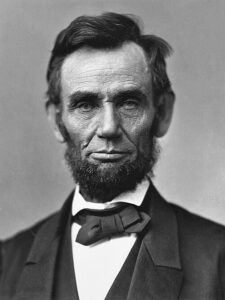
Abraham Lincoln
Abraham Lincoln (1809–1865)
- Abraham Lincoln — born in a log cabin in Kentucky, largely self-educated, self-taught lawyer, four-term Illinois state legislator, and one-term congressman — rose from frontier poverty to the presidency in 1861 through a combination of forensic intelligence, political timing, and a public debate performance against Stephen Douglas that made him a national figure despite holding no office at the time.1Britannica — Abraham Lincoln
- His presidency from 1861 to 1865 encompassed the secession of eleven states, the bloodiest war in American history, the Emancipation Proclamation, the Gettysburg Address, the Thirteenth Amendment abolishing slavery, and his own assassination five days after the Confederate surrender — a four-year arc of leadership under conditions of existential national pressure that no other American president has faced before or since.2Miller Center — Abraham Lincoln Key Events
- The variable profile that produced this record — high Vision, extraordinary Communication, genuine Humility combined with absolute Conviction on the union question, and a People selection capability that placed former rivals and critics in cabinet positions where they could be most useful — is the most analytically coherent high-performing presidential profile in the dataset.3Doris Kearns Goodwin — Team of Rivals
Abraham Lincoln is the benchmark profile in the American Political domain. Not because the equations produce the highest score — the Environment variable across all four snapshots is among the most hostile in the dataset — but because the ratio of output to circumstance is unmatched. He operated in conditions designed to destroy the institution he was leading and left that institution larger, more coherent, and more consistent with its founding principles than he found it.
The pre-presidential formation period is analytically significant in ways that are easy to understate. Lincoln's self-education — reading Blackstone's Commentaries by firelight, teaching himself Euclidean geometry to sharpen his logical reasoning — is not biographical colour.4Abraham Lincoln Online — Self-Education It is the Learning and Process variables being built without institutional support, which produces a specific kind of analytical capability: the ability to construct arguments from first principles rather than from received authority. Every major Lincoln decision — the Emancipation Proclamation framed as a military necessity rather than a moral declaration, the suspension of habeas corpus justified by constitutional emergency, the gradual public movement on slavery — reflects this first-principles reasoning operating under political constraint.
The First Term opens with the Confederacy already forming and the Union army unprepared for the scale of conflict it was about to face. Lincoln's People variable is the most analytically important in the profile and the most counterintuitive — he appointed William Seward, Salmon Chase, and Edwin Stanton to his cabinet, all of whom had defeated him for the Republican nomination or publicly dismissed him as unqualified.3Doris Kearns Goodwin — Team of Rivals The reasoning was precise: he needed the most capable people available, and personal loyalty was a secondary consideration. That is a People score operating at its ceiling — and it stands in direct contrast to the Jackson and Carter profiles where loyalty appointments consistently suppressed the variable.
The military command decisions of the First Term reflect Decisiveness and Adaptability in combination. Lincoln went through a sequence of commanding generals — McDowell, McClellan, Burnside, Hooker, Meade — before Grant, adjusting his assessment of each with a lack of sentimentality that his Communication variable sometimes obscured.2Miller Center — Abraham Lincoln Key Events McClellan's removal was politically costly and analytically correct. The Adaptability variable scores high not because Lincoln changed his objectives — the union and eventually emancipation were fixed — but because he changed his methods repeatedly and without ego investment in prior decisions.
The Emancipation Proclamation of January 1863 is the canonical snapshot's defining moment and the most precise expression of Lincoln's Congruence variable. He had privately held abolitionist sympathies for years. He moved publicly when the military and political conditions made it strategically viable — framing the proclamation as a war measure to preserve its constitutional standing.5National Archives — Emancipation Proclamation The say-do gap between private conviction and public timing is recorded in the Congruence score — not a collapse, but a deliberate sequencing that his critics called cowardice and his defenders called mastery. The Leaderment model records the gap without adjudicating it.
The Communication variable across all snapshots is the highest in the American presidential dataset. The Gettysburg Address — 272 words reframing the entire meaning of the war and the founding principles of the republic — is the most efficient deployment of language in political history.6Library of Congress — Gettysburg Address The Second Inaugural — delivered five weeks before his assassination, with the war effectively won — is the most generous victory speech ever given by a leader in that position. Neither was accidental. Lincoln drafted, revised, and understood exactly what he was doing. The Intent variable at these moments is at its ceiling.
The Environment variable across all four snapshots is the most important contextual number in the profile. Lincoln governed during the only period in American history when the physical survival of the United States as a political entity was genuinely in question. The k variable fluctuates — Bull Run, Antietam, the 1864 election that he expected to lose — but the structural environment never improves beyond hostile until the final weeks of his life.2Miller Center — Abraham Lincoln Key Events That his output scores remain high across this environmental baseline is the analytical signature of the profile.
The assassination on 14 April 1865 forecloses the Reconstruction question — what Lincoln's approach to reintegrating the Confederate states would have produced relative to what followed under Johnson and Grant is the most consequential counterfactual in American history. The Value variable at the final snapshot scores at its ceiling on the union and emancipation outcomes. What it cannot score is what did not happen.
The number that matters most across all four snapshots is Humility — specifically, its combination with Conviction. Lincoln held absolute conviction on the union question and genuine humility about almost everything else, including his own capabilities, his generals' advice, and the pace at which public opinion could be moved. That combination — Conviction without Pride, Humility without weakness — is the rarest variable pairing in the dataset. It is what made the People variable work, what made the Communication variable land, and what made the Adaptability variable available when the situation demanded it. It is the Leaderment profile of Abraham Lincoln.
Score Comparison
Add up to 10 leaders. Click a name to visit their profile.
The 13 Equations
Scores for: First Term — Emancipation and the WarThe 22 Variables
Canonical scoresWhat changed: Illinois Lawyer and Congressional Formation → First Term — Emancipation and the War
Sources & Bibliography
The scores assigned to this leader are derived from publicly available sources. Variable inputs reflect documented behaviour, structural conditions, and historical record at the time of each snapshot.