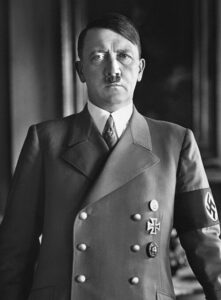
Adolf Hitler
Adolf Hitler (1889–1945)
- Adolf Hitler — failed artist, Austrian drifter, decorated but non-commissioned First World War soldier, failed putschist, prison author of Mein Kampf, and political organiser of extraordinary tactical skill — rose from complete obscurity to the chancellorship of Germany in January 1933 through a combination of economic catastrophe, institutional failure, elite miscalculation, and a Communication and Conviction variable profile that the Weimar Republic's democratic structures were not designed to withstand.1Britannica — Adolf Hitler
- His twelve years in power from 1933 to 1945 produced the systematic destruction of German democratic institutions, the annexation of Austria and Czechoslovakia, the invasion of Poland and the launch of the Second World War, the murder of six million Jews and five to six million others in the Holocaust, the deliberate starvation and execution of three million Soviet prisoners of war, and the physical destruction of Germany itself — making his tenure the most catastrophic exercise of national leadership in recorded history by any measurable criterion of human cost.2United States Holocaust Memorial Museum — Adolf Hitler
- The Leaderment model does not require evil to be incompetent — Hitler's early political and diplomatic achievements were operationally effective, his Communication and Conviction variables were genuinely high, and his People variable in the consolidation period functioned well enough to neutralise every institutional check against him — which is precisely why the profile is analytically important: the equations demonstrate that high operational scores in the absence of Value and Congruence do not produce leadership, they produce the most efficient possible mechanism for catastrophe.3United States Holocaust Memorial Museum — Introduction to the Holocaust
Adolf Hitler is the defining case in the Leaderment model for why Value is not an optional variable. Every other variable in the profile can be discussed in terms of effectiveness. Value cannot. The equations do not produce a high overall score for Hitler regardless of his operational capabilities because the Value variable is not a minor corrective — it is a multiplier, and when it scores at or near the floor the entire profile collapses. That is by design. A model that produced high scores for Hitler would be a broken model.
The formation period is analytically significant precisely because it contains no obvious explanation for what followed. Hitler was not systematically abused beyond the ordinary hardships of his era, not psychologically distinguished from thousands of contemporaries who shared his circumstances, and not intellectually exceptional.1Britannica — Adolf Hitler What distinguished the formation period was the specific combination of variables that the First World War produced and the Weimar crisis activated: a Conviction variable built around a coherent explanatory framework for German defeat — the stab-in-the-back mythology — that was factually false, emotionally compelling, and perfectly calibrated to the psychological needs of a specific population at a specific historical moment. The Communication variable developed in the Munich beer halls of the early 1920s through direct audience feedback, which Hitler processed and refined with a sensitivity to crowd response that most democratic politicians do not develop. The result was a Communication capability built entirely in the service of a Value score that was at the floor from the beginning.
The Beer Hall Putsch of November 1923 is analytically instructive as a failure. Hitler moved before his institutional base was sufficient, the attempt collapsed within hours, and he was imprisoned for nine months of a five-year sentence.4Britannica — Beer Hall Putsch The Learning variable records something important here: Hitler correctly concluded that direct seizure of power against functioning state institutions was not viable, and pivoted to a strategy of using democratic processes to achieve anti-democratic ends. Mein Kampf, written in Landsberg Prison, laid out the ideological framework with a transparency that subsequent events suggest almost nobody in a position to act on it took seriously. The Adaptability variable in this period is genuinely high — the strategic pivot from putsch to electoral politics reflects a leader who updated his method without updating his objective.
The consolidation period from January 1933 to the Night of the Long Knives in June 1934 is the most operationally efficient seizure of total power in modern democratic history. The Reichstag Fire Decree, the Enabling Act, the elimination of trade unions, the dissolution of all other political parties, the coordination of state governments, and the purge of the SA leadership — all within eighteen months — reflect Process and Defined Output variables operating at high efficiency in the service of a single objective: the irreversible concentration of power.5United States Holocaust Memorial Museum — Nazi Rise to Power The People variable in this period is analytically complex — Hitler selected Göring, Goebbels, Himmler, and Speer with a reasonable degree of capability matching to role, and managed the relationships between them through deliberate rivalry and ambiguity that prevented any single subordinate from accumulating sufficient power to threaten his position. That is a People score that functions, in operational terms, at a moderate level — while producing outcomes that score at the floor on Value.
The diplomatic period from 1933 to 1938 reflects the highest operational scores in the profile. The remilitarisation of the Rhineland in 1936, the annexation of Austria in March 1938, and the acquisition of the Sudetenland at Munich in September 1938 were achieved without military conflict against opponents who consistently underestimated both Hitler's intentions and his willingness to act on them.6US State Department — Munich Agreement The Decisiveness variable is at its ceiling throughout — Hitler moved faster than the international system could respond, exploiting the gap between democratic deliberation and autocratic decision speed. Chamberlain's People variable failure — the most consequential misreading of an opponent in the twentieth century — is recorded in his profile. Hitler's corresponding Conviction and Communication variables, which produced the misreading, are recorded here.
The military period from 1939 onwards reflects a progressive divergence between Hitler's operational variables and military reality. The early campaigns — Poland, Norway, France, the Low Countries — succeeded partly on German military capability and partly on strategic surprise and opponent unpreparedness.7Britannica — World War II The decision to invade the Soviet Union in June 1941, while Britain remained undefeated in the west, is the Adaptability variable at its most catastrophically absent — Hitler's ideological commitment to Lebensraum in the east overrode every military and strategic consideration that argued against opening a two-front war. The subsequent refusal to allow tactical retreats on the Eastern Front, the micromanagement of military operations, and the systematic dismissal of commanders who delivered unwelcome assessments reflects the Humility variable at the floor interacting with an Ego variable at its ceiling — a combination that, in a military context, translates directly into avoidable casualties at industrial scale.
The Holocaust is not a variable scoring problem — it is the reason the Value variable exists in the model. The systematic murder of six million Jews, and the concurrent murder of Roma, disabled people, Soviet prisoners, political opponents, and homosexuals, was not a byproduct of the war or an institutional excess that Hitler failed to prevent.3United States Holocaust Memorial Museum — Introduction to the Holocaust It was a policy objective, resourced and prioritised even when it competed with military logistics, executed through an administrative apparatus that required the active participation of tens of thousands of people across multiple countries. The Value variable scores at the absolute floor. The Congruence variable, in a grotesque inversion of its normal function, scores relatively high — Hitler's public statements about Jewish people and his actions toward them were entirely consistent. The say-do gap was absent. The problem was not hypocrisy. The problem was that what he said and did were both at the floor of human conduct.
The final period in the Berlin bunker reflects a variable profile in complete collapse. Hitler's military decisions became divorced from battlefield reality, his People variable imploded as he dismissed or executed commanders who contradicted his assessments, and his Adaptability scored zero — he refused every strategic option that did not conform to a world that had ceased to exist.1Britannica — Adolf Hitler The Conviction variable remained at 10 throughout, which is the final analytical observation: Conviction without Value, Humility, or Adaptability does not sustain leadership. It sustains delusion.
The number that matters most across all four snapshots is Value — and it scores at the floor in every one of them. That is the analytical signature of Hitler in the Leaderment model. Not that his operational variables were low — several were genuinely high in specific periods. But the Value variable is not a minor corrective. A leader whose Value is at the floor produces outcomes commensurate with that score regardless of the efficiency of the mechanism that delivers them. The equations confirm what history records: Adolf Hitler was the most operationally capable catastrophe in the history of organised human society.
Score Comparison
Add up to 10 leaders. Click a name to visit their profile.
The 13 Equations
Scores for: Rise to Power — Weimar and ConsolidationThe 22 Variables
Canonical scoresSources & Bibliography
The scores assigned to this leader are derived from publicly available sources. Variable inputs reflect documented behaviour, structural conditions, and historical record at the time of each snapshot.
- Britannica — Adolf Hitler biography
- United States Holocaust Memorial Museum — Adolf Hitler
- United States Holocaust Memorial Museum — Introduction to the Holocaust
- United States Holocaust Memorial Museum — Nazi Rise to Power
- Britannica — Beer Hall Putsch
- US State Department — Munich Agreement
- Britannica — World War II