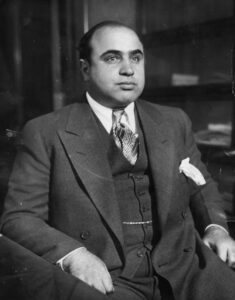
Al Capone
Al Capone (1899–1947)
- Arrived in Chicago at twenty-one, took over as boss of the Chicago Outfit in 1925 when Johnny Torrio retired after an assassination attempt, and built — through bootlegging, gambling, prostitution, political protection and the systematic elimination of rivals — an operation generating an estimated $100 million annually by 1927, with the city's law enforcement apparatus functioning as an operational extension of his organisation.1Britannica — Al Capone
- Ordered the St Valentine's Day Massacre on 14 February 1929 — seven members of Bugs Moran's gang machine-gunned against a garage wall by men posing as police officers — photographs of the victims shocking the public, the Chicago Crime Commission naming him Public Enemy Number One, and a secret White House meeting within weeks directing all federal agencies to concentrate on Capone simultaneously.2Wikipedia — Al Capone
- Convicted on 18 October 1931 of tax evasion — not bootlegging or murder — sentenced to eleven years, the harshest sentence delivered for tax fraud to that point3History.com — 8 Things About Al Capone — transferred to Alcatraz in 1934 where neurosyphilis progressively destroyed his mental faculties, a formal diagnosis of syphilis of the brain made in 1938, his physician concluding by 1939 that he had the mentality of a twelve-year-old child — and died at his Palm Island mansion in January 1947, aged forty-eight.2Wikipedia — Al Capone
Al Capone establishes one of the most analytically distinctive profiles in the Criminal domain. The variable configuration that produced the most powerful criminal organisation in American history is not complicated. It is the direct consequence of operating entirely outside the institutional constraints that suppress every legitimate leader in the dataset. Maximum Autonomy. Maximum Resources. Administrative Impotence approaching zero. No parliament, no board, no regulator, no electorate, no chain of command, no oversight mechanism of any kind that he had not already purchased or eliminated. The Effective Power equation responds to that configuration in the way the mathematics requires.
The rise in Chicago period establishes the operational template under Johnny Torrio and then independently after Torrio's retirement in 1925.4FBI — Al Capone Capone arrived in Chicago at twenty-one and within four years was running the largest criminal organisation in the city. The variable profile in this period reflects a leader still consolidating — building the political relationships with Mayor Thompson and the Chicago Police Department that would become the operational foundation of everything that followed, establishing supply chains for bootleg liquor that reached to Canada, negotiating territory agreements with rival gangs before resorting to violence. The Ego and Pride variables in this period are elevated but not at the level that prevents operational discipline. Capone negotiated before he shot. He maintained relationships that required sustained management. He ran a logistics operation of genuine complexity across multiple jurisdictions with sufficient coherence to grow revenue consistently year on year.
The peak of power period is the canonical snapshot and the Codex records its highest Criminal domain rating — because this is where all the structural variables converged simultaneously at their maximum values. The bootlegging operation generated revenue that no legitimate business of equivalent size in Chicago was producing. Political protection was comprehensive — the city's law enforcement apparatus was functionally an extension of the Outfit's operational security.2Wikipedia — Al Capone Rivals had been eliminated, neutralised or brought inside the tent. Autonomy within his operational territory was absolute in a way that no legitimate leader in the dataset approaches. The soup kitchens opened during the Depression, the charitable donations, the carefully cultivated Robin Hood public image — these are the Visibility and Recognition variables being managed with the same operational discipline applied to every other aspect of the organisation. When he appeared at baseball games to cheers from the crowd, he was not indulging vanity. He was managing his public position with deliberate intent.
The Congruence variable sits at its documented floor throughout the profile and the Codex records it honestly. The gap between his public persona — I am just a businessman giving the people what they want — and his operational reality as the boss of a murder-backed criminal empire is the widest say-do gap in the dataset. Every leader in the dataset has some gap between stated values and operational behaviour. Capone's gap was structural and absolute. It was not incidental to his operation. It was the operation. The Codex records Congruence at its floor not as a moral judgment but as an analytical measurement of the distance between what he said and what he did.
The St Valentine's Day Massacre on 14 February 1929 is the single most important event in the profile — not because of its violence, which was not exceptional by the standards of Chicago in the 1920s, but because of what it revealed about the Pride variable trajectory. The decision to order a mass public killing of seven men in broad daylight, in a city that had tolerated years of gang violence at a lower visibility level, crossed a threshold that brought institutional consequences no amount of political protection could absorb. The photographs of the victims shocked the public. The Chicago Crime Commission named Capone Public Enemy Number One. Within weeks of the Massacre, a secret meeting at the White House directed all federal agencies to concentrate on Capone simultaneously.2Wikipedia — Al Capone The Pride variable at its elevated level produced a decision that converted the most powerful criminal in America into the most comprehensively investigated man in America.
The federal pressure and decline period records the collapse of the structural conditions that had produced the peak. The Environment variable dropped to near its minimum as the IRS and Eliot Ness operated simultaneously and beyond the reach of his purchased influence. The operational genius of the federal case against him was its chosen instrument — tax evasion rather than bootlegging or murder, charges that did not require witnesses who could be intimidated or evidence that could be suppressed.5History.com — Al Capone His own lawyer had made crucial admissions about his income during prior negotiations. The Defined Output and Process variables in this period record a leader who could not adapt to a threat that operated through mechanisms his organisation had no answer for.
The Alcatraz period is the terminal snapshot and the Codex records its lowest possible score — because there is no other honest reading. Neurosyphilis progressively eroded his mental faculties from his arrival at the prison. His formal diagnosis of syphilis of the brain was made in 1938. He spent his final year at Alcatraz in the hospital section, confused and disoriented. By 1939 his physician concluded he had the cognitive processes of a twelve-year-old child.6Mob Museum — Al Capone He died in January 1947 at his Palm Island mansion, aged forty-eight. The Outfit continued without him, managed by Frank Nitti at lower visibility and without the open violence that had marked Capone's rule — which is itself an analytical observation about what his Pride variable had cost the organisation he built.
The Codex records his profile without moral adjudication. The framework measures what the variables produce. What they produce for a Criminal domain leader who maximised Autonomy, zeroed Administrative Impotence and kept Ego and Pride at functional rather than terminal levels for most of his operational career is a peak score that places him among the most operationally effective leaders in the dataset — and a terminal score at the floor that records with equal precision what happens when the structural conditions that produced that effectiveness collapse simultaneously and completely.
Score Comparison
Add up to 10 leaders. Click a name to visit their profile.
The 13 Equations
Scores for: Rise in ChicagoThe 22 Variables
Canonical scoresSources & Bibliography
The scores assigned to this leader are derived from publicly available sources. Variable inputs reflect documented behaviour, structural conditions, and historical record at the time of each snapshot.