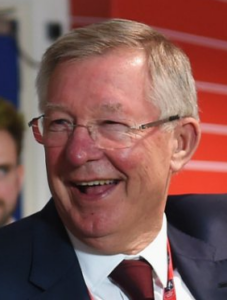
Alex Ferguson
Alex Ferguson - Born 1941
- Managed Manchester United for twenty-six seasons from 1986 to 2013, winning thirty-eight trophies including thirteen Premier League titles and two UEFA Champions League titles — the most trophies won by any manager in the history of football, with a record of 528 wins from 810 Premier League matches, making him the defining figure of the Premier League era and the only manager ever described by Harvard Business School as the analytical equivalent of Steve Jobs to Apple.1Harvard Business Review — Ferguson's Formula ↗
- Arrived at Manchester United in November 1986 when the club had finished twenty-first in the First Division and faced serious financial difficulty, rebuilt the youth system that produced the Class of '92, and ended the club's twenty-six-year wait for a league title in 1992-93 — then won eight more Premier League titles in the eleven seasons from 1992-93 to 2002-03, including the unprecedented treble of league, FA Cup and Champions League in 1998-99.2Wikipedia — Alex Ferguson ↗
- Articulated the distinction between 'building a team and building a club' — prioritising youth development, institutional identity and long-term succession over short-term recruitment — in a management philosophy studied at Harvard Business School, Stanford Graduate School of Business and business schools worldwide, making him uniquely the only sports manager whose leadership framework has been formally adopted as a case study in university management curricula across multiple institutions.3Harvard Business School — Ferguson Case Study ↗
Sir Alexander Chapman Ferguson was born on 31 December 1941 in Govan, Glasgow, the son of a shipyard worker, played as a forward for several Scottish clubs including Rangers and Dunfermline — where he was the Scottish Football League's top scorer in 1965-66 — and began his managerial career at East Stirlingshire in 1974.2Wikipedia — Alex Ferguson ↗ His route to Manchester United ran through St Mirren, where he transformed a Second Division club into league champions, and Aberdeen, where between 1978 and 1986 he won three Scottish Premier Division titles, four Scottish Cups, and the European Cup Winners' Cup in 1983 against Real Madrid — breaking the Rangers and Celtic duopoly and demonstrating on a small budget that systematic institutional building could produce results that outperformed the structural advantages of much wealthier rivals. The analytical entry point for Ferguson's profile is the distinction the Harvard Business Review case study draws between his role as coach and his role as institutional builder. By his own account, and by the analytical record, his primary achievement at Manchester United was not the tactical decisions he made on the training pitch but the institutional systems he created around them.1HBR — Ferguson's Formula ↗ He rebuilt the youth development system from its foundations. He established an academy that produced the Class of '92 — Scholes, Giggs, the Nevilles, Beckham, Butt — who became the core of three consecutive league title-winning teams. He managed the transition from that generation to the next, and from that generation to the next again. Across twenty-six seasons, he replaced every significant player in his squad multiple times while maintaining competitive output — a leadership achievement with no parallel in professional team sport. The Defined Output variable in his profile is set not at 'win the match' or even 'win the league' but at a genuinely longer time horizon: leave Manchester United in a stronger institutional position than you found it. That is an unusual Defined Output for a football manager, who operates under constant short-term performance pressure, but it is the one that explains both his longevity and his willingness to rebuild rather than buy his way to success.4Stanford GSB — Ferguson Leadership ↗ He was near the sack in January 1990 when his team, 21st in the table, drew 0-0 against Nottingham Forest in an FA Cup third round tie that became the most analysed single result in the history of football management. They won. He kept his job. He won thirty-seven more trophies. The People variable is where his profile is most analytically contested. He was, by his own description, ruthless in releasing players who no longer served the team's needs — Beckham, van Nistelrooy, Jaap Stam, Roy Keane, multiple others. His willingness to do this without sentimentality is a People management strength in the Codex framework because the variable measures whether the leader maintained the human architecture necessary to deliver the Defined Output, not whether that process was comfortable for its participants. The Ego and Pride variables score high: he was famously combative, never retreating publicly from a position once taken, deploying what the media called 'mind games' against opponents with conscious tactical deliberation. He announced his retirement on 8 May 2013 after his thirteenth and final Premier League title. Manchester United have not won the league since. He remains a club director and ambassador. The institution he built has not yet produced another manager capable of sustaining what he created, which is itself an analytical finding about the rarity of what he did.
Score Comparison
Add up to 10 leaders. Click a name to visit their profile.
The 13 Equations
Scores for: Final League Title — 2012-13The 22 Variables
Canonical scoresWhat changed: The Treble Season — 1998-99 → Final League Title — 2012-13
Sources & Bibliography
The scores assigned to this leader are derived from publicly available sources. Variable inputs reflect documented behaviour, structural conditions, and historical record at the time of each snapshot.