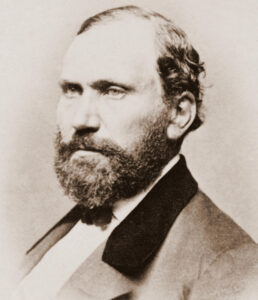
Allan Pinkerton
Allan Pinkerton (1819-1884)
- Founded the Pinkerton National Detective Agency in Chicago around 1850 — growing it into the largest private law enforcement organisation in the world by the 1870s and 1880s, with offices in New York, Philadelphia and across the United States — pioneering systematic criminal surveillance, the mug shot as a tool of identification, undercover infiltration of criminal networks, and the first national criminal intelligence database, establishing the institutional template for the Secret Service and the FBI.1Wikipedia — Allan Pinkerton ↗
- Served as head of the Union Intelligence Service during the first two years of the Civil War, operating under the pseudonym Major E.J. Allen — running agents behind Confederate lines to gather military intelligence, foiling an alleged plot to assassinate Abraham Lincoln in Baltimore in February 1861, and providing General McClellan with Confederate troop strength estimates that were, in the analytical vocabulary of the Codex, a catastrophic failure of Defined Output, being systematically and significantly inflated throughout the Peninsula Campaign.2Wikipedia — Pinkerton Agency ↗
- Hired the first female detective in American history — Kate Warne in 1856, eight years before the Civil War — recruited agents from minority communities at a time of explicit racial exclusion from most law enforcement, established a code of conduct that included prohibition of contingency fees and the requirement of written reports for all investigations, and produced a series of popular true-crime books that shaped public understanding of detective work and created demand for professional investigation services.3National Park Service — Allan Pinkerton ↗
Allan Pinkerton was born on 21 August 1819 in the Gorbals, a working-class district of Glasgow, the son of a police sergeant who died when Allan was a child, leaving the family in poverty.4Britannica — Allan Pinkerton ↗ He became a cooper, was drawn into Chartist radical politics, found himself facing arrest for his activities, fled to the United States in 1842, settled in Illinois, and stumbled into detective work by accident when he discovered a gang of counterfeiters while cutting wood on a deserted island and had them arrested. His effectiveness led to appointment as deputy sheriff of Kane County and then Cook County, and in 1850 he resigned from the Chicago police force to establish the detective agency that would make his name. The analytical profile of Pinkerton is split across two distinct phases of his career — the detective agency period and the Civil War intelligence period — which require entirely separate analytical treatments because the performance variables point in opposite directions between them. In the detective agency phase, the Defined Output, Process and Ability variables are all high. He identified a genuine gap in the American law enforcement landscape — there was no national detective infrastructure, no way to track criminals across state lines, no systematic method of identifying repeat offenders — and built an organisation to fill it.2Wikipedia — Pinkerton Agency ↗ The criminal records system he established was the direct precursor of the FBI's criminal intelligence database. The mug shot as an investigative tool was a Pinkerton innovation. The use of female agents and minority recruits at a time of explicit exclusion was an institutional decision that reflected both pragmatic intelligence — women could access social environments closed to male detectives — and a personal abolitionism that was documented and genuine. In the Civil War intelligence phase, the same leader who built the most effective private intelligence organisation in the United States produced consistently and significantly inflated estimates of Confederate strength that contributed directly to McClellan's chronic paralysis during the Peninsula Campaign.1Wikipedia — Allan Pinkerton ↗ The analytical explanation is twofold. First, Pinkerton's methods — built on human informants, undercover infiltration, and pattern recognition from criminal intelligence — were well-suited to peacetime detective work and poorly suited to military order-of-battle estimation, where the Defined Output requires systematic counting rather than inference from partial information. Second, and more analytically significant, he was providing McClellan with the numbers McClellan wanted to receive, a Congruence failure of the first order: a man who had built his agency's reputation on honest reporting was now producing intelligence shaped by what his principal expected. After the Civil War he resumed management of the agency, pursued the James-Younger gang, and in 1875 authorised a raid on the James family farm that went catastrophically wrong — a device exploded and killed Jesse James's eight-year-old half-brother — destroying public sympathy for the Pinkertons and marking the point at which his Value variable began its terminal decline.5PBS American Experience — Pinkerton Agency ↗ The later Pinkerton Agency's role in strikebreaking — most notoriously at Homestead in 1892 — represented a fundamental transformation in the organisation's Value, from crime detection to the suppression of labour rights. Pinkerton died in 1884 before the Homestead strike, but the trajectory was already set. He is buried in Chicago's Graceland Cemetery. The agency that bears his name is now a subsidiary of Securitas AB.
Score Comparison
Add up to 10 leaders. Click a name to visit their profile.
The 13 Equations
Scores for: Pinkerton Agency — Peak Detective EraThe 22 Variables
Canonical scoresWhat changed: Civil War Intelligence — Union Secret Service → Pinkerton Agency — Peak Detective Era
Sources & Bibliography
The scores assigned to this leader are derived from publicly available sources. Variable inputs reflect documented behaviour, structural conditions, and historical record at the time of each snapshot.