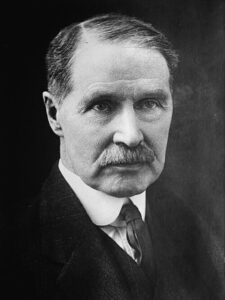
Andrew Bonar Law
Andrew Bonar Law (1858–1923)
- Andrew Bonar Law — born in New Brunswick to a Presbyterian minister of Ulster-Scots descent, raised in Scotland after his mother's death, iron merchant, Glasgow MP, Parliamentary Secretary to the Board of Trade, and leader of the Conservative Party from 1911 — rose to the party leadership through a combination of forensic parliamentary capability and a willingness to deploy Ulster Unionist intransigence as a constitutional weapon against the Liberal government's Home Rule programme with a ruthlessness that permanently altered the boundaries of legitimate parliamentary opposition.1Britannica — Andrew Bonar Law
- His career encompassed the Ulster crisis of 1912 to 1914 — in which he publicly pledged Conservative support for Ulster resistance to Home Rule up to and including armed rebellion — coalition service as Colonial Secretary and Chancellor of the Exchequer during the First World War, a pivotal role in bringing down the Asquith coalition in 1916 and installing Lloyd George, the destruction of Lloyd George's coalition in October 1922, and a premiership of two hundred and nine days before terminal illness forced his resignation in May 1923, making him the shortest-serving Prime Minister of the twentieth century and the only one to die in office in the same year he left it.2Britannica — Andrew Bonar Law
- The man whom Asquith called the unknown Prime Minister — a label that has stuck with sufficient tenacity to constitute a minor injustice — was in analytical terms one of the most effective parliamentary operators of the Edwardian era, a leader whose Conviction and Communication variables in the House of Commons exceeded those of most of his more celebrated contemporaries, and whose career is most instructively read not as a footnote to Lloyd George and Churchill but as the mechanism by which Conservative parliamentary dominance was reconstructed after the disasters of 1906 and sustained through the turbulence of 1914 to 1922.3Oxford DNB — Andrew Bonar Law
Andrew Bonar Law is the most underscored profile in the British Political domain and the one whose variable analysis diverges most sharply from his historical reputation. The unknown Prime Minister label is analytically misleading — he was unknown in the sense that his contributions operated through institutional mechanisms rather than personal mythology, which is precisely the kind of leadership the Leaderment model is designed to capture accurately.
The formation period is commercially rather than politically rooted, which is unusual in the British political dataset. Bonar Law made his own money as an iron merchant before entering politics at forty, bringing to Westminster a directness and a comfort with numerical argument that distinguished him from the barrister-dominated parliamentary culture of his era.1Britannica — Andrew Bonar Law The Process variable in his parliamentary career reflects this formation — he prepared meticulously, argued precisely, and did not mistake eloquence for effectiveness. His debating capability was built on command of detail rather than rhetorical flourish, which made him less quotable than Lloyd George or Churchill and more consistently effective in the procedural business of the House.
The Conservative leadership from 1911 is the analytically central period of his career. He inherited a party that had lost three general elections in five years, was divided between Tariff Reform and Free Trade factions, and faced a Liberal government with a commanding majority and an ambitious legislative programme that included Irish Home Rule, Welsh Disestablishment, and the Parliament Act stripping the Lords of their veto.1Britannica — Andrew Bonar Law His strategic response was to weaponise Ulster Unionism — committing the Conservative Party publicly and without qualification to Ulster's resistance to Home Rule, including the implicit endorsement of the Ulster Volunteer Force's arming and drilling. The Bonar Law speech at Blenheim Palace in July 1912 — in which he told a mass Unionist rally that there were things stronger than parliamentary majorities — is the Conviction variable at its most operationally aggressive and the Congruence variable under its greatest stress. He meant it. He was also using it. Both are recorded.
The Ulster crisis of 1912 to 1914 brought the United Kingdom closer to constitutional breakdown than at any point since the seventeenth century, and Bonar Law's role in producing that proximity is the most analytically contested element of his career.4History Ireland — Tories and the Ulster Crisis The Curragh Incident of March 1914 — in which British Army officers indicated they would resign rather than enforce Home Rule against Ulster — was the direct consequence of the political environment Bonar Law had helped construct. The Value variable at this snapshot is the most contested score in the profile: he prevented a legislative settlement that might have resolved the Irish question before the Easter Rising changed its terms permanently, or he preserved the democratic rights of a minority against majoritarian imposition, depending on the analytical frame applied. Both assessments have merit. The score reflects the ambiguity.
The wartime coalition period is where the variables most clearly separate from the historical reputation. Bonar Law as Colonial Secretary and subsequently Chancellor of the Exchequer was a reliable, effective, and self-effacing partner in two coalition governments — first under Asquith, then under Lloyd George.3Oxford DNB — Andrew Bonar Law His willingness to subordinate his own position and his party's interests to the requirements of coalition governance during the war — accepting roles and policies he would not have chosen — reflects a Humility variable that most leaders of his capability do not sustain when institutional power is available. The Process variable at this period is high: he managed the Conservative parliamentary party through the sustained disruption of coalition politics without losing its coherence as a political force, which was the precondition for everything that followed in 1922.
The Carlton Club meeting of October 1922 is the most consequential single political event of his career and the one that most precisely captures the Decisiveness and People variables in combination. Conservative MPs voted to withdraw from Lloyd George's coalition by 187 votes to 87 — a result that ended Lloyd George's premiership immediately and returned Bonar Law to Downing Street within days.5Conservative Home — Carlton Club Meeting 1922 Bonar Law had judged the parliamentary mood with precision, moved at the right moment, and achieved the outcome he sought without the kind of public campaigning that would have made the result harder to reverse if it had gone wrong. The Adaptability variable at this moment reflects a leader who had waited, assessed, and acted only when the conditions were sufficient — the opposite of his Ulster period, where he moved aggressively before the situation demanded it.
The premiership of two hundred and nine days is too short to score comprehensively but analytically significant in one respect: Bonar Law's stated objective on entering Downing Street was tranquillity — a deliberate decompression of the political temperature after the Lloyd George years.1Britannica — Andrew Bonar Law The Vision variable at this snapshot is lower than in earlier periods, not because his capability had declined but because the Vision was deliberately modest — stabilisation rather than transformation. For a country that had been through eight years of war, coalition crisis, Irish partition, and post-war economic disruption, tranquillity was not a trivial objective. The terminal cancer diagnosis that ended the premiership in May 1923 forecloses any assessment of what a full term might have produced.
The number that matters most across all three snapshots is the People variable — specifically its application to institutional management rather than individual relationships. Bonar Law rebuilt the Conservative Party as a coherent parliamentary force after 1906, held it together through coalition, and directed it to the Carlton Club vote at precisely the moment when its members were ready to act. That sequence required a sustained and accurate reading of a large and diverse group of people over more than a decade. It produced the Conservative parliamentary dominance that defined British politics for most of the twentieth century. The unknown Prime Minister label has obscured this. The equations do not.
Score Comparison
Add up to 10 leaders. Click a name to visit their profile.
The 13 Equations
Scores for: Carlton Club and PremiershipThe 22 Variables
Canonical scoresWhat changed: Wartime Coalition — Chancellor and Party Manager → Carlton Club and Premiership
Sources & Bibliography
The scores assigned to this leader are derived from publicly available sources. Variable inputs reflect documented behaviour, structural conditions, and historical record at the time of each snapshot.