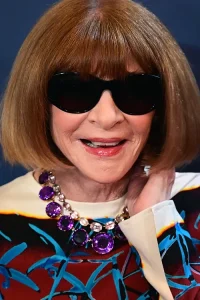
Anna Wintour
Anna Wintour (born 1949)
- Served as Editor-in-Chief of American Vogue from 1988 to 2025 — thirty-seven years — transforming a stagnating publication into the most influential fashion magazine in the world, pioneering the practice of placing celebrities rather than models on covers, launching the CFDA/Vogue Fashion Fund, and championing designers including Galliano, McQueen and Marc Jacobs at the critical early stages of their careers.1Wikipedia — Anna Wintour ↗
- Transformed the Metropolitan Museum of Art's Costume Institute annual fundraiser from a minor social gathering into the Met Gala — the most internationally visible fashion event in the world, generating tens of millions for the museum's collections — and served as its lead chairperson for three decades, reshaping its guest list, themes and cultural significance until it became a media event comparable to the Oscars.2Britannica — Anna Wintour ↗
- Appointed Artistic Director of Condé Nast in 2013 and subsequently Global Chief Content Officer in 2020, extending her authority from a single magazine to an entire portfolio of global publishing brands — awarded the Presidential Medal of Freedom by President Biden in January 2025 and appointed to the Order of the Companions of Honour by King Charles III in the same year.3Business of Fashion — Anna Wintour ↗
Anna Wintour was born on 3 November 1949 in London, the daughter of Charles Wintour, long-serving editor of the Evening Standard, and grew up in a household where editorial authority, journalistic decisiveness and the management of public taste were not abstract concepts but daily practice.1Wikipedia — Anna Wintour ↗ She dropped out of school at sixteen, worked her way through British and American fashion magazines across two decades, and arrived at American Vogue in 1988 with a precise understanding of what the magazine had become and what she intended to make it. Her first cover — a model in a $50 pair of jeans paired with a $10,000 Christian Lacroix jewelled sweater — was rejected by the printer as a mistake. It was not a mistake. It was the statement of intent: Vogue under Wintour would not be the magazine of unattainable luxury for passive admirers. It would be a magazine that told women what to wear and why, that treated fashion as a serious cultural force rather than a decorative afterthought, and that would use its platform to shape the industry rather than merely to report on it.4The Profile — Anna Wintour ↗ The leadership variables that distinguish Wintour from every other editor in the dataset are Defined Output and Intent. Her Defined Output was not a single issue or a single season — it was the repositioning of fashion as a legitimate cultural institution with Vogue as its authoritative voice. Her Intent was communicated with such clarity to the industry around her that the question 'Do you want me to go to Anna with this?' became a standard tool of commercial leverage for fashion industry publicists — a measure of the degree to which her imprimatur was understood to be the effective arbiter of success or failure in the global fashion market.1Wikipedia — Anna Wintour ↗ The People variable in her profile requires careful analytical handling. Her management style has been described as glacial, imperial and demanding to the point of cruelty — the roman à clef The Devil Wears Prada, written by a former assistant, sold millions and was adapted into one of the most successful films of the 2000s. The character of Miranda Priestly is not a flattering portrait. But the People variable measures not whether people enjoyed working for her but whether she built and maintained the human architecture necessary to deliver her Defined Output. The answer is unambiguous: the generation of supermodels, the careers of Galliano, McQueen, Marc Jacobs and Thom Browne, the transformation of the Met Gala, the global expansion of Vogue — none of these were accidental. They were the product of a leader who understood exactly which people she needed, in which roles, at which moments.2Britannica — Anna Wintour ↗ She stepped down as Editor-in-Chief in June 2025 after thirty-seven years, remaining as global editorial director of Vogue and chief content officer of Condé Nast. The Costume Institute at the Metropolitan Museum of Art was renamed the Anna Wintour Costume Institute in 2014. Her father was an editor. She became the most powerful editor in the world. The inheritance was not accidental — it was made.
Score Comparison
The 13 Equations
Scores for: Global Chief Content OfficerThe 22 Variables
Canonical scoresWhat changed: Vogue — Transformation Phase → Global Chief Content Officer
Sources & Bibliography
The scores assigned to this leader are derived from publicly available sources. Variable inputs reflect documented behaviour, structural conditions, and historical record at the time of each snapshot.