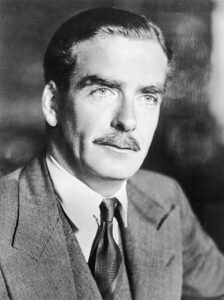
Anthony Eden
Anthony Eden (1897–1977)
- Anthony Eden — decorated company commander on the Western Front, the youngest brigade major in the British Army at nineteen, Oriental Languages scholar at Christ Church Oxford, Conservative MP from 1923, Parliamentary Private Secretary to Austen Chamberlain, Parliamentary Under-Secretary at the Foreign Office, Lord Privy Seal with responsibility for League of Nations affairs, and three times Foreign Secretary — spent thirty years being groomed as Churchill's natural successor, accumulating a foreign policy reputation of such consistent lustre that his eventual premiership was treated as a coronation, and proceeded to destroy both his government and British foreign policy in a single catastrophic act of imperial self-deception at Suez.1Britannica — Anthony Eden
- His premiership from April 1955 to January 1957 — twenty-one months in total — produced a landslide election victory, a successful Geneva summit, competent early domestic management, and then the Suez Crisis of October to November 1956, in which Eden colluded secretly with France and Israel to manufacture a pretext for Anglo-French military intervention in Egypt, was halted by American financial pressure and Soviet threats, withdrew in humiliation, lied to the House of Commons about the collusion, and resigned in January 1957 citing ill health — the most complete single collapse of British foreign policy in the twentieth century and the moment at which Britain's pretension to independent great power status ended.2Miller Center — Suez Crisis
- The variable profile that produced Suez is not that of a reckless or stupid man — Eden was neither — but of a leader whose Congruence had been eroded by illness, whose Humility had been consumed by thirty years of waiting for an office he believed was his by right, whose People variable had narrowed to a circle of advisers who would not tell him what Eisenhower would actually do, and whose Conviction about Nasser as a threat equivalent to Hitler reflected a pattern-matching failure that the equations record with precision.3Britannica — Suez Crisis
Anthony Eden is the most instructive profile in the British Political domain on the subject of formation damage — specifically, what happens when a leader spends so long in preparation for an office that the preparation itself becomes the variable profile, leaving insufficient adaptability for the realities of the office when it arrives. He was an exceptional Foreign Secretary. He was a failed Prime Minister. The equations explain precisely why those two assessments are consistent rather than contradictory.
The formation period is distinguished by genuine courage and genuine ability operating in parallel. Eden's First World War record — winning the Military Cross, reaching the rank of brigade major at nineteen, losing two brothers and his closest friend to the war — produced a Resilience variable and a direct personal knowledge of what military action costs that should have been the most important corrective variable at Suez.1Britannica — Anthony Eden That it was not — that a man who had seen industrial-scale death at close range authorised a military adventure on the basis of a fabricated pretext — is the most analytically significant variable failure in the profile. The formation built the Resilience variable. The thirty-year wait for the premiership degraded the Humility variable that should have governed its use.
The Foreign Office years established the public reputation that made everything else possible and the analytical baseline that Suez then inverted. Eden resigned as Foreign Secretary in February 1938 over Chamberlain's decision to open direct negotiations with Mussolini without consulting him — a resignation that was vindicated by subsequent events and that established his anti-appeasement credentials with a clarity that sustained his reputation through the war years and beyond.1Britannica — Anthony Eden The Conviction and Congruence variables at this snapshot are among the highest in the profile — he identified a genuine threat, took a costly personal action in response, and was proved right. The irony embedded in this episode is that the same pattern-matching — authoritarian leader making territorial demands must be appeased or confronted — that made the 1938 resignation correct made the 1956 Nasser comparison catastrophically wrong. Nasser was not Hitler. Egypt was not Germany. The Suez Canal was not the Rhineland. Eden's Adaptability variable failed at precisely the point where his Conviction told him it was unnecessary.
The wartime period under Churchill produced the highest People and Process scores in the profile. Eden managed complex multilateral diplomacy across the Tehran, Yalta, and Potsdam conferences, maintained productive working relationships with Molotov, Hull, and Stettinius, and navigated the intersection of British imperial interests and emerging American dominance with a sophistication that his Suez performance later made it fashionable to underestimate.4Oxford DNB — Anthony Eden The Humility variable in this period is higher than in any subsequent snapshot — operating within Churchill's shadow required a sustained suppression of his own instinct to lead that was psychologically costly but variable-positive.
The waiting period from 1945 to 1955 is analytically significant as a slow degradation. Churchill's repeated postponements of retirement — he had promised Eden the succession repeatedly from 1945 onwards — produced a decade of anticipation that the Ego and Pride variables absorbed and the Humility variable paid for.2Britannica — Anthony Eden By the time Eden reached Downing Street in April 1955 he had been waiting for twenty years, had been told repeatedly that the office was his, and had constructed a self-image in which the premiership was the natural culmination of an exceptional career rather than a new and different challenge requiring new and different variables. That self-image is the analytical source of Suez — not the illness, not the American miscalculation, but the Pride variable's conviction that Anthony Eden's judgment about British interests was self-evidently correct and did not require the kind of external challenge that healthy advisory processes provide.
The 1955 election is the high point of the premiership and the canonical snapshot of the political rather than the diplomatic career. Eden called the election within weeks of taking office, increased the Conservative majority from seventeen to sixty, and achieved a personal mandate that Churchill had never sought independently.1Britannica — Anthony Eden The Communication and Confidence variables at this snapshot are at their highest — Eden on the campaign trail was polished, authoritative, and entirely credible as a Prime Minister. The Geneva summit of July 1955, at which the four powers met for the first time since Potsdam, produced the Geneva Spirit of temporary Cold War relaxation and reflected Eden's diplomatic capability operating at its established level. The Environment and k variables at this snapshot are the most favourable in the profile. Everything that followed was self-inflicted.
Nasser's nationalisation of the Suez Canal Company in July 1956 triggered the variable collapse. Eden's response — comparing Nasser explicitly to Mussolini and Hitler in cabinet discussions, authorising secret military planning immediately, and pursuing the collusion with France and Israel that produced the Protocol of Sèvres in October 1956 — reflects the Humility variable at its lowest point in the profile and the People variable in catastrophic failure.3Britannica — Suez Crisis The cabinet was not told the full truth about the collusion. The Americans were not consulted. Harold Macmillan, the Chancellor of the Exchequer who told Eden that Eisenhower would not intervene financially and then presided over the sterling crisis that forced withdrawal, represents the most consequential People variable failure in postwar British political history — Eden trusted the wrong assessment at the moment when the correct assessment was the only variable that mattered.
The lying to the House of Commons about the existence of foreknowledge of the Israeli attack is the Congruence variable at its absolute floor. Eden told the Commons on 31 October 1956 that Her Majesty's Government had no foreknowledge of Israeli intentions — a statement he knew to be false at the moment he made it.5Hansard — Eden Statement October 1956 The Protocol of Sèvres, which documented the collusion, was not publicly confirmed until the 1990s, but the gap between Eden's parliamentary statement and the operational reality of what his government had arranged was total. A leader who spent his career on the principle that British foreign policy must be honest and consistent with its stated values told the legislature the opposite of the truth at the moment of maximum public scrutiny. That is the Congruence variable recording its most complete failure in the British Political domain.
The resignation in January 1957 — citing ill health, which was genuine but not the reason — is the final Congruence gap. The ill health was real: Eden had suffered a botched bile duct operation in 1953 that left him dependent on amphetamines and other medications that affected his judgment and temperament throughout the Suez period.1Britannica — Anthony Eden The medication is a contextual variable but not an exculpatory one — the decisions were his, the collusion was authorised by him, and the lie to the Commons was delivered by him. The health framing allowed the Conservative Party to manage the succession without a formal reckoning with what had actually happened. Harold Macmillan, who had been among the most hawkish advocates of intervention and then the most decisive advocate of withdrawal when the money ran out, became Prime Minister. Eden retired to Alvediston, wrote his memoirs, and spent the remainder of his life declining to acknowledge the collusion that the documents eventually confirmed.
The number that matters most across all three snapshots is the gap between the Humility variable at the Foreign Office peak and the Humility variable at Suez. That gap — from seven to three across twenty years — is the analytical story of Anthony Eden. The capability was genuine. The reputation was earned. The thirty-year wait consumed the correcting variable that might have saved both. That is the Leaderment profile of Anthony Eden.
Score Comparison
Add up to 10 leaders. Click a name to visit their profile.
The 13 Equations
Scores for: Foreign Secretary — Anti-Appeasement and Wartime DiplomacyThe 22 Variables
Canonical scoresSources & Bibliography
The scores assigned to this leader are derived from publicly available sources. Variable inputs reflect documented behaviour, structural conditions, and historical record at the time of each snapshot.