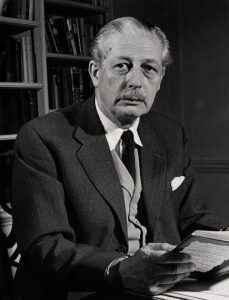
Harold Macmillan
Harold Macmillan (1894–1986)
- Harold Macmillan — son of an Anglo-American publishing family, Balliol scholar, Captain in the Grenadier Guards wounded three times at the Somme and Loos, MP from 1924, Minister Resident in North Africa under Eisenhower, Minister of Housing, Minister of Defence, Foreign Secretary, Chancellor of the Exchequer, and Prime Minister from January 1957 to October 1963 — was the most theatrically gifted political performer of the postwar British Political domain, a man who constructed an Edwardian persona of unflappable patrician ease as a deliberate instrument of political management, and whose actual variable profile — shaped by the Somme, by the Depression-era poverty of his Stockton constituency, and by a marriage of sustained private misery — was considerably more complex than the performance suggested.1Britannica — Harold Macmillan
- His premiership from 1957 to 1963 produced the restoration of the Anglo-American relationship after Suez, the Wind of Change speech accelerating African decolonisation, the Nassau Agreement securing Polaris missiles and Britain's independent nuclear deterrent, the Partial Nuclear Test Ban Treaty, the failed EEC membership application vetoed by de Gaulle, and the Profumo Affair — a sequence that began with the most assured parliamentary performance of any postwar Prime Minister and ended with the most complete collapse of political authority since Eden, compressed into six years that redefined what British global power actually meant in the post-imperial world.2History Extra — Harold Macmillan
- The private record beneath the public performance — a marriage destroyed by his wife Lady Dorothy's thirty-year affair with Conservative MP Robert Boothby, which Macmillan endured in public silence while privately writing diary entries of considerable anguish, the wartime experience that left him with a lifelong identification with ordinary soldiers and a permanent distrust of military glamour, and a political style that contemporaries experienced as effortless superiority and biographers have subsequently identified as the most carefully maintained act in postwar British politics — is the Congruence variable under its most sustained and least visible pressure in the British Political domain.3Oxford DNB — Harold Macmillan
Harold Macmillan is the most analytically layered profile in the postwar British Political domain — layered because the public performance and the private reality operated in sustained and deliberate tension, because the theatrical ease concealed genuine intellectual engagement with the structural questions of British decline, and because the career arc from Somme veteran to Edwardian anachronism contains more variable complexity than the Supermac caricature suggests. The equations strip the performance and record what was underneath it.
The formation period is defined by two experiences that the subsequent public persona was partly constructed to manage. The Somme and Loos — where Macmillan was wounded multiple times, spent hours lying in a shell crater reading Aeschylus in the original Greek while waiting for darkness to move, and lost the majority of his generation of Balliol contemporaries — produced a Resilience variable and a relationship with death and suffering that the patrician performance permanently concealed but never resolved.1Britannica — Harold Macmillan The Stockton years as MP for a constituency of chronic unemployment and Depression-era poverty produced a Vision variable that was not conservative in the conventional sense — Macmillan's The Middle Way, published in 1938, advocated managed capitalism and state intervention in terms that placed him closer to Keynes than to the Treasury orthodoxy of his own party. Both formation experiences — the war and Stockton — gave him a direct knowledge of human cost that most of his Conservative contemporaries had processed at a greater distance.
The wartime period as Minister Resident in North Africa from 1942 to 1945 is the most underanalysed phase of the career and the one that most directly established the operational baseline for the premiership. Macmillan managed the relationship between Eisenhower, de Gaulle, and the competing French factions with a diplomatic sophistication that Eisenhower subsequently acknowledged, developing in the process both a personal relationship with the future American President and a precise understanding of how to manage the gap between British and American power — a gap that the postwar world would make the central strategic challenge of British foreign policy.3Oxford DNB — Harold Macmillan The People variable in this period is among the highest in the profile — Macmillan could read individuals of radically different cultural and political backgrounds with a precision that the theatrical persona tended to obscure.
The Chancellor of the Exchequer period under Eden is analytically significant primarily because of the Suez crisis and Macmillan's role in it. He was among the most hawkish advocates of military intervention in cabinet — and then, when the sterling crisis produced by American financial pressure made withdrawal unavoidable, among the first to conclude that withdrawal was necessary.4Britannica — Suez Crisis The Congruence variable at this snapshot records both positions without resolving them — he advocated intervention on the basis of assessments he presented to cabinet as more certain than they were, and he advocated withdrawal on the basis of financial reality that his earlier advocacy had helped create. The subsequent emergence as Prime Minister — succeeding Eden within months of the crisis that Eden's Congruence failure had produced — reflects a political intelligence of the highest order: Macmillan had positioned himself as the solution to the problem that his own conduct had partly generated.
The first year of the premiership is the canonical snapshot and the most analytically coherent phase of the career. The restoration of the Anglo-American relationship — through the personal Eisenhower connection, the Bermuda Conference of 1957, and the sustained cultivation of the special relationship as Britain's primary strategic asset — reflected the People and Process variables operating at their most effective.5US State Department — Anglo-American Nuclear Relations The 1959 general election victory — increasing the Conservative majority from sixty to one hundred — is the Communication variable operating at its peak domestic register: the you've never had it so good framing was not a boast but a political positioning that associated Conservative governance with the prosperity that the postwar settlement had produced and that the electorate was experiencing directly. The Confidence variable at this snapshot is the highest in the profile — Macmillan had taken over a party and a country demoralised by Suez and within two years had produced a mood of national confidence sufficiently convincing to win a landslide.
The Wind of Change speech in Cape Town in February 1960 is the most analytically significant single speech of the premiership and the one that most precisely captures the Vision variable operating at its most courageous register.1Britannica — Harold Macmillan Delivering to the South African parliament — in the presence of Hendrik Verwoerd, the architect of apartheid — the assessment that a wind of change was blowing through the continent and that British policy would align with African nationalism rather than white minority rule, was a Communication and Conviction combination that the audience did not expect and that the domestic Conservative Party found uncomfortable. The Humility variable at this snapshot is higher than the patrician persona suggests — Macmillan was acknowledging that the British Empire's era was over in terms that the imperial nostalgics in his own party had not yet processed, and doing so in the most politically uncomfortable venue available.
The Nassau Agreement of December 1962 — in which Macmillan secured Polaris missiles from Kennedy following the cancellation of Skybolt, preserving Britain's independent nuclear deterrent — is the most analytically precise expression of the People variable in the foreign policy record.6US State Department — Nassau Agreement Macmillan read Kennedy's political position with sufficient accuracy to understand that the American President needed to be given a face-saving framework for a concession that the State Department opposed, and constructed the multilateral nuclear force concept as the diplomatic packaging within which the bilateral Polaris agreement could be presented as something other than a straightforward Anglo-American special relationship transaction. The outcome — Britain retaining an independent nuclear deterrent at a fraction of the development cost — reflected a diplomatic capability that the theatrical persona had consistently concealed from those who took the performance at face value.
The EEC application and de Gaulle's veto of January 1963 is the most significant strategic failure of the premiership and the one that most directly captures the limits of the People variable when applied to de Gaulle.2Britannica — Harold Macmillan Macmillan had concluded that British membership of the European Community was strategically essential — a Vision variable operating correctly and ahead of most of his contemporaries — and had spent eighteen months negotiating the terms of entry. De Gaulle's veto, delivered in January 1963 in terms that made clear it was about British Atlanticism rather than the negotiating terms, reflected a failure to read the French President's actual position with the accuracy that the North Africa relationship might have been expected to produce. The Nassau Agreement — which de Gaulle cited as evidence of British subordination to American strategic interests — had provided the pretext, and Macmillan had not seen it coming with sufficient clarity to prevent it.
The Profumo Affair is the terminal variable failure and the one that most precisely illustrates the gap between the performance and the reality. John Profumo's affair with Christine Keeler — who was simultaneously involved with a Soviet naval attaché — was a security and political embarrassment that Macmillan managed with a combination of genuine naivety about what was actually occurring and a patrician instinct to believe what a gentleman told him.7Britannica — Profumo Affair The People variable at this snapshot records its lowest point in the profile — Macmillan misread Profumo, misread the political consequences of defending him, and misread the public mood that the affair had crystallised around Conservative sleaze and out-of-touch establishment complacency. The theatrical persona, which had been an asset in conditions of political confidence, became a liability in conditions of political humiliation — it made Macmillan look not unflappable but disconnected.
The resignation in October 1963 — ostensibly for health reasons following a prostate operation, actually because the political damage of Profumo had made his position untenable — is the final Congruence gap in the profile: a leader who had maintained a performance of effortless control for six years, departing on the grounds of illness at the moment when the performance had become unsustainable.1Britannica — Harold Macmillan The subsequent peerage, the memoirs of exceptional literary quality, and the House of Lords speech in 1984 attacking Thatcher's privatisation programme as selling the family silver — delivered at ninety with the timing of a man who had been performing for sixty years — reflect a variable profile that the resignation had not diminished.
The number that matters most across all four snapshots is the gap between the Performance variable — which does not exist in the Leaderment model — and the variables that the performance was constructed to manage. Macmillan's theatrical ease was not the Communication variable operating at its ceiling. It was the Pride and Ego variables being managed through the construction of a persona sufficiently robust to contain them. The actual Communication variable — the Wind of Change speech, the Nassau negotiation, the 1959 election campaign — was operating underneath the performance at a high level. The Congruence variable records the gap between the two. That gap is the analytical signature of Harold Macmillan, and it is the reason that the most assured performer in postwar British politics left office in circumstances that the performance could not survive.
Score Comparison
Add up to 10 leaders. Click a name to visit their profile.
The 13 Equations
Scores for: First Years — Suez Recovery and 1959 ElectionThe 22 Variables
Canonical scoresWhat changed: Minister Resident North Africa — Wartime Formation → First Years — Suez Recovery and 1959 Election
Sources & Bibliography
The scores assigned to this leader are derived from publicly available sources. Variable inputs reflect documented behaviour, structural conditions, and historical record at the time of each snapshot.