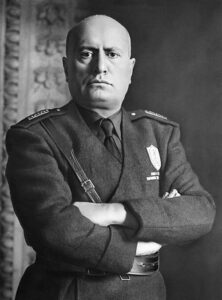
Benito Mussolini
Benito Mussolini (1883–1945)
- Benito Mussolini — blacksmith's son, primary school teacher, revolutionary socialist journalist, editor of Avanti!, founder of the Fasci di Combattimento, organiser of the March on Rome, and Prime Minister of Italy from October 1922 — invented a political form that did not previously exist, gave it a name that became a global category, and spent twenty-three years demonstrating both the operational effectiveness and the structural fragility of a system built entirely around the variables of a single individual whose Ego and Pride made institutional correction impossible.1Britannica — Benito Mussolini
- His regime from 1922 to 1943 produced the systematic destruction of Italian democratic institutions, the invasion of Ethiopia in 1935 in defiance of League of Nations sanctions, the intervention in the Spanish Civil War alongside Franco, the Pact of Steel with Hitler, the declaration of war on Britain and France in June 1940 from a position of military unpreparedness so complete that his own generals told him Italy could not sustain six months of combat, the catastrophic North Africa and Greek campaigns, and the loss of Sicily in July 1943 — at which point his own Fascist Grand Council voted him out of power, the King had him arrested, and the edifice of twenty-one years collapsed within hours.2Britannica — Benito Mussolini
- The Italian Social Republic — the puppet state Mussolini led in northern Italy from September 1943 after German forces rescued him from imprisonment — is the most analytically revealing snapshot in the profile: a leader stripped of every variable that had sustained his position, dependent entirely on German military occupation for his authority, presiding over a civil war between Italian partisans and a regime that had ceased to exist as an independent political entity, and shot by partisans at Dongo on 28 April 1945, two days before Hitler's suicide in Berlin.3United States Holocaust Memorial Museum — Benito Mussolini
Benito Mussolini is the most instructive profile in the dataset on the relationship between Communication and substance — specifically on what happens when a Communication variable of genuine quality operates in the complete absence of the analytical framework needed to convert it into durable output. He could move crowds, dominate rooms, and manufacture consent with a facility that democratic politicians of his era could not match. He could not build an army, manage an alliance, or read a strategic situation accurately. The equations separate these capabilities precisely.
The formation period contains the variable that explains everything that follows. Mussolini's pre-fascist career as a revolutionary socialist journalist and editor of Avanti! established a Communication capability built on provocation, simplification, and emotional mobilisation rather than analytical precision.1Britannica — Benito Mussolini The move from socialism to fascism after the First World War — driven by his fury at Italy's treatment at Versailles and his reading of nationalist sentiment — is the Adaptability variable operating without the Congruence corrective: he changed his entire ideological framework when the political market shifted, without acknowledging the change as a change. The resulting system was not a coherent political philosophy but a Communication strategy with a paramilitary enforcement mechanism — which is precisely why it collapsed the moment the enforcement mechanism was removed.
The March on Rome in October 1922 is analytically less dramatic than its mythology suggests. Mussolini did not seize power by force — he was invited to form a government by King Victor Emmanuel III, who concluded that constitutional resistance to the Fascist movement would produce more disorder than accommodation.4Britannica — March on Rome The People variable at this snapshot records a specific capability: Mussolini understood that the King, the military establishment, and the industrial interests that funded the Fascist movement all needed to believe that he was a manageable conservative force rather than a revolutionary one. He managed those perceptions successfully for several years — suppressing the squadrismo violence when it threatened elite support, presenting himself in parliament as a constitutional actor, and moving toward total power incrementally rather than immediately. The Process variable in the consolidation period is higher than his subsequent record suggests.
The consolidation from 1922 to 1926 — the Acerbo Law restructuring the electoral system, the assassination of Giacomo Matteotti and the Aventine Secession that followed, the suppression of opposition parties and the independent press, and the establishment of the Special Tribunal for the Defence of the State — reflects a Decisiveness and Defined Output variable combination operating at moderate efficiency in the service of institutional destruction.1Britannica — Benito Mussolini The Matteotti crisis of 1924 is the most analytically significant near-failure of the regime — the opposition withdrawal from parliament following the Socialist leader's murder briefly created the conditions for Mussolini's removal, and his survival reflected the King's continued unwillingness to act rather than any institutional resilience of the Fascist system itself. The fragility embedded in a system dependent on a single individual's continued political survival was present from the beginning.
The canonical snapshot covers the period of highest operational effectiveness — the mid-1930s, when the domestic consolidation was complete, the Ethiopian campaign had produced the regime's peak of popular support, and the international position had not yet been irreversibly compromised by the Axis alignment.5Britannica — Second Italo-Ethiopian War The Ethiopian conquest of 1935 to 1936 — achieved against a military opponent with no capacity to resist modern weaponry, including the use of mustard gas in defiance of international prohibition — reflected Decisiveness and Vision in the service of imperial ambition but produced outcomes whose Value score reflects both the Italian nationalist perspective and the Ethiopian one. The League of Nations sanctions that followed were ineffective enough to be diplomatically humiliating without being economically damaging enough to deter, which reinforced Mussolini's conclusion that the international order could be challenged without material consequence — a Learning variable failure of the first order.
The Axis alignment with Hitler is the most consequential strategic decision of the regime and the one that most precisely captures the People variable in failure. Mussolini had initially regarded Hitler with contempt — in 1934 he moved Italian troops to the Brenner Pass to deter a potential German annexation of Austria — and the subsequent reversal of that position, driven by shared ideological framing and the isolation produced by Ethiopian sanctions, subordinated Italian strategic interests to German ones in a relationship that was never equal.2Britannica — Benito Mussolini The Pact of Steel of 1939 committed Italy to automatic military support for Germany without a cabinet discussion of what Italian military capability could actually sustain. The Congruence variable at this snapshot is at its lowest point in the pre-war period — Mussolini's public declarations of Italian military power were systematically inconsistent with the intelligence assessments of Italian military readiness that his own generals were providing.
The declaration of war in June 1940 — timed to exploit what appeared to be France's imminent collapse — is the Decisiveness variable producing its most catastrophically mistimed output.6Britannica — Italy in World War II Mussolini's generals had told him that Italy lacked fuel, ammunition, modern aircraft, and transport for sustained operations. He declared war anyway, believing the conflict would be over within weeks and that Italy needed to be present at the peace conference to claim territorial rewards. The Learning variable at this snapshot is at the floor — he had received accurate information about Italian military unpreparedness and processed none of it. The Greek campaign of October 1940 — in which Italian forces invaded Greece and were driven back into Albania within weeks by a vastly outnumbered Greek army — is the ability variable recording the gap between the Communication of military power and its operational reality.
The July 1943 Grand Council vote — in which Mussolini's own senior Fascists voted 19 to 7 to restore military command to the King — is the People variable failure reaching its terminal expression.2Britannica — Benito Mussolini A leader who had spent twenty years constructing a system of personal power so complete that no institutional corrective existed had simultaneously constructed a system so dependent on his continued effectiveness that when that effectiveness failed, the entire edifice had no mechanism for self-repair other than removing him. He was arrested the same day. The regime that had presented itself as the model for national regeneration dissolved in hours.
The Italian Social Republic period from September 1943 to April 1945 is the most analytically reduced snapshot in the profile. Rescued by German special forces on Hitler's orders, installed in Salò on Lake Garda, Mussolini presided over a government whose authority extended only as far as German military occupation permitted, whose security apparatus was engaged in the execution of Italian partisans and Jews, and whose leader had ceased to function as an independent political actor in any meaningful sense.3United States Holocaust Memorial Museum — Benito Mussolini The Autonomy variable at this snapshot scores at its floor. The Conviction variable remains — he continued to believe in the Fascist idea even as its operational reality had become German occupation — but Conviction without any of the supporting variables that convert it into output is analytically inert.
The number that matters most across all four snapshots is the gap between the Communication variable and the Ability variable. Mussolini's Communication was among the highest in the European Political domain of his era. His Ability — specifically his capacity to convert strategic decisions into operational outcomes — was mediocre in peacetime and catastrophic under military pressure. That gap is sustainable in a system where Communication can substitute for Ability indefinitely — which is what the Fascist domestic consolidation provided. It is not sustainable when the system encounters an external environment that scores outputs rather than performances. The Second World War was that environment. The equations record the result.
Score Comparison
Add up to 10 leaders. Click a name to visit their profile.
The 13 Equations
Scores for: War and Collapse — Declaration to OverthrowThe 22 Variables
Canonical scoresWhat changed: Imperial Peak — Ethiopia and Axis Alignment → War and Collapse — Declaration to Overthrow
Sources & Bibliography
The scores assigned to this leader are derived from publicly available sources. Variable inputs reflect documented behaviour, structural conditions, and historical record at the time of each snapshot.