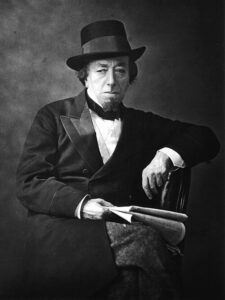
Benjamin Disraeli
- Benjamin Disraeli — novelist, dandy, twice-failed parliamentary candidate, MP for Maidstone, leader of the Young England movement, Chancellor of the Exchequer three times, Leader of the Opposition, and twice Prime Minister — was the most improbable figure ever to reach the summit of Victorian political life: a Jewish-born outsider who baptised himself into the Church of England at twelve, constructed a political identity from sheer force of personality and prose style, and proceeded to reshape the Conservative Party, extend the franchise to the working class, and define a vision of One Nation Toryism that British conservatism is still arguing about.1Britannica — Benjamin Disraeli
- His two premierships — the first a brief minority government of ten months in 1868, the second a commanding majority from 1874 to 1880 — produced the Public Health Act, the Artisans' Dwellings Act, the Trade Union Act, the purchase of the Suez Canal shares, the Royal Titles Act making Victoria Empress of India, the Congress of Berlin at which he returned from Europe claiming peace with honour, and a domestic social reform programme that demonstrated that conservative governance and working-class improvement were not merely compatible but strategically interdependent.2Britannica — Benjamin Disraeli
- The relationship with Queen Victoria — who loathed Gladstone and adored Disraeli, who sent him primroses from Windsor and called him her dear friend — is the most analytically precise illustration of the People variable in the Victorian Political domain: Disraeli understood Victoria as an individual, managed her as a constitutional actor, and deployed her emotional investment in his government as a political resource with a sophistication that no other Victorian politician approached.3Royal.uk — Queen Victoria and her Prime Ministers
Benjamin Disraeli is the most analytically distinctive profile in the Victorian Political domain and the one whose variable profile diverges most sharply from the social conditions that should have produced it. He was an outsider who became an insider by constructing a more compelling version of insiderness than the insiders themselves possessed. The equations capture a leader whose Communication and Vision variables were operating at their ceiling from the beginning, and whose career is the record of those variables gradually overcoming every structural obstacle the Victorian establishment could place in their path.
The formation period is without parallel in the British Political dataset for sheer improbability. Disraeli's early career — three failed parliamentary attempts, crushing debts from disastrous stock speculation, the novels that made his reputation and confirmed establishment suspicion, the dandy affectations that were simultaneously self-invention and self-protection — reflects a Resilience variable being built under conditions of sustained social rejection that would have ended most political careers before they began.1Britannica — Benjamin Disraeli The Conviction variable in this period is analytically remarkable: he continued pursuing political office through repeated failure, public mockery, and financial catastrophe with a certainty about his own eventual success that the external evidence did not support. That Conviction, sustained without institutional backing, is the foundation of everything that followed.
The Young England period of the early 1840s is where the Vision variable first operates at scale. Disraeli's critique of industrialism — that it had severed the organic connection between the aristocracy and the people, producing two nations between whom there was no intercourse and no sympathy — was not merely political rhetoric.4Oxford DNB — Benjamin Disraeli It was a coherent analytical framework, expressed through the novels Coningsby, Sybil, and Tancred, that identified a structural problem in Victorian society and proposed a political solution. The One Nation concept — that conservatism's purpose was to unite rather than divide the classes — was original, durable, and operationally useful in ways that subsequent Conservative leaders demonstrated by adopting it. That is the Vision variable producing output that outlasts the leader.
The destruction of Peel over the Corn Laws repeal in 1846 is the most consequential single parliamentary performance in the Victorian Political domain. Disraeli — a backbencher with no ministerial experience — delivered a sequence of speeches against his own party leader of such sustained forensic brilliance that Peel's authority never recovered.1Britannica — Benjamin Disraeli The Communication variable at this moment is at its absolute ceiling. The analytical complexity is that the substantive case Disraeli made against free trade was weaker than Peel's case for it — he was deploying a Communication variable of exceptional quality in the service of a position the subsequent economic record did not vindicate. The Intent variable records the gap: Disraeli's primary objective was not agricultural protection but the destruction of Peel. He achieved the objective. The justification was instrumental.
The 1867 Reform Act is the canonical analytical centrepiece of the career and the most audacious single piece of parliamentary manoeuvre in the Victorian dataset. Disraeli, as Chancellor in a minority Conservative government, extended the franchise further than Gladstone's Liberal bill of the previous year — enfranchising a million new working-class voters — through a sequence of parliamentary amendments that progressively expanded the bill beyond its original scope while outmanoeuvring the Liberal opposition at every stage.5UK Parliament — Reform Acts The Process variable at this moment is the highest in the profile. Disraeli understood that the Conservative Party's long-term survival required a working-class electoral base, and that the way to build it was to be the party that gave working men the vote. The Adaptability variable is equally high — he moved with the political tide faster and further than his opponents expected, converting a potential defeat into a defining achievement.
The second premiership from 1874 to 1880 is the canonical snapshot and the period of highest sustained output. The social reform programme — Cross's housing legislation, the Public Health Act, the Sale of Food and Drugs Act, the Employers and Workmen Act — was the most substantive Conservative domestic reform agenda between Peel and the twentieth century.2Britannica — Benjamin Disraeli The foreign policy record — the Suez Canal purchase, the Congress of Berlin, the assertion of British imperial interests — reflected a Vision of British global position that Disraeli had articulated since the 1840s and was now in a position to execute. The People variable at this period reflects the Victoria relationship operating at its most productive: she was a constitutional resource he managed with precision, a source of political legitimacy that Gladstone's more distant relationship with the monarch could not match.
The Congress of Berlin in 1878 is the most analytically complex achievement of the second premiership. Disraeli — seventy-three years old, chronically ill, negotiating in French at a multilateral conference with Bismarck, Gorchakov, and the representatives of six great powers — returned with Cyprus, secured the Ottoman territorial settlement Britain required, and delivered the phrase peace with honour that entered the political lexicon.6US State Department — Congress of Berlin The Confidence variable at this snapshot is among the highest in the Victorian Political domain — a man who had spent fifty years being told he did not belong, performing at the highest level of European diplomacy with complete authority. The Resilience variable records the physical dimension: he conducted the Congress while suffering from gout, asthma, and Bright's disease, refusing to allow his physical condition to constrain his diplomatic performance.
The defeat in 1880 — the Midlothian Campaign in which Gladstone's moral assault on Beaconsfieldism produced a Liberal landslide — is the most instructive electoral failure in the profile. Disraeli's foreign policy, which had played well in 1878, had produced the Afghan War and the Zulu War by 1880 — two imperial conflicts that Gladstone converted into a moral indictment of Conservative governance.2Britannica — Benjamin Disraeli The Communication variable, which had been Disraeli's primary instrument throughout his career, was outperformed by Gladstone's moral register in the specific conditions of the 1880 election. The Adaptability variable at this snapshot is lower than at any previous point — Disraeli did not find a register to counter Gladstone's campaign effectively, partly because his own physical decline had reduced the energy available for the attempt.
The number that matters most across all four snapshots is the Communication variable — and its relationship with Vision. Disraeli could articulate where he wanted to go with a clarity and wit that made the destination seem both inevitable and desirable. The One Nation framework, the imperial vision, the working-class Conservative voter — all were Communication achievements before they were policy achievements. A leader whose Communication variable consistently runs ahead of his institutional position, pulling the institutional position upward toward the Communication, is operating the variable in the direction the Leaderment model most rewards. That is the analytical signature of Benjamin Disraeli, and it is the reason the improbable outsider who began with nothing ended as Earl of Beaconsfield.
Score Comparison
Add up to 10 leaders. Click a name to visit their profile.
The 13 Equations
Scores for: Midlothian Defeat and Final YearsThe 22 Variables
Canonical scoresWhat changed: Second Premiership — Social Reform and Berlin → Midlothian Defeat and Final Years
Sources & Bibliography
The scores assigned to this leader are derived from publicly available sources. Variable inputs reflect documented behaviour, structural conditions, and historical record at the time of each snapshot.