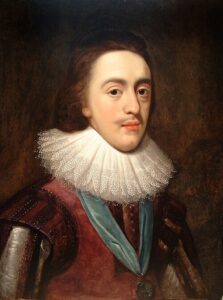
Charles I
Charles I (1600–1649)
- Born on 19 November 1600 at Dunfermline Castle — the second son of James VI of Scotland and Anne of Denmark, a sickly child with a residual stammer who wore ankle braces to strengthen his legs — became heir apparent in 1612 on the death of his elder brother Henry, received a classical education in languages and mathematics, and ascended the throne in March 1625 at twenty-four having spent his formative years in the shadow of a more capable brother and the influence of the Duke of Buckingham, who controlled foreign policy during the last years of James's reign and the first years of Charles's.1Wikipedia — Charles I
- Dissolved Parliament four times in his first four years, dismissed it entirely in March 1629 and governed alone for eleven years — funding the crown through Ship Money, forest fines and forced loans that Parliament had not authorised — appointed William Laud as Archbishop of Canterbury and imposed the Anglican prayer book on Scotland in 1637, triggering the Bishops' Wars that forced him to recall Parliament, accepted the Petition of Right, the execution of Strafford and Laud, the abolition of the Star Chamber and the High Commission under parliamentary pressure2Britannica — Charles I — then in January 1642 entered the House of Commons with armed men to arrest five Members of Parliament who had already escaped, converting a constitutional crisis into a civil war.
- Was defeated at Naseby in June 1645, surrendered to the Scots in May 1646, was handed to Parliament in January 1647, escaped to the Isle of Wight in November 1647, secretly allied with Scotland to restart the war, was defeated again at Preston in August 1648, was tried by the Rump Parliament in January 1649, refused to enter a plea on the grounds that "a king cannot be tried by any superior jurisdiction on earth," was convicted of high treason, and was executed on a scaffold outside the Banqueting House at Whitehall on 30 January 16493Britannica — Charles I Civil War — dying with a composure that contemporaries on both sides acknowledged, and which secured him a posthumous reputation as a martyr that his living governance had entirely failed to earn.
Charles I ruled England from 1625 to 1649 and transformed it — not as he intended, but through the consequences of his failure. The constitutional monarchy that defines British governance today was built on the ruins of his absolutist project. He did not intend this outcome. He did not intend any outcome other than the restoration of a royal prerogative he believed God had granted him and Parliament had no right to diminish. The equations record that this Conviction, operating with near-floor Humility and low Congruence against an environment that had fundamentally changed the relationship between crown and legislature, produced his death as its mathematically predictable output.
The early reign and Personal Rule period is where the mechanism is clearest. Charles's model of kingship was his father's, applied without his father's tactical flexibility. James I had held the same divine right theology but had "tempered it by compromise and consensus," as Britannica records. Charles believed he had no need to compromise or even explain his actions — "Princes are not bound to give account of their actions, but to God alone." This is the Humility variable at near floor expressed as explicit political philosophy: a leader who had constructed a framework that made the receipt of contrary information structurally impossible, because contrary information was by definition sinful. He was not ignorant. He was constitutionally protected from learning.4The Royal Family — Charles I
The Congruence variable is the most damaging across the full profile. He accepted the Petition of Right in 1628 and violated it within months. He made concessions under the Long Parliament and revoked them when he believed he had sufficient military force. He negotiated from captivity at Carisbrooke while secretly concluding the Engagement with Scotland to restart the war. Contemporary parliamentarians knew he could not be trusted because the evidence was comprehensive and consistent. When the Army concluded in late 1648 that "permanent peace was impossible whilst Charles lived," they were recording not a political judgement but an empirical observation based on his documented behaviour across twenty-three years. His Congruence score of 3 throughout reflects this precisely: the gap between what he stated and what he did was not occasional but structural.5Historic UK — Charles I
The Civil War snapshot is the canonical period because it is where the full profile expresses itself most completely. The military campaigns of 1642–45 show a leader with genuine Conviction, moderate Ability in strategic conception, reasonable initial Resources, but catastrophically low Humility and People. His selection of commanders was inconsistent — Rupert's cavalry were operationally brilliant but strategically undisciplined, and Charles could not manage the tension between Rupert's instinct and his own strategic requirements. The New Model Army that defeated him at Naseby in June 1645 was the product of the Parliamentary system he had spent twenty years trying to destroy. The Battle of Naseby is the Process variable: Parliament's institutional capacity to create, finance and discipline a professional army against the king's personal force. The equations record the outcome correctly.
The final period — captivity and execution — is where the profile produces its most analytically interesting variable: his Conviction remained at 10 while every other operational variable had collapsed to near zero. He refused to enter a plea at his trial not from obstinacy but from principle — he genuinely believed no earthly court had jurisdiction over a divinely appointed king. His conduct on the scaffold was composed, dignified and coherent. He said to his chaplain, minutes before he died, "I go from a corruptible to an incorruptible Crown." That is the Conviction variable operating at ceiling with no remaining operational context for it to act on. The equations record a man who died consistent with his beliefs, which is the highest Congruence reading of his entire reign. It came too late to mean anything.6Historic Royal Palaces — Charles I Execution
He was a sensitive man with genuine cultural intelligence. His patronage of Van Dyck and Rubens, his collection of Raphael and Titian, and his creation of the Master of the King's Music are not irrelevant to his profile — they record a Humility in aesthetic reception that was entirely absent from his political cognition. He could recognise greatness in a painting. He could not recognise it in a constitutional argument. The equations do not explain why. They simply record the variable scores that produced the outcome.
Score Comparison
Add up to 10 leaders. Click a name to visit their profile.
The 13 Equations
Scores for: Captivity and Trial — The Martyr KingThe 22 Variables
Canonical scoresWhat changed: Civil War — The King in Arms → Captivity and Trial — The Martyr King
Sources & Bibliography
The scores assigned to this leader are derived from publicly available sources. Variable inputs reflect documented behaviour, structural conditions, and historical record at the time of each snapshot.