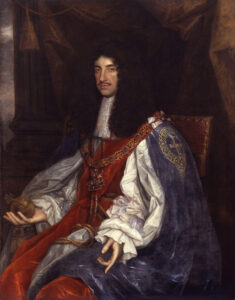
Charles II
Charles II (1630–1685)
- Spent nine years in exile across Europe following his father's execution, escaping the Battle of Worcester in disguise through England before the political system that had displaced him collapsed of its own contradictions — returning to London on his thirtieth birthday to public acclaim, having secured his restoration through the Declaration of Breda, a precise piece of political architecture that promised religious tolerance, parliamentary cooperation and general amnesty.1Wikipedia — Charles II
- Founded the Royal Observatory at Greenwich, the Mathematical School at Christ's Hospital, and the Royal Hospital in Chelsea, personally managed naval officer appointments as documented by Pepys, directed the firefighting effort during the Great Fire of London alongside his brother James,2World History Encyclopedia — Charles II and secretly committed by the Treaty of Dover to announce conversion to Catholicism at an unspecified future date in exchange for French money and military support — while publicly maintaining Anglican observance throughout.1Wikipedia — Charles II
- Dissolved Parliament four times, governed alone for the last four years of his reign on French pension money that gave him the financial independence Parliament had always denied him,3New World Encyclopedia — Charles II and died apologising for being such a time a-dying — receiving into the Catholic Church on his deathbed a man whose actual religious convictions the historical record cannot resolve.4Britannica — Charles II
Charles II is the Royalty domain profile where the gap between reputation and operational reality is widest. The Merry Monarch legend — the mistresses, the wit, the hedonism, the court that Rochester described as scandalous and poor — systematically obscured a leader who personally managed the Royal Navy's officer appointments, founded the Royal Observatory and the Mathematical School at Christ's Hospital, dissolved Parliament four times and governed alone for the last four years of his reign with considerable effectiveness.2World History Encyclopedia — Charles II John Evelyn's verdict — a prince of many virtues and many great imperfections — is the most analytically precise summary in the contemporary record. The equations arrive at the same conclusion by a different route.
The exile period is where the variable profile is established under conditions that would have broken a less resilient leader. Nine years in Europe — France, the Dutch Republic, the Spanish Netherlands — with no money, no reliable army, and no realistic path to the throne until the political system that had displaced him collapsed of its own contradictions.4Britannica — Charles II Resources at their minimum. Environment at its minimum. The equations record what that combination produces in a leader whose Conviction and Humility were both genuine: a score that reflects the structural reality of the situation rather than the personal variable quality. The Declaration of Breda, which secured his restoration by promising religious tolerance, parliamentary cooperation and general amnesty, was a precise piece of political architecture produced by a man who had spent nine years learning what restoration would require.1Wikipedia — Charles II
The early reign period establishes the constitutional pattern that defined his entire kingship. Charles favoured religious tolerance — the historical record is clear that his instincts ran toward indulgence rather than persecution. The Clarendon Code, which established Anglican dominance through a series of restrictive acts, was Parliament's work rather than his, and he acquiesced rather than championed it.1Wikipedia — Charles II That gap between personal preference and institutional outcome is the Congruence variable at a constrained reading — not the deliberate betrayal of stated values but the structural inability of a restored constitutional monarch to impose his preferences against a Parliament that controlled his finances. The Great Plague, the Great Fire — Charles directed the firefighting effort personally alongside his brother James — these are snapshots of a leader whose operational engagement was genuine and whose public profile consistently underrepresented it.2World History Encyclopedia — Charles II
The secret treaties and religious crisis period is the profile's most analytically complex. The Treaty of Dover committed Charles to announcing conversion to Catholicism at an unspecified future date in exchange for French money and military support. He publicly maintained Anglican observance throughout.1Wikipedia — Charles II The Royal Declaration of Indulgence — a genuine attempt at religious tolerance that Parliament forced him to withdraw — was issued in the same year as the Third Anglo-Dutch War he fought as a French ally, which Parliament opposed. The Popish Plot, which Charles privately disbelieved from the outset, produced the execution of innocent men because the political cost of public disbelief was higher than the moral cost of private scepticism.5Britannica — Charles II: Foreign Policy These are not the same as the deliberate cruelty or ideological betrayal that marks lower Congruence scores in other profiles. They are the systematic operation of a leader whose survival instinct consistently prioritised the preservation of his position over the consistent expression of his stated values. The wit and the affability were genuine. The impenetrable reserve that contemporaries noted — especially concerning political agendas — was the mechanism that made the gap sustainable.
The personal rule period is the profile's operational peak and the period that academic historians have most consistently undervalued in favour of the social and cultural narrative. With Parliament dissolved and Louis XIV's pension providing financial independence, Charles governed directly and effectively.3New World Encyclopedia — Charles II The naval management documented by Pepys — decision-making on warship deployment and officer appointments described as wholly performed by the king's immediate direction — is Process and Ability operating at their documented maximum within the structural constraints of constitutional monarchy. His support for Arthur Herbert as Mediterranean commander against the opposition of the Admiralty Board and Pepys — who were rarely allies — was eventually vindicated by Herbert's convoy tactics producing better outcomes than the alternatives. These are the judgements of a competent operational leader, not a decorative figurehead.
The Chaos score across all four snapshots is the most analytically significant constant in the profile. Ego and Pride both moderate and consistent — Charles was not destroyed by identity-threatening vanity. Rochester's couplet — restless he rolls from whore to whore, a merry monarch, scandalous and poor — captures the surface accurately and the mechanism not at all. The reserve that made his political agendas impenetrable was not Pride protecting an identity. It was a constitutionally sophisticated leader who had spent nine years in exile calculating exactly what survival required and never stopped calculating. The mistresses were genuine. So was the laboratory where he spent mornings distilling mercury.6Royal Museums Greenwich — Charles II Both things were true simultaneously, and the equations record both.
He died apologising for being such a time a-dying, and was received into the Catholic Church on his deathbed — whether from genuine conviction, political calculation, or both remains unclear. The ambiguity is characteristic. The equations do not resolve it. They record a leader whose Congruence was consistently the most contested variable in his profile, and whose operational competence was consistently the most undervalued.
Score Comparison
Add up to 10 leaders. Click a name to visit their profile.
The 13 Equations
Scores for: Secret Treaties — Religious CrisisThe 22 Variables
Canonical scoresWhat changed: Early Reign — Parliament → Secret Treaties — Religious Crisis
Sources & Bibliography
The scores assigned to this leader are derived from publicly available sources. Variable inputs reflect documented behaviour, structural conditions, and historical record at the time of each snapshot.