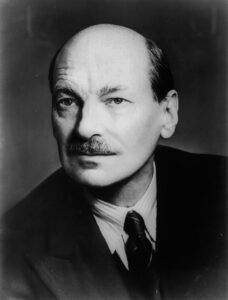
Clement Attlee
Clement Attlee (1883–1967)
- Born in Putney in 1883 into an upper-middle-class family, called to the bar in 1906, abandoned law after volunteering at a settlement house in Limehouse and witnessing the poverty of London's East End — served in Gallipoli, Mesopotamia and France, reaching the rank of Major, then became MP for Limehouse in 1922, Labour leader in 1935, and Deputy Prime Minister under Churchill from 1942 to 1945, running the Lord President's Committee for domestic affairs and — in Churchill's absence — chairing the war cabinet with a decisiveness that its members later recorded with some surprise.1GOV.UK — Clement Attlee
- Won the 1945 general election in a landslide that surprised almost everyone including himself — then in six years created the National Health Service, built the modern welfare state, granted independence to India, founded NATO, nationalised twenty percent of the British economy, and implemented practically every pledge in his party's manifesto2Wikipedia — Clement Attlee — managing simultaneously a cabinet that contained Bevin, Bevan, Cripps, Morrison, Dalton and Gaitskell, each of them a dominant political personality capable of consuming any leader whose ego was sufficiently large to experience them as threats rather than assets.
- Lost office narrowly in 1951 despite winning more votes than the Conservatives, retired from the Labour leadership in 1955, was elevated to the House of Lords, and died in 1967 leaving an estate of £7,2953Britannica — Clement Attlee — subsequently voted the greatest British Prime Minister of the twentieth century by a poll of academic historians, having spent six years running Britain with a Chaos score the equations record as the lowest in the Political domain dataset.
Clement Attlee is the dataset's most complete refutation of the idea that effective leadership requires a large personality. He was described by contemporaries as a mouse, a sparrow, an insignificant elderly clerk. Beatrice Webb wrote in 1940 that realising he was the parliamentary leader of the Labour Party was pitiable. He went on to create the National Health Service, grant independence to India, found NATO, build the welfare state, and be voted the greatest British Prime Minister of the twentieth century by a poll of academic historians. The equations explain the mechanism. The contemporaries were measuring the wrong variables.
The opposition period establishes what Attlee's profile looks like under constraint. The Labour Party he inherited in 1935 was a fractured remnant — decimated in 1931, facing a National Government with an overwhelming Commons majority, operating in an international environment moving inexorably toward catastrophe. Attlee held it together not through inspiration but through the consistent application of what contemporaries called the most selfless leadership they had observed — objective, free of common human weaknesses, loyal to colleagues, and entirely uninterested in what any of it meant for his own position.4Museum of the Prime Minister — Clement Attlee The Chaos score at this period is the lowest in the Political domain dataset. Not because Attlee had no identity, but because his identity was not involved in the decisions he was making.
The Congruence score across all three snapshots sits below what a surface reading of his character would suggest, and the reason is documented. The Palestine policy of his government — the internment of Holocaust survivors in Cyprus camps, the covert operations against refugee ships, and Attlee's sustained personal hostility to Israel years after its establishment — sits in direct contradiction to the stated ethical foundation of a Labour government built on the principle that the state exists to protect the vulnerable. The equations record that gap honestly. It does not collapse the scores because the gap is real but not dominant — the overwhelming majority of his government's actions were consistent with its stated values — but it prevents the profile from presenting a frictionlessly virtuous leader when the historical record says otherwise.
The Deputy Prime Minister period is the most analytically undervalued in his record. Running domestic Britain while Churchill ran the war, Attlee streamlined the machinery of government, abolished redundant committees, and acted as conciliator between Labour and Conservative ministers whose working relationship was under permanent strain.1GOV.UK — Clement Attlee He was, according to those who observed him, able to cut to the heart of a matter, steer meetings to his desired end, and silence over-talkative colleagues — including some of the most formidable political personalities in British twentieth-century history. His pipe was a political tool: lighting it bought time to think when the room was moving too fast. That is Process operating at documented maximum.
The post-war government peak is where the equation outputs are most dramatic and most defensible. The Chaos score remains at its floor throughout a period when Attlee was managing Bevin, Bevan, Cripps, Morrison, Dalton, and Gaitskell simultaneously. Attlee's low Ego made him constitutionally incapable of experiencing capable subordinates as threats. He gave them difficult jobs and left them to do them. Bevan fathered the NHS. Bevin masterminded NATO. Cripps managed the economy. Attlee chaired the meetings and got the agenda through.5Wikipedia — Attlee Ministry
The Defined Output and Intent scores at this period are the highest in his record. The 1945 manifesto was not vague aspiration. It was a specific programme of specific reforms with specific timescales, understood at every level of the government because Attlee had spent the opposition years building the policy architecture that made the programme executable. The transition from opposition to government produced no gap between promise and direction because the direction had been precisely specified before the election was won.1GOV.UK — Clement Attlee
The estate of £7,295 at death is not a footnote. It is a variable score. A man who ran Britain for six years, who had commanded resources that no private individual could approach, who could have leveraged his position into wealth at any point during or after his tenure, died with less money than most senior civil servants. The personal pronoun genuinely did not exist for him. The equations begin with that observation and build outward from it. Everything else follows from a Chaos score at its floor.
Score Comparison
Add up to 10 leaders. Click a name to visit their profile.
The 13 Equations
Scores for: Wartime Deputy — Home Front and BeveridgeThe 22 Variables
Canonical scoresSources & Bibliography
The scores assigned to this leader are derived from publicly available sources. Variable inputs reflect documented behaviour, structural conditions, and historical record at the time of each snapshot.