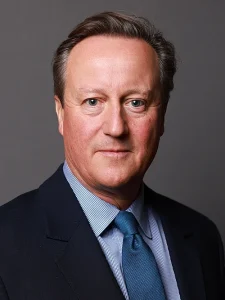
David Cameron
David Cameron (born 1966)
- Born in London to a wealthy family, educated at Eton and Oxford, worked as a Conservative Party special adviser and in media communications before being elected MP for Witney in 2001 — became Conservative Party leader in 2005 at 39, repositioning a party that had lost three consecutive elections as socially liberal and electable1Wikipedia — David Cameron — then formed the first coalition government since the Second World War in May 2010, legalised same-sex marriage against significant opposition within his own party, and in September 2014 won the Scottish independence referendum by 55 percent to 45 percent, preserving the union.
- Won an outright Conservative majority in May 2015 in a result that defied virtually every pre-election poll2Britannica — David Cameron Brexit — then on 24 June 2016, the morning after the Brexit referendum produced a 52 percent Leave result, resigned on the steps of Downing Street, telling the country "I do not think it would be right for me to try to be the captain that steers our country to its next destination" — later writing that he thought about it "every single day" and knew "some people will never forgive me."1Wikipedia — David Cameron
- Returned to public life in November 2023 when Rishi Sunak appointed him Foreign Secretary — requiring him to enter the House of Lords as Lord Cameron of Chipping Norton, as he had resigned his parliamentary seat in 20163EBSCO Research Starters — David Cameron — the most significant post-departure return to frontline politics of any former British Prime Minister since the Second World War, and one that the Foreign Affairs Select Committee's description of his Brexit planning as "an act of gross negligence" made analytically notable.
David Cameron served as Prime Minister of the United Kingdom from 2010 to 2016 — first leading a coalition government with the Liberal Democrats, then winning an outright Conservative majority in 2015 that surprised almost every pollster in Britain. A former PR man and Eton-educated moderniser, he repositioned the Conservative Party as socially liberal, environmentally conscious and electable after three consecutive defeats — and then bet everything he had built on a referendum he did not need to call.
He was not an ideological leader. He was a managerial one — skilled at reading rooms, building coalitions, and projecting a calm authority that the public found reassuring. He legalised same-sex marriage against significant opposition within his own party. He navigated the Scottish independence referendum in 2014, winning the union by a margin that felt comfortable in retrospect but was genuinely uncertain until the final days. He won a majority in 2015 that his own campaign had not fully expected.4Museum of the Prime Minister — David Cameron
None of it survived the morning of 24 June 2016.
The Brexit referendum was not forced upon him. It was his choice — a calculated political gamble designed to neutralise the Eurosceptic wing of his party and see off the UKIP threat. He had run the numbers. He had won Scotland. He believed he would win again. He was wrong in a way that ended his career, reshaped British politics for a decade, and triggered the most sustained period of political instability in modern British history. He resigned before breakfast. He was on a paddleboard within weeks.5NPR — David Cameron Brexit greatest regret
Cameron's Codex profile is a study in the relationship between Pride and catastrophic miscalculation. His Pride score is not extreme by the standards of the leaders in this database — he is not Boris Johnson or Donald Trump. But the specific form his Pride took was the most consequential of any British leader since Suez. He had a model of the world in which he won referendums. Scotland confirmed it. He applied it to Brexit without adequately updating for the difference between the two contests — the nature of the question, the quality of the opposition, the volatility of the electorate, the role of social media, the depth of the Leave movement's grievance.
His Conviction score is consistently low across all three snapshots — not as a criticism but as an accurate description. Cameron believed in winning, in modernising, in pragmatic governance. He did not believe in Brexit or Remain with the kind of Conviction that might have driven a more authentic campaign. His Remain campaign was competent and joyless. His opponents were chaotic and electric. The equations recorded the difference.2Britannica — David Cameron Brexit
His Management score during the coalition years is genuinely high — Process was strong, Defined Output was clear, Administrative Impotence was manageable. The coalition worked because he was good at the mechanics of government. His Leaderment score reflects a leader who was better at managing systems than inspiring them.
The k variable — external volatility — was relatively benign during his coalition years. The financial crisis was inherited, not created. The recovery, slow as it was, happened on his watch. By 2016 k had risen sharply: social media, the European migration crisis, the aftermath of the financial crash, and a Leave campaign whose emotional register he fundamentally misread all contributed to an external environment he could not control and had not fully modelled.
Score Comparison
Add up to 10 leaders. Click a name to visit their profile.
The 13 Equations
Scores for: Coalition and MajorityThe 22 Variables
Canonical scoresSources & Bibliography
The scores assigned to this leader are derived from publicly available sources. Variable inputs reflect documented behaviour, structural conditions, and historical record at the time of each snapshot.