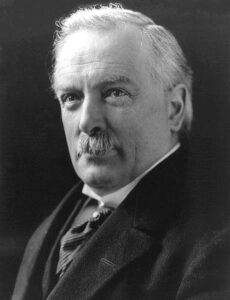
David Lloyd George
- David Lloyd George — son of a schoolteacher, raised by his Welsh shoemaker uncle after his father's early death, solicitor, MP for Caernarfon Boroughs from 1890 to 1945 — the longest continuous parliamentary career of any twentieth-century British politician — President of the Board of Trade, Chancellor of the Exchequer, Minister of Munitions, Secretary of State for War, and Prime Minister from December 1916 to October 1922, rose from Welsh Nonconformist poverty to the summit of British and European power through a combination of forensic oratory, political cunning, and an administrative energy that those who worked with him consistently described as operating at a different metabolic rate from ordinary politicians.1Britannica — David Lloyd George
- His career encompassed the People's Budget of 1909, the National Insurance Act of 1911 — the foundation of the British welfare state — the political destruction of the House of Lords' veto, the strategic direction of Britain through the decisive phase of the First World War as both Minister of Munitions and Prime Minister, the Paris Peace Conference of 1919, the Irish Treaty of 1921, and a post-war coalition government that collapsed at the Carlton Club meeting of October 1922, making him the last Liberal to serve as Prime Minister and the only twentieth-century leader to have both built the welfare state and negotiated a European peace settlement.2Miller Center — Paris Peace Conference
- The private record beneath the public achievement — sustained marital infidelity conducted with minimal concealment, a political style that contemporaries described as combining genius with an almost total absence of scruple, the sale of honours that produced the Honours (Prevention of Abuses) Act 1925, and a relationship with truth that Churchill — who admired him enormously — captured in the observation that he devoted his life to the affairs of state and found time to conduct his own affairs with remarkable energy — is the Congruence variable under its most sustained pressure in the British Political domain, and the variable that most precisely explains both the scale of his achievement and the manner of its ending.3Oxford DNB — David Lloyd George
David Lloyd George is the most purely talented political leader in the British dataset and the one whose variable profile contains the widest gap between operational capability and personal Congruence. He could do things other politicians could not do — negotiate, legislate, inspire, organise, and improvise at a level that made him the indispensable figure in two of the most consequential episodes in modern British history. He could not be trusted in the ordinary sense of that word, and the people who worked most closely with him knew it and worked with him anyway because the alternative was operating without the most capable instrument available. The equations record both facts without resolving the tension between them.
The Welsh formation is analytically essential and consistently underweighted in assessments that treat Lloyd George primarily as a British statesman. He was not British in the cultural sense his contemporaries understood — he was Welsh, Nonconformist, and working class, operating in an institution designed by and for English Anglican landowners and lawyers.1Britannica — David Lloyd George The outsider formation produced the same variable pattern visible in Disraeli — Resilience and Conviction built under conditions of structural exclusion, Communication capability developed in chapel and public meeting rather than at Oxford Union, and an Adaptability born of the necessity of reading rooms and situations that the insider's automatic social fluency did not prepare him for. The difference from Disraeli is that Lloyd George's outsider status was not individual but communal — he carried Wales with him, which gave his political identity a moral dimension that Disraeli's self-invention lacked.
The People's Budget of 1909 is the canonical expression of the Vision and Communication variables operating in combination before Lloyd George held the executive power to match them. The budget — introducing progressive income tax, land value duties, and increased death duties to fund old age pensions and naval rearmament — was not merely a fiscal instrument but a political declaration that the Liberal government intended to use taxation to restructure the relationship between wealth and the state.4UK Parliament — People's Budget The House of Lords' rejection of the budget — constitutionally unprecedented, since the Lords had not rejected a finance bill for two centuries — triggered the constitutional crisis that produced the Parliament Act 1911, stripping the Lords of their absolute veto. Lloyd George provoked that rejection deliberately, understanding that it would produce exactly the constitutional confrontation he needed. The Intent variable at this moment is operating at its ceiling — he wanted the fight, engineered the conditions for it, and won.
The National Insurance Act of 1911 is the most durable domestic achievement of the career and the one that most directly connects Vision to Value across generations. Lloyd George had visited Germany to study Bismarck's social insurance system — a Learning variable operating at its best, going directly to the source of what worked rather than theorising from first principles — and produced a British version that provided health insurance and unemployment insurance to the working population for the first time.5UK Parliament — National Insurance Act 1911 The opposition — from doctors, from insurance companies, from Conservative landowners, and from sections of the working class who resented the contributory principle — was overcome through a combination of political pressure, financial concession, and the Communication variable deployed at full intensity. The NHS that emerged thirty-five years later was built on the institutional architecture Lloyd George constructed.
The Minister of Munitions period from 1915 is where the Process and Defined Output variables reach their highest point in the profile. Lloyd George inherited a shell shortage that was killing soldiers on the Western Front, bypassed the War Office's procurement machinery entirely, created a new ministry from scratch, brought businessmen into government, imposed industrial conscription on munitions factories, and resolved the shortage within months.3Oxford DNB — David Lloyd George The Autonomy variable at this snapshot is lower than the output suggests — Lloyd George was operating within Asquith's coalition and was constrained by cabinet colleagues at every stage — but the Decisiveness variable compensates: he moved faster than the system was designed to move and pulled the system behind him.
The replacement of Asquith in December 1916 is the most analytically complex political manoeuvre of the career and the one that most precisely captures the Congruence variable under pressure. Lloyd George had served in Asquith's cabinet, owed his ministerial career to Asquith's patronage, and proceeded to orchestrate his replacement with a precision that contemporaries described as political assassination.1Britannica — David Lloyd George The analytical case for the manoeuvre is strong — Asquith's management of the war had been inadequate and the strategic situation required a different kind of leadership. The Congruence variable does not adjudicate on whether the cause was just. It records the gap between Lloyd George's stated loyalty to the coalition and his operational behaviour toward its leader. The gap was large and was known to be large by everyone involved.
The wartime premiership from December 1916 to November 1918 is the canonical snapshot and the period of highest sustained output. Lloyd George reorganised the War Cabinet from a body of twenty-three to one of five, imposed the convoy system on an Admiralty that resisted it until the U-boat campaign threatened to starve Britain out of the war, pushed for the unified Allied command under Foch that produced the coordinated offensive of 1918, and sustained public morale through two years of attritional warfare with a Communication capability that the Western Front's grinding reality made extraordinarily difficult to maintain.6Imperial War Museum — Lloyd George and the War The People variable at this period reflects a specific capability: he could work with Haig — whom he privately considered incompetent and publicly could not remove without destabilising the military — while simultaneously building the institutional structures that constrained Haig's autonomy. That is the People variable operating at high sophistication under conditions of maximum institutional friction.
The Paris Peace Conference of 1919 is the most analytically contested achievement of the career. Lloyd George arrived between Wilson's idealism and Clemenceau's punitive realism, and produced a settlement that satisfied neither — too harsh for Wilson's Fourteen Points, too lenient for France's security requirements.7Britannica — Paris Peace Conference Keynes's The Economic Consequences of the Peace — which savaged the settlement and made Lloyd George's pragmatic triangulation look like moral failure — shaped the historical assessment for a generation. The Adaptability variable at Paris is actually among the highest in the profile: Lloyd George read the political constraints accurately and produced what was achievable rather than what was ideal. The subsequent argument is about whether achievable was good enough, which is a Value variable question that the next twenty years answered.
The Irish Treaty of 1921 is the achievement most consistently undervalued in the Lloyd George record. Negotiating with Michael Collins and Arthur Griffith — under the constant threat that Ulster Unionist defection would collapse his coalition government — he produced the Anglo-Irish Treaty that established the Irish Free State, ending eight centuries of direct British rule over most of Ireland.8Britannica — Anglo-Irish Treaty The Decisiveness variable at this moment is at its highest point in the post-war period: Lloyd George moved faster than his coalition partners expected, gave more than his Conservative backbenchers wanted, and produced an agreement that his Ulster Unionist allies considered a betrayal. He judged correctly that the agreement was better than the alternative. The Congruence variable records the methods — threats, deceptions, and the famous remark to Collins that if the Treaty was not signed, terrible and immediate war would follow within three days — without adjudicating on whether they were justified.
The Carlton Club collapse of October 1922 — which appears in the Bonar Law profile as an achievement — is recorded here as the terminal expression of the Congruence variable failure. Conservative MPs voted to end the coalition not primarily because of any specific policy failure but because Lloyd George's style of governance — secretive, personal, improvisational, and unconstrained by conventional political scruple — had exhausted the tolerance of a parliamentary party that had been watching him operate at close range for six years.9Conservative Home — Carlton Club 1922 He never held office again. The Communication and Vision variables remained at their ceiling — his post-coalition speeches and writings demonstrate no decline in intellectual energy — but the institutional trust required to convert those variables into executive power had been consumed.
The number that matters most across all four snapshots is the interaction between Communication and Congruence. Lloyd George's Communication variable is the highest in the British Political domain — higher than Churchill, higher than Disraeli, operating at a register that contemporaries across the political spectrum acknowledged even when they distrusted everything else about him. His Congruence variable is among the lowest of any leader in the domain who achieved sustained high office. The combination produced the welfare state, victory in the First World War, and the Irish Treaty. It also produced the Carlton Club vote and forty years without office after 1922. The equations record both outcomes as products of the same variable profile. That is the Leaderment profile of David Lloyd George.
Score Comparison
Add up to 10 leaders. Click a name to visit their profile.
The 13 Equations
Scores for: People's Budget and Parliament ActThe 22 Variables
Canonical scoresSources & Bibliography
The scores assigned to this leader are derived from publicly available sources. Variable inputs reflect documented behaviour, structural conditions, and historical record at the time of each snapshot.
- Britannica — David Lloyd George biography
- Oxford Dictionary of National Biography — David Lloyd George
- UK Parliament — People's Budget 1909
- UK Parliament — National Insurance Act 1911
- Imperial War Museum — Lloyd George and the War
- Britannica — Paris Peace Conference
- Britannica — Anglo-Irish Treaty
- Conservative Home — Carlton Club Meeting 1922
- Miller Center — Paris Peace Conference