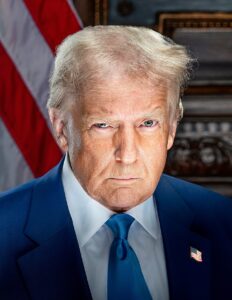
Donald Trump
Donald Trump (born 1946)
- Won the 2016 presidential election against Hillary Clinton in one of the most unexpected upsets in modern democratic history, became the first president in American history without prior public office or military service1Wikipedia — First Presidency of Donald Trump — was impeached twice, the only president in history to receive that distinction — and was convicted on 34 felony counts of falsifying business records in May 2024, the first former or sitting president in American history to be convicted of criminal charges.2Wikipedia — Donald Trump
- Lost the 2020 election to Joe Biden, refused to concede, and was at the centre of the January 6th 2021 Capitol riot when a pro-Trump mob attacked the building and disrupted the certification of the election result — then won the 2024 election and on his first day in office issued a blanket pardon to approximately 1,270 people convicted of offences related to the attack.3Wikipedia — January 6 Capitol attack
- Returned to the White House in January 2025 as the 47th President — only the second in history to serve non-consecutive terms — signing 225 executive orders in his first year, the most of any president in a single year since Franklin D. Roosevelt4Wikipedia — Second Presidency of Donald Trump — deploying the DOGE operation to restructure federal agencies, and arriving with a more consolidated grip on the Republican Party and a more ideologically aligned cabinet than his first term.
Donald Trump served as the 45th and 47th President of the United States, making him only the second president in history to serve non-consecutive terms. Born in Queens, New York, the son of a major real estate developer, he built a global brand through real estate, licensing, and television — most notably as host of The Apprentice from 2004 to 2015.2Wikipedia — Donald Trump He entered politics as an outsider, winning the 2016 presidential election against Hillary Clinton in one of the most unexpected upsets in modern democratic history.
His first term was defined by disruption — trade wars with China, withdrawal from the Paris Climate Agreement, two impeachments, and a pandemic response that remains deeply contested. He lost the 2020 election to Joe Biden, refused to concede, and was at the centre of the January 6th 2021 Capitol riot. Convicted on 34 felony counts in 2024, he nonetheless won the presidency again, returning to the White House in January 2025 with a more consolidated grip on the Republican Party and a more compliant cabinet than his first term.5Britannica — Donald Trump
Trump operates in a deeply polarised America where institutional norms have weakened significantly. His second term began with executive orders at unprecedented scale — dismantling federal agencies, restructuring trade relationships, and deploying Elon Musk's DOGE operation to cut federal spending. He signed 225 executive orders in his first year of the second term, the most of any president in a single year since Franklin D. Roosevelt, many of which were challenged in court.4Wikipedia — Second Presidency of Donald Trump He inherited a system that had spent four years preparing for his return, and arrived with a clearer ideological agenda than in 2016.
In Codex terms, Trump presents one of the most analytically complex profiles in the dataset. His personal variables produce a configuration that is internally consistent but sits outside the normal range for elected democratic leaders. Conviction sits near maximum throughout — his core positions on trade, immigration, and American decline have remained consistent across decades. Visibility is at its ceiling — no leader in the modern dataset has maintained higher sustained public salience. Autonomy is unusually high for an elected leader in his second term, reflecting the consolidation of Republican Party structures around his personal brand.
The Congruence variable is the most analytically significant and the hardest to assess. On one dimension, Trump exhibits unusually high Congruence — he said he would build a wall, renegotiate trade agreements, withdraw from multilateral institutions, and challenge electoral outcomes he considered fraudulent. He attempted all of these. What he said he would do, he pursued. On the other dimension, the documented gap between stated commitments — to the rule of law, to democratic norms, to factual accuracy — and operational behaviour represents one of the widest Congruence gaps in the Political domain dataset. The Codex records both dimensions simultaneously because both are analytically real.
The Pride and Ego variables run at near-maximum throughout the profile. The refusal to concede the 2020 election, the framing of every legal proceeding as persecution, the self-description as the greatest president in American history — these are Pride and Ego variables at their documented ceiling. The equations register what they produce: exceptional electoral force within a fragmented institutional context, and a Chaos score that reflects both the energy those variables generate and the friction they create in every system they encounter.
Score Comparison
Add up to 10 leaders. Click a name to visit their profile.
The 13 Equations
Scores for: Second TermThe 22 Variables
Canonical scoresWhat changed: First Term → Second Term
Sources & Bibliography
The scores assigned to this leader are derived from publicly available sources. Variable inputs reflect documented behaviour, structural conditions, and historical record at the time of each snapshot.