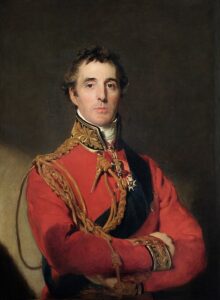
Duke of Wellington
The Duke of Wellington (1769–1852)
- Born Arthur Wesley on 1 May 1769 in Dublin into an Anglo-Irish Protestant family — described by his own mother as "food for powder and nothing more" — educated inadequately at Eton, withdrawn when the family finances collapsed after his father's death, sent to a French military academy at Angers where he learned French and horsemanship, commissioned as an ensign in 17871Britannica — Wellington - and spent the next decade in administrative military roles before his elder brother Richard's appointment as Governor-General of India gave him the operational command in which he discovered what he was.
- Won his first major victory at Assaye in September 1803 — a battle he later ranked above Waterloo as the finest he ever fought — returned to England, entered Parliament, accepted command of the Peninsular campaign in 1808 and spent six years doing what no other commander had managed: consistently defeating Napoleon's marshals across Portugal and Spain through superior logistics, intelligence, defensive positioning and operational patience, driving France out of the Iberian Peninsula by April 18142National Army Museum — Wellington — before commanding the Allied forces at Waterloo on 18 June 1815 and destroying Napoleon's last army in a battle he described afterwards as "the nearest run thing you ever saw in your life."
- Returned from Waterloo as the most celebrated man in Britain, accepted the Prime Ministership in 1828, passed Catholic Emancipation against his personal convictions because the alternative was civil war in Ireland, and then spent four years resisting parliamentary reform with a stubbornness that saw his windows twice smashed by angry mobs and earned him the nickname "the Iron Duke" — not as a compliment3GOV.UK — Wellington — before conceding the Reform Bill in 1832 by absenting himself from the Lords, serving thereafter as Elder Statesman, Foreign Secretary, and finally retiring from politics in 1846, dying at Walmer Castle in September 1852 at eighty-three, his state funeral attended by 1.5 million people.
Wellington is the dataset's clearest example of a leader whose character variables were optimally matched to one environment and catastrophically mismatched to another. The military profile is exceptional across almost every variable. The political profile, driven by identical character variables against a different k, produces a leader rated by his own contemporaries as among the worst Prime Ministers in British history. The equations capture both readings from the same inputs.
The military formation period — India then the Peninsula — is where the operating method was built and refined. Wellington in India learned what military historians have consistently identified as the foundation of his later success: the absolute primacy of logistics, the intelligence-gathering habit that preceded every engagement, the preference for the defensive position chosen to maximise British infantry advantage, and the iron conviction that discipline was the only variable that separated an army from a mob. His contemptuous remark about his own troops — "the scum of the earth, enlisted for drink" — was not cynicism but accurate diagnosis: his achievement was making that material into the finest infantry in Europe.2National Army Museum — Wellington
The Peninsular campaign is the canonical military achievement — not Waterloo, as Wellington himself would have agreed. Six years of sustained excellence against numerically superior forces commanded by Napoleon's best marshals. The key variables at this period: Process at ceiling (the reverse slope defence, the Lines of Torres Vedras, the logistical mastery that kept the army fed while the French starved), People at 9 (his selection and management of subordinate commanders was consistently excellent), Defined Output at 9 (drive the French from the Peninsula — precise, consistent, eventually delivered), Humility at 7 (he adjusted plans constantly in response to intelligence, reversed positions when evidence required, acknowledged tactical errors without ego damage).
The canonical snapshot at Waterloo is where his career reached its public peak. The battle itself — which he described as "the nearest run thing you ever saw in your life" — was not his most technically accomplished engagement but his most consequential. He held the Allied line for seven hours against Napoleon's army while waiting for Blücher's Prussians, using the same reverse slope discipline that had worked throughout the Peninsula, adjusting the line in real time as French pressure found weak points, and committing his reserves at exactly the moment that tipped the balance.4EBSCO Research Starters — Wellington
The political period is where the same variables that won the Peninsula and Waterloo produced a different outcome against a different environment. His Conviction at 9 — unchanged from the military years — was now directed at a framework about political order that the Reform era had rendered obsolete. His Humility that had been 7 on a battlefield, where intelligence about the enemy was empirically available, dropped to 4 in a political environment where intelligence about public sentiment required a completely different kind of receptor than he possessed. He had defeated Napoleon by understanding terrain, supply lines and enemy dispositions with precision. He understood the political terrain of post-Napoleonic Britain almost not at all.
Britannica's observation about him is the most analytically precise contemporary reading: "False pride, however, never prevented him from retreating either on the field or in Parliament." This is the Congruence variable at near ceiling — a leader whose operating principle was duty to the crown and country rather than personal consistency, who would abandon personal positions when the national interest required it. He passed Catholic Emancipation he personally opposed. He abstained on the Reform Bill he had spent four years fighting. He told a king summoning him to form a government in 1834 that Peel must be Prime Minister. These are not the acts of an Ego-driven leader. They are the acts of a man whose Ego and Pride were genuinely subordinated to his conception of service.5Britannica — Wellington Last Years
He died at eighty-three, the longest-lived Prime Minister of the nineteenth century, the last person buried in St Paul's with a full heraldic state funeral. His mother had concluded he was food for powder. He had instead become the man who decided what happened to Europe.
Score Comparison
Add up to 10 leaders. Click a name to visit their profile.