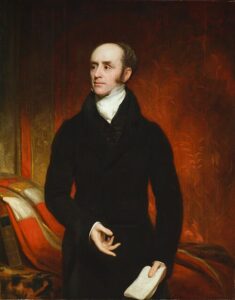
Earl Grey
Earl Grey (1764–1845)
- Charles Grey, second Earl Grey — Northumberland landowner, Whig MP from 1786, leader of the Foxite Whigs, First Lord of the Admiralty, Foreign Secretary, Leader of the Opposition for nearly two decades, and Prime Minister from November 1830 to July 1834 — spent forty years in parliamentary opposition advocating parliamentary reform before the political conditions finally aligned to make it possible, and in two years of premiership passed the Great Reform Act of 1832, the Slavery Abolition Act of 1833, and the Factory Act of 1833 — a legislative record that, measured by long-run constitutional and humanitarian consequence, ranks among the most significant of any British Prime Minister.1Britannica — Earl Grey
- The Reform Act of 1832 — redistributing parliamentary seats from rotten boroughs to the new industrial cities, extending the franchise to middle-class property owners, and establishing the principle that the House of Commons derived its legitimacy from a representative rather than a proprietary relationship with the electorate — did not produce democracy in the modern sense but created the institutional framework through which subsequent reform was possible, establishing a constitutional precedent that every subsequent extension of the franchise built upon.2UK Parliament — Reform Act 1832
- The Slavery Abolition Act of 1833 — passed through a Parliament in which West Indian plantation interests retained significant representation, compensating slave owners rather than the enslaved and providing a four-year apprenticeship period that delayed full emancipation — is the most analytically contested achievement of the premiership: an act that ended legal slavery across the British Empire while simultaneously demonstrating the limits of what the political system of 1833 could deliver and to whom it considered itself accountable.3UK Parliament — Abolition of Slavery
Earl Grey is the most instructive profile in the British Political domain on the subject of patience as a leadership variable — specifically on what happens when a leader holds a correct position for forty years against institutional resistance, outlasts the resistance, and then executes within a two-year window with a precision that the waiting period alone made possible. The equations capture a leader whose operational variables were mid-range throughout most of his career and whose Value output in the premiership was disproportionately large relative to those variables — because the position had been correctly held for long enough that the institutional conditions eventually aligned with it.
The formation period establishes the variable baseline that the entire subsequent career reflects. Grey entered Parliament in 1786 as a Foxite Whig — committed to parliamentary reform, Catholic emancipation, and the extension of civil liberties in a Parliament dominated by interests that opposed all three.1Britannica — Earl Grey The early career contained one significant personal scandal — a prolonged affair with Georgiana, Duchess of Devonshire, which produced a daughter he acknowledged — but did not derail the political trajectory in the way that equivalent conduct damaged Lloyd George. The Conviction variable from the outset is analytically high — Grey's commitment to parliamentary reform was not tactical positioning but a genuinely held constitutional view that he maintained through twenty years of Tory dominance when the prospect of enacting it was essentially zero.
The long opposition period from the 1790s to 1830 is the most analytically significant phase of the career precisely because nothing of conventional political consequence happened in it. Grey led the Foxite Whigs after Fox's death in 1806, served briefly as Foreign Secretary, and spent the remainder of the period watching a political landscape in which reform was associated with Jacobinism, revolution, and the threat of social disorder that the French Revolutionary and Napoleonic wars had made the dominant political anxiety of the governing class.4Oxford DNB — Earl Grey The Resilience variable in this period is among the highest in the British Political dataset — not dramatic resilience in the face of personal crisis, but the sustained, unglamorous maintenance of a political position through decades of structural unreceptiveness. The Learning variable is equally significant: Grey watched the failures of previous reform attempts, understood the constitutional mechanisms that would be required to overcome Lords resistance, and arrived at the premiership with a precise understanding of how the Reform Act needed to be constructed to succeed.
The 1830 election and the political crisis that produced the Whig government are the k variable operating at its most consequential. The July Revolution in France, the death of George IV and the accession of William IV, the agricultural distress producing the Captain Swing riots, and the collapse of Wellington's government on a confidence vote created a political environment in which parliamentary reform had moved from a Whig minority position to a political necessity that the governing class could no longer resist.5Britannica — Reform Bill Grey had not created these conditions. He had waited for them with a patience that most political careers cannot sustain, and arrived at the premiership with the clarity of purpose that forty years of consistent advocacy had produced.
The Reform Act campaign from 1831 to 1832 is the canonical snapshot and the most analytically precise expression of the Process and Decisiveness variables in the profile. The bill was introduced in March 1831, defeated in committee, and Grey called a general election on the reform question — winning a landslide majority that demonstrated the political demand for reform was genuine and substantial.2UK Parliament — Reform Act 1832 The Lords rejected the bill twice. Grey threatened to create sufficient new Whig peers to pass the bill through the Lords — a constitutional nuclear option that the King reluctantly agreed to hold in reserve — and the threat alone was sufficient to produce enough abstentions among Tory peers to allow the bill to pass. The Decisiveness variable at this moment is at its highest point in the profile: Grey identified the one mechanism available to overcome Lords resistance and deployed it with sufficient credibility to make its actual use unnecessary. That is Decisiveness operating at its most sophisticated — the threat that works because it is believed, which requires the Conviction variable to have been consistent enough that opponents cannot doubt it.
The Slavery Abolition Act of 1833 requires explicit treatment in the Value variable. The Act ended legal slavery across the British Empire — an achievement of genuine moral consequence — while compensating slave owners twenty million pounds, an amount that represented forty percent of the Treasury's annual expenditure, and imposing the apprenticeship system that required the formerly enslaved to continue working for their former owners for up to six years without full wages.3UK Parliament — Abolition of Slavery The compensation and apprenticeship provisions reflect the political constraints of what the 1833 Parliament could deliver — but they also reflect a conception of whose interests the political system considered itself accountable to that the Value variable cannot ignore. The Act scores high on Value for the global anti-slavery movement and for the principle it established. It scores considerably lower on Value for the people whose freedom it made contingent on continued unpaid labour and whose suffering it monetised in the direction of their oppressors.
The Factory Act of 1833 — limiting the working hours of children in textile factories and establishing the first factory inspectorate — is analytically the most undervalued achievement of the premiership.6UK Parliament — Factory Act 1833 It passed in the same parliamentary session as the Slavery Abolition Act, received considerably less contemporary attention, and established the principle of state inspection of private industrial practice that subsequent health and safety legislation built upon. The Defined Output variable at this snapshot is among the highest in the Victorian Political domain — three Acts of transformative consequence passed within two parliamentary sessions, each with a clear and measurable outcome.
Grey's resignation in July 1834 — over an Irish coercion bill that split his cabinet — reflects a Humility variable operating correctly at the end of a premiership rather than a failure of will.1Britannica — Earl Grey He had achieved what he came to do. The Reform Act had passed, slavery had been abolished, the factory inspectorate was in place. He was seventy years old and had been in political life for forty-eight years. The Adaptability variable at resignation reflects a leader who understood that the moment for his particular contribution had passed and did not attempt to extend it beyond its natural term.
The number that matters most across all three snapshots is Conviction — specifically its duration. Grey held the same constitutional position on parliamentary reform for forty years through a political landscape in which holding it produced no advancement and considerable professional cost. When the environment finally moved into alignment with that position, he was the only leader available who had both the credibility of having held it consistently and the institutional knowledge of how to execute it. That combination — long Conviction meeting a brief window of environmental alignment — is the rarest variable interaction in the British Political dataset. It produced the constitutional foundation of modern British democracy in two parliamentary sessions. That is the Leaderment profile of Earl Grey.
Score Comparison
Add up to 10 leaders. Click a name to visit their profile.
The 13 Equations
Scores for: Reform Act Campaign and Royal CrisisThe 22 Variables
Canonical scoresWhat changed: Long Opposition — Foxite Whig Leadership → Reform Act Campaign and Royal Crisis
Sources & Bibliography
The scores assigned to this leader are derived from publicly available sources. Variable inputs reflect documented behaviour, structural conditions, and historical record at the time of each snapshot.