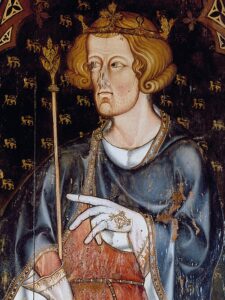
Edward I
Edward I (1239–1307)
- Born on 17 June 1239 at Westminster — the eldest son of Henry III and Eleanor of Provence, named after Edward the Confessor in an unusual choice for Norman aristocracy — came of age during the Barons' Wars, fought at Lewes where his impetuous pursuit of the Londoners contributed to his father's defeat, escaped captivity, won decisively at Evesham in 1265 where Simon de Montfort was killed, joined the Ninth Crusade in 1270, was wounded by a poisoned dagger at Acre, and returned to find himself king — ascending the throne in 1272 at thirty-three with more military and political experience than any English king since the Conquest.1Wikipedia — Edward I
- Spent the first twenty years of his reign building the most sophisticated legal and administrative structure England had yet seen — the Statutes of Westminster I (1275) and II (1285), Gloucester (1278), Mortmain (1279) and Quia Emptores (1290) codifying common law and curbing baronial abuses — convened the Model Parliament of 1295 including knights and burgesses alongside nobles and clergy, completed the conquest of Wales in 1283 following Llywelyn ap Gruffudd's death and built the great castle ring at Caernarfon, Conwy and Harlech to hold it2Britannica — Edward I — and in 1290 issued the Edict of Expulsion removing the entire Jewish community from England, the longest-lasting expulsion of Jews from any European country in the medieval period.
- Invaded Scotland in 1296 following John Balliol's defiance, removed the Stone of Scone to Westminster, and discovered that Scotland — unlike Wales — would not be conquered: William Wallace's rebellion, the victory at Stirling Bridge, Edward's counter at Falkirk in 1298, Wallace's capture and execution in 1305, Robert the Bruce's renewed campaign — the Scottish war consumed the last eleven years of his reign, exhausted his treasury, forced domestic crisis in 1297 when barons and clergy refused to fund further campaigns, and ended only with his death on 7 July 1307 at Burgh by Sands, his army marching north again, his body directed per his request to be carried on Scottish campaigns.1Wikipedia — Edward I
Edward I reigned England from 1272 to 1307 and built more of the structural architecture of English governance than any monarch between Henry II and the Tudor reformers. He codified common law through a legislative programme of unprecedented ambition, established Parliament as a functional institution of taxation and counsel, completed the conquest of Wales, and died attempting to do the same to Scotland. The equations record the achievement and the mechanism of its partial undoing simultaneously.
The formation period is analytically significant for what it reveals about his operating method. Edward at Lewes made the mistake that Pride at 7 predicts — pursuing the Londoners off the field while his father's centre collapsed. He learned from it. At Evesham he commanded with systematic discipline rather than personal impulse, encircled de Montfort, and won decisively. The Crusade added strategic patience to what had been a volatile temperament. The man who returned from Acre in 1274 was more correctable than the one who had fought at Lewes — and the legal reforms that followed were the product of that corrected operating model.3EBSCO Research Starters — Edward I
The canonical period is where the Process variable reaches its ceiling. The great statutes of 1275 to 1290 — drafted largely with his Chancellor Robert Burnell — are the most systematic legislative programme in medieval English history. They did not innovate so much as codify: defining existing custom, standardising procedure, curbing baronial and ecclesiastical franchise abuse, and establishing jury trial as the mechanism of royal justice across the kingdom. Britannnica's description — "conservative and definitory rather than original" — understates their operational significance. A law that is consistently enforced is more valuable than an innovation that is not. Edward's statutes were enforced because the administrative machinery he built alongside them was capable of enforcing them.2Britannica — Edward I
The Model Parliament of 1295 is the Process variable at its most constitutionally significant. Edward summoned it primarily to raise taxes for his wars — a pragmatic rather than idealistic motivation. The inclusion of knights and burgesses alongside nobles and clergy established the principle that taxation required the consent of those taxed across the social spectrum. He did not intend to constrain royal authority. He created the institution that would eventually do so. This is the same pattern as Henry II's common law: the leader building institutional architecture that outlives and eventually limits the power that built it.
The Value variable at canonical is contested and the Codex handles the contest honestly. The legal reforms are genuine civilisational contributions — the Statute of Quia Emptores from 1290 was still being cited in English property law in the twentieth century. Against this must be set the 1290 Edict of Expulsion: an entire community removed from England through a combination of medieval antisemitism and financial calculation, the Jewish community's assets confiscated to fund Edward's campaigns. The Value variable cannot record the legal achievements without recording the expulsion alongside them, and the net score reflects both.1Wikipedia — Edward I
The late period is where Britannica's observation becomes analytically precise: with Eleanor of Castile dead in 1290 and Burnell dead in 1292, Edward lost the two advisers who had functioned as external correctors of his operating model. The Humility variable drops. The autocratic temper that Britannica records runs without restraint. The Scottish campaign, begun in 1296 with the confidence that it would replicate the Welsh conquest of a decade earlier, ran into a structural miscalculation: Scotland was not Wales. Its capacity for sustained resistance, its alliance with France, and its geography defeated a strategy that had worked precisely because Wales lacked all three. The People variable records the misread — he never corrected his model of Scottish capacity even as the evidence accumulated across eleven years.3EBSCO Research Starters — Edward I
The domestic crisis of 1297 — barons and clergy refusing to fund further campaigns, Edward forced to reconfirm Magna Carta to obtain money — is the most significant constitutional constraint on any English medieval king since John. The Autonomy variable drops at the late snapshot. The man who had governed with such sureness for twenty years found himself governing against a country exhausted by his wars and unconvinced of their necessity.
He died marching north. The Stone of Scone was in Westminster. Scotland was not. His tomb inscription — Scottorum Malleus — was written by someone who did not understand that an anvil that does not break is not hammered but merely struck.
Score Comparison
Add up to 10 leaders. Click a name to visit their profile.
The 13 Equations
Scores for: Scottish Wars and Overextension — The Final CampaignsThe 22 Variables
Canonical scoresWhat changed: The Great Statutes — Model Parliament and Welsh Conquest → Scottish Wars and Overextension — The Final Campaigns
Sources & Bibliography
The scores assigned to this leader are derived from publicly available sources. Variable inputs reflect documented behaviour, structural conditions, and historical record at the time of each snapshot.