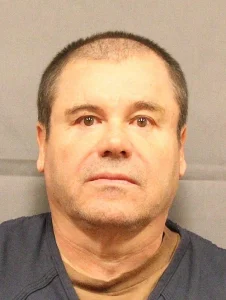
El Chapo
Joaquín "El Chapo" Guzmán (1957–present)
- Joaquín Archivaldo Guzmán Loera — born in the rural poverty of La Tuna, Badiraguato, in the Sierra Madre mountains of Sinaloa, the son of a poppy farmer, school dropout at fifteen, early apprentice to regional drug traffickers, logistics coordinator for the Guadalajara Cartel, co-founder of the Sinaloa Cartel, and the most wanted criminal in the world for the better part of three decades — built the largest drug trafficking organisation in history from a subsistence farming background in one of Mexico's poorest municipalities, making him the most operationally successful criminal leader in the dataset by measurable market share and organisational longevity.1Britannica — El Chapo
- His organisation at peak operation controlled an estimated forty to sixty percent of all drug imports into the United States, operated distribution networks across more than fifty countries, generated revenues estimated between three and thirty-nine billion dollars annually, survived two Mexican federal prison escapes — the second through a mile-long tunnel equipped with a motorcycle on rails — two decades of pursuit by Mexican and American law enforcement, and the internal violence of cartel competition that eliminated most of his contemporaries, before his final capture in 2016 and conviction in New York in 2019 on ten counts including drug trafficking, murder conspiracy, and money laundering.2DEA — El Chapo Sentenced
- The variable profile that produced this record — exceptional operational intelligence, a People capability that combined violent enforcement with genuine loyalty cultivation, a Process sophistication that industrialised drug smuggling through infrastructure investment that legitimate logistics companies would recognise, and a Value score at the absolute floor — is the clearest case in the Criminal domain of the Hitler and Mussolini analytical problem: high operational variables in the complete absence of Value do not produce leadership in any meaningful sense, they produce the most efficient possible mechanism for the specific catastrophe the organisation is designed to deliver.3Britannica — El Chapo
Joaquín Guzmán is the benchmark profile in the Criminal domain and the one that most precisely tests the Leaderment model's treatment of operational effectiveness in the service of catastrophic Value outcomes. The equations do not celebrate him. They record the variable profile that made him possible — and in doing so, demonstrate why the model requires Value to be a multiplier rather than an addendum.
The formation period is defined by the specific geography and economy of the Sierra Madre mountains — a region where poppy cultivation was the primary cash economy, where the Mexican state was effectively absent, and where the trafficking organisations that replaced it offered the only available pathway from subsistence poverty to material security.1Britannica — El Chapo The k variable at this snapshot is analytically unusual — fortune in the conventional sense was absent, but the structural conditions of Sinaloa in the 1970s produced a specific kind of formation advantage: early immersion in the operational culture of drug trafficking at a granular level, direct exposure to the logistics, the violence, and the relationship management that the industry required, and a Learning variable that operated without institutional constraint on what could be learned or from whom. Guzmán entered the Guadalajara Cartel as a logistics coordinator — a role that gave him direct operational knowledge of supply chains, border crossing points, and the corruption management that kept both functioning.
The Guadalajara Cartel period under Miguel Ángel Félix Gallardo established the operational baseline. Guzmán's specific contribution — developing more efficient border crossing methods, building relationships with the Colombian cocaine suppliers that the Mexican cartels were beginning to displace as primary US distribution networks, and demonstrating a Process capability that the existing organisation recognised and promoted — reflects the Ability and Process variables operating at high efficiency within an existing institutional framework before he had the autonomy to apply them independently.4InSight Crime — El Chapo and the Sinaloa Cartel The People variable in this period records a specific and consistent pattern: Guzmán cultivated personal loyalty through a combination of genuine generosity to those who served him well and the credible threat of catastrophic violence toward those who did not. Both instruments were deployed consistently and were understood to be consistent by everyone within the organisation, which is the operational definition of a high-functioning People variable in a context where legal enforcement mechanisms are unavailable.
The Sinaloa Cartel's construction from the early 1990s is the canonical organisational achievement of the career. Following the Guadalajara Cartel's fragmentation after Félix Gallardo's arrest in 1989, Guzmán and his partners constructed an organisation whose structural design reflected a specific and analytically sophisticated set of principles: federated rather than hierarchical, with affiliate organisations maintaining operational independence while sharing infrastructure, corruption networks, and the Sinaloa brand's implicit guarantee of reliability to suppliers and distributors.2DEA — El Chapo Sentenced The Process variable at this snapshot is among the highest in the Criminal domain — the tunnel infrastructure alone, which involved engineering, logistics, and corruption management at industrial scale, reflects a Process capability that most legitimate construction organisations would struggle to replicate under the operational constraints Guzmán faced.
The corruption management operation is the most underanalysed element of the organisational model. Guzmán's organisation did not merely bribe officials — it constructed systematic corruption relationships with law enforcement, judiciary, military, and political figures at every level of the Mexican state, creating an institutional environment in which the cartel's operations were partially integrated into the formal structures of the state rather than merely tolerated by them.5InSight Crime — Sinaloa Cartel Corruption The People variable at the canonical snapshot records this as a high score specifically because of the sophistication of the relationship management — understanding what each official required, what they feared, and what the organisation needed from them, and calibrating the offer accordingly. That is the same variable capability that LBJ deployed in the United States Senate, operating in a radically different institutional context in the service of radically different ends.
The two prison escapes are the most visible expressions of the organisational capability in the public record. The 2001 escape from Puente Grande — in a laundry cart, according to the most popular account, though the precise mechanism is disputed — and the 2015 escape from El Altiplano through a mile-long air-conditioned tunnel equipped with a modified motorcycle on a rail system reflected an organisation that maintained sufficient operational capacity, corruption penetration, and engineering resource to construct a covert infrastructure project inside a maximum-security federal prison.1Britannica — El Chapo The Defined Output variable at these moments is at its ceiling — a complex operation with a single measurable success criterion, executed against formidable institutional resistance, delivered on time. The Vision variable records the same moments from a different analytical angle: a leader who understood that his own continued freedom was the primary operational variable the organisation required to function, and invested accordingly.
The Arellano Félix conflict, the Beltrán Leyva split, and the sustained competition with the Zetas reflect the Competition variable operating at its most hostile across the canonical period. Guzmán survived each conflict through a combination of military capability, alliance management, and a willingness to escalate violence to levels his opponents could not sustain — not because he was more brutal in absolute terms but because his organisation's deeper resource base and more sophisticated logistics allowed him to absorb losses that would have been terminal for a less capitalised competitor.4InSight Crime — El Chapo and the Sinaloa Cartel The Resilience variable across all snapshots is among the highest in the Criminal domain — he was arrested, escaped, recaptured, escaped again, and continued operating the organisation through periods of personal captivity that most leaders could not have survived institutionally.
The New York trial and conviction in February 2019 produced testimony that documented the operational detail of the organisation with a granularity that the academic and law enforcement literature had not previously achieved.6US Department of Justice — El Chapo Sentencing Witnesses described a leader who personally directed violence, maintained detailed operational knowledge of distribution networks across dozens of countries, cultivated relationships with Colombian and other supplier organisations at the most senior levels, and managed a financial operation of sufficient sophistication to move billions of dollars through legitimate business structures without detection for decades. The Ability variable at the canonical snapshot reflects all of this — not because the activity was admirable but because the operational execution was genuinely at the high end of what the Criminal domain records.
The Value variable scores at the absolute floor across every snapshot. The Sinaloa Cartel's operations contributed directly to the deaths of tens of thousands of people in Mexico's drug wars, the addiction and overdose deaths of hundreds of thousands of Americans and others who consumed the substances it distributed, and the corruption of Mexican state institutions at a scale that has not yet been fully repaired.2DEA — El Chapo Sentenced The organisation was not a neutral logistics provider — it was the supply chain for a market whose primary output was human suffering at industrial scale. The Value variable does not require the leader to have intended the suffering. It records the suffering as the output of the system the leader built and ran.
The number that matters most across all four snapshots is the ratio between the Process variable and the Value variable. Guzmán built one of the most sophisticated organisational processes in the Criminal domain dataset — tunnel engineering, corruption management, federated distribution networks, financial concealment infrastructure — in the service of a Value score at the absolute floor. That ratio is the analytical signature of El Chapo, and it is the clearest illustration in the Criminal domain of why the model is designed the way it is. A high Process score multiplied by a floor Value score does not produce a successful leader. It produces the most efficiently delivered catastrophe the organisation is capable of generating.
Score Comparison
Add up to 10 leaders. Click a name to visit their profile.
The 13 Equations
Scores for: Guadalajara Cartel — Formation and LogisticsThe 22 Variables
Canonical scoresSources & Bibliography
The scores assigned to this leader are derived from publicly available sources. Variable inputs reflect documented behaviour, structural conditions, and historical record at the time of each snapshot.