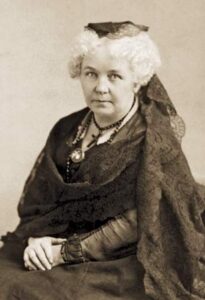
Elizabeth Cady Stanton
Elizabeth Cady Stanton 1815-1902
- Co-founded the National Woman Suffrage Association in 1869, served as its president for twenty years, and served as the first president of the merged National American Woman Suffrage Association until 1892 — leading an organised political campaign with national membership, a published journal, congressional testimony, state-by-state lobbying and formal delegate structures across more than two decades, making the NWSA the primary strategic vehicle for American women's suffrage and the intellectual framework that ultimately produced the Nineteenth Amendment in 1920, eighteen years after her death.1Wikipedia — Elizabeth Cady Stanton ↗
- Authored the Declaration of Sentiments at the 1848 Seneca Falls Convention — modelling it explicitly on the Declaration of Independence and asserting that 'all men and women are created equal' — producing the foundational document of the American women's rights movement and the first systematic public demand for women's suffrage in the United States; then drafted the federal suffrage amendment in 1878 that was introduced in every Congress thereafter until ratification in 1920.2Britannica — Elizabeth Cady Stanton ↗
- Led the women's rights movement for fifty years in a partnership with Susan B. Anthony in which Stanton was the primary intellectual architect — writing the speeches Anthony delivered, drafting the petitions and legislative arguments, producing the first three volumes of the History of Woman Suffrage, and articulating the philosophical foundations of the movement — while managing a household of seven children that severely constrained her freedom to travel and organise in the way that Anthony, unmarried, could do.3NWHM — Elizabeth Cady Stanton ↗
Elizabeth Cady was born on 12 November 1815 in Johnstown, New York, the daughter of a prominent judge and congressman, studied law in her father's office but was refused admission to the bar because she was a woman, attended Emma Willard's Troy Female Seminary, graduated in 1832, and spent the following decade acquiring a legal and philosophical education that convinced her the discrimination she observed in law, property rights and education was systematic, deliberate and remediable.1Wikipedia — Elizabeth Cady Stanton ↗ She married the abolitionist Henry Brewster Stanton in 1840, attended the World Anti-Slavery Convention in London where women were refused seats, and organised the Seneca Falls Convention in 1848 — at which she introduced the Declaration of Sentiments and persuaded a convention that was initially sceptical to adopt a resolution calling for women's right to vote. The analytical profile of Elizabeth Cady Stanton raises a precise question about what the Defined Output variable should capture for a leader whose output was not achieved in her lifetime. She spent fifty years building the intellectual, organisational and political infrastructure for a specific legislative outcome — the Nineteenth Amendment — that was ratified eighteen years after her death. She knew she would not live to vote. She pursued the output anyway.2Britannica — Elizabeth Cady Stanton ↗ The equations handle this in the same way they handle Herzl, whose state was also established after his death: the Defined Output scores at its ceiling, and the Defined Output was delivered — eventually — by the institutional infrastructure she built. The Conviction and Congruence variables score at their ceiling throughout her career. Stanton was not an advocate who softened her position when it became politically inconvenient. When the Fifteenth Amendment was passed in 1870 giving Black men the right to vote without extending the franchise to women, she opposed it — a position that created a permanent rift with some of her abolitionist allies and led her to found the NWSA as a separate organisation from the more accommodating American Woman Suffrage Association.4Wikipedia — NWSA ↗ This was not political calculation. It was principled consistency with the position she had first articulated at Seneca Falls: equal rights must be universal, not incremental and selective. The Codex framework records this as a Congruence and Conviction strength, while noting the Reputation and Environment consequences of the position. The Environment variable scores at the lower end of the scale throughout her career — reflecting the structural conditions of mid-nineteenth-century America for a woman attempting to lead a political organisation — but the Ability and Process variables reflect a leader who operated with maximum sophistication within those constraints. She could not personally deliver speeches across the country because she was raising seven children. She wrote the speeches that Anthony delivered. She could not attend congressional sessions regularly. She drafted the legislative arguments that others presented. She worked within the constraints of her environment without accepting those constraints as permanent. The Woman's Bible, published in 1895, in which she systematically challenged the Biblical basis for the inferior status ascribed to women, caused a rift with the NAWSA that formally censured her for it. The Congruence variable in her late career snapshot registers this: her intellectual consistency was absolute, but her willingness to say things that fractured the coalition she had spent decades building raises a legitimate analytical question about whether conviction that damages the institution you built scores as a Congruence strength or a leadership failure. She died on 26 October 1902. The Nineteenth Amendment was ratified in 1920.
Score Comparison
The 13 Equations
Scores for: NAWSA Presidency and The Woman's Bible — Late CareerThe 22 Variables
Canonical scoresWhat changed: NWSA — Suffrage Movement Peak Leadership → NAWSA Presidency and The Woman's Bible — Late Career
Sources & Bibliography
The scores assigned to this leader are derived from publicly available sources. Variable inputs reflect documented behaviour, structural conditions, and historical record at the time of each snapshot.