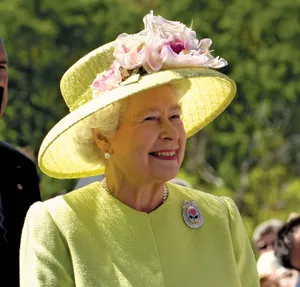
Elizabeth II
Elizabeth II (1926–2022)
- Britain's longest-reigning monarch, on the throne for 70 years and 214 days1Wikipedia — Elizabeth II — meeting fourteen US presidents, five popes, and more than 170 prime ministers across her realms,1Wikipedia — Elizabeth II making the first state visit to the Republic of Ireland by a British monarch since its independence in 1921,1Wikipedia — Elizabeth II and being described by the UN Secretary-General in 2010 as an anchor for our age.
- On her 21st birthday in 1947, declared before the Commonwealth that her whole life, whether long or short, shall be devoted to service.2Library of Congress — Elizabeth II She kept that commitment without visible deviation for seventy years — renewing the same pledge in her Platinum Jubilee accession message in 2022.
- Held no executive power, commanded no army, and could not act without ministerial advice — and yet was, for seven decades, one of the most influential individuals on the planet. The gap between those two statements is the analytical story of her reign.
Elizabeth II presents the Codex with its most analytically unusual profile. She held no formal power. She commanded no army, controlled no budget, and could not act without ministerial advice. The Autonomy and Resources variables reflect this with scores among the lowest for any serving head of state in this dataset. And yet she was, for seven decades, one of the most influential individuals on the planet. The gap between those two statements is the analytical story of her reign — and the clearest illustration in this dataset that influence and formal power are not the same variable.
Her influence operated entirely through soft power: presence rather than instruction, continuity rather than direction, symbol rather than policy. Three-quarters of Australia's population turned out to see her on her first tour.3Britannica — Elizabeth II Brian Mulroney credited her as a behind-the-scenes force in ending apartheid. Australian referendums on republicanism were deferred for decades because of her personal standing. The 2011 state visit to Ireland — the first by a British monarch — was a diplomatic act of considerable consequence delivered entirely through presence and symbolism.1Wikipedia — Elizabeth II None of this required a single executive order. All of it was real.
The Congruence score is the foundation of everything else. In a broadcast on her 21st birthday in 1947, she pledged that her whole life, whether long or short, would be devoted to service.2Library of Congress — Elizabeth II She kept it. Seventy years later, in her Platinum Jubilee accession message, she renewed exactly the same commitment she had made as a young woman in South Africa. No other leader in this dataset made a public promise of that scope and held it without visible deviation for that length of time. The say-do gap that defines so many profiles in this dataset is simply absent.
The Ego and Pride scores are correspondingly low. She published no memoirs. She conducted almost no interviews. She expressed no political opinions in public across seventy years of some of the most turbulent politics in British history.1Wikipedia — Elizabeth II When Harold Macmillan wrote of her in 1961 that she loved her duty and meant to be a queen, he was not describing ambition. He was describing something rarer — a person who had genuinely subordinated self to role, and found that sufficient. The Chaos variable sits at its floor as a result. The equations reward this structurally: low Chaos in the denominator of the Leadership equation produces high Leadership scores regardless of what the numerator contains.
The Conviction variable requires careful reading in her context. She held no ideological conviction in the conventional sense — she expressed no politics, championed no cause, advocated no policy. What she held instead was conviction about the role itself: its requirements, its constraints, its continuity. This held through Suez, through the Wilson and Thatcher years, through the annus horribilis of 1992, through the Diana crisis of 1997, through Andrew's catastrophic association with Jeffrey Epstein, through her grandson's public departure from the institution.3Britannica — Elizabeth II She never wavered on what the role required of her. That is Conviction, even if its object was the monarchy rather than a political programme.
The Diana crisis of 1997 is the single moment where the variables were genuinely tested. The five days of silence at Balmoral, the failure to fly a flag at half-mast, the public fury — these were read at the time as a failure of Congruence. A woman who claimed to serve her people was visibly absent when her people needed to see her.3Britannica — Elizabeth II The subsequent broadcast, the return to London, the walkabout — these were either a rare exercise of genuine Humility in updating her position in response to evidence, or a managed retreat under pressure. The framework cannot fully resolve which. What it records is that the monarchy survived, her personal approval recovered, and the institution she had defined herself against outlasted the crisis.
The succession is the one variable where her profile produces an unambiguous positive result that most leaders in this dataset cannot match. The transition to Charles III was orderly, constitutional, and complete.1Wikipedia — Elizabeth II The institution she had defined herself as the servant of continued without interruption. After seventy years in which every political leader she worked with eventually failed, fell, or was removed, the framework she maintained outlasted them all.
The Codex identifies the mechanism: minimum Chaos, maximum Congruence, and the disciplined suppression of every variable that destroys leaders from the inside. She did not lead by doing. She led by being — consistently, without deviation, for longer than any British monarch in history.
Score Comparison
Add up to 10 leaders. Click a name to visit their profile.
The 13 Equations
Scores for: Late Reign 1997–2022The 22 Variables
Canonical scoresWhat changed: Middle Reign 1966–1996 → Late Reign 1997–2022
Sources & Bibliography
The scores assigned to this leader are derived from publicly available sources. Variable inputs reflect documented behaviour, structural conditions, and historical record at the time of each snapshot.