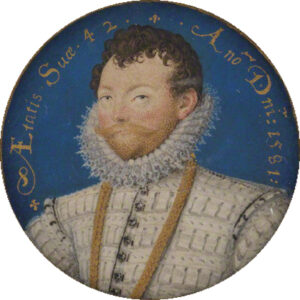
Francis Drake
Francis Drake (1540-1596)
- Completed the second circumnavigation of the globe between December 1577 and September 1580 aboard the Golden Hind — the first captain to command his own ship around the world — returning to Plymouth with treasure estimated at more than double England's entire annual revenue, having raided Spanish ports and captured treasure ships across two oceans while losing four of his original five vessels.1Britannica — Francis Drake ↗
- Raided the Spanish harbour at Cádiz in April 1587, destroying over thirty ships and vast quantities of stores intended for the Armada fleet — an operation he described as singeing the King of Spain's beard — delaying the Spanish invasion of England by a full year and fundamentally altering the strategic balance between the two powers.2Wikipedia — Francis Drake ↗
- Served as Vice Admiral of the English fleet against the Spanish Armada in 1588, deploying fire ships against the anchored Spanish fleet at Gravelines in an operation that broke their formation and contributed to the Armada's destruction — before dying of dysentery off Porto Bello, Panama in January 1596 during a failed final expedition, buried at sea in a lead coffin.3History.com — Drake Circumnavigates the Globe ↗
Francis Drake was born around 1540 in Devonshire, the son of a tenant farmer, and spent his early life in the household of the Hawkins family of Plymouth — merchants, sea captains and practitioners of the slave trade who gave him his first experience of the sea and his first introduction to the methods by which Tudor England conducted its maritime commerce.1Britannica — Francis Drake ↗ He made several slaving voyages to West Africa and the Caribbean before the defining experience of his early career: a 1568 expedition with John Hawkins to San Juan de Ulúa, where a Spanish fleet trapped and destroyed most of the English ships, killing hundreds of men. Drake escaped. From that moment the destruction of Spanish maritime power was not merely a commercial objective — it was personal. The circumnavigation of 1577–80 is the canonical snapshot and the analytically richest profile in the early modern Explorers domain. Drake set out from Plymouth on 13 December 1577 with five ships and approximately 160 men, commissioned by Queen Elizabeth in a covert arrangement that gave him plausible deniability — the expedition was publicly described as a voyage of discovery, while its actual purpose was the systematic plunder of Spanish Pacific possessions that Spain considered inviolable under the Treaty of Tordesillas.4Wikipedia — Drake's Circumnavigation ↗ The Congruence variable in Drake's profile requires careful handling: his stated purpose and his actual purpose were not the same, but his actual purpose was perfectly understood by his crew, his investors, and his Queen. The deception was institutional rather than personal. By the time the fleet reached South America, Drake faced a near-mutiny led by Thomas Doughty, a gentleman investor who challenged his authority. Drake convened a trial at Port San Julian — the same spot where Magellan had executed a mutinous captain fifty years earlier — and had Doughty executed.5World History Encyclopedia — Drake's Circumnavigation ↗ The Authority and Conviction variables in his profile are visible in that decision — a man from a tenant farming background executing a social superior in order to maintain command of an expedition that depended on absolute obedience. Only the Golden Hind made it through the Magellan Strait and into the Pacific. Drake sailed north up the South American coast, raiding Spanish ports and capturing the treasure galleon Nuestra Señora de la Concepción, before continuing across the Pacific, through the East Indies, around the Cape of Good Hope and back to Plymouth on 26 September 1580.3History.com — Drake Circumnavigates the Globe ↗ Of the original crew of approximately 160, 56 returned. The treasure aboard was worth more than double England's annual revenue. Elizabeth knighted him on the deck of the Golden Hind. The Cádiz raid of 1587 — singeing the King of Spain's beard, as Drake called it — is the most strategically significant act of his career and the one that most clearly separates the explorer from the admiral.2Wikipedia — Francis Drake ↗ Drake sailed into a fortified Spanish harbour, destroyed or captured thirty-seven ships and large quantities of stores, and withdrew before the Spanish could mount an effective response. The operation delayed the Armada by a year — a year in which English defences improved significantly. The Process variable in this snapshot reflects a commander who had thought through the operational problem with complete clarity and executed it without hesitation. He died of dysentery off Porto Bello on 28 January 1596, during a failed final expedition against Spanish possessions in the Caribbean — an expedition in which his previously infallible strategic instinct had deserted him and in which both he and his co-commander John Hawkins died within weeks of each other.1Britannica — Francis Drake ↗ He was buried at sea in a lead coffin in waters he had sailed twice. The Spanish offered 20,000 ducats for his head during his lifetime. They never collected.
Score Comparison
Add up to 10 leaders. Click a name to visit their profile.
The 13 Equations
Scores for: Armada and Final VoyageThe 22 Variables
Canonical scoresWhat changed: Singeing the King of Spain's Beard → Armada and Final Voyage
Sources & Bibliography
The scores assigned to this leader are derived from publicly available sources. Variable inputs reflect documented behaviour, structural conditions, and historical record at the time of each snapshot.