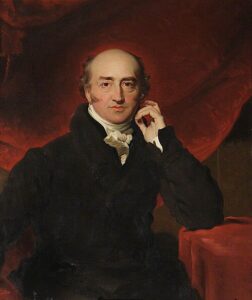
George Canning
George Canning (1770–1827)
- George Canning — son of an actress, raised in poverty after his father's early death, educated at Eton and Christ Church Oxford through the patronage of his uncle, barrister, MP from 1793, Under-Secretary of State for Foreign Affairs, Paymaster of the Forces, Treasurer of the Navy, Foreign Secretary twice, President of the Board of Control, and Prime Minister for the last hundred and nineteen days of his life in 1827 — was the most intellectually brilliant British politician of the Regency era, the architect of a liberal foreign policy that recognised the independence of the Latin American republics and supported Greek independence from the Ottoman Empire, and the only Prime Minister to have died in office within months of appointment, his premiership so brief and so contested that its significance has been consistently underestimated relative to the Foreign Office career that preceded it.1Britannica — George Canning
- His two periods as Foreign Secretary — 1807 to 1809 and 1822 to 1827 — produced the bombardment of Copenhagen to prevent the Danish fleet falling into Napoleon's hands, the support for the Spanish guerrilla resistance that Wellington's Peninsular campaign subsequently built upon, the recognition of the Latin American republics breaking from Spanish colonial rule, the Monroe Doctrine's effective enforcement through British naval power, and the intervention in support of Greek independence — a foreign policy record that repositioned Britain from the conservative legitimism of Castlereagh's Concert of Europe toward a liberal interventionism that Palmerston subsequently inherited and amplified.2Oxford DNB — George Canning
- The personal record of a man who fought a duel with his own cabinet colleague Castlereagh in 1809 — the only example of two serving cabinet ministers duelling in British political history — who was excluded from office for thirteen years by the enmity that duel produced, who constructed his return through a combination of public oratory and political journalism of exceptional quality, and who died of pneumonia one hundred and nineteen days into his premiership before any of his domestic programme could be enacted, is the most compressed and turbulent career arc in the British Political domain, and the one whose counterfactual — what a full Canning premiership might have produced — is the most analytically tantalising in the dataset.3Britannica — George Canning
George Canning is the most analytically frustrating profile in the British Political domain — frustrating because the variable profile is among the highest of any British statesman of his era, because the Foreign Office record demonstrates those variables operating at scale, and because the premiership that might have converted them into domestic institutional legacy lasted less than four months before pneumonia ended it. The equations capture what happened. The counterfactual of what might have happened is beyond their scope.
The formation period is the most socially anomalous in the British Political dataset of his era. Canning's mother went on the stage after his father's death — a social descent so complete in late eighteenth-century terms that it should have foreclosed the political career entirely.1Britannica — George Canning His uncle Stratford Canning's financial support and Eton's institutional machinery converted raw intellectual ability into the social credentials the political world required, but the formation scar never entirely healed — contemporaries noted throughout his career a sensitivity to social slight and a combativeness in debate that the more securely positioned Pittites did not share. The Resilience variable in this period is among the highest in the British dataset — built not through dramatic single crisis but through the sustained management of social exposure that his background made permanent. The Communication variable developed at Eton and Oxford through a combination of classical education, political journalism in the Anti-Jacobin Review, and the House of Commons debating culture that Pitt's circle provided, producing an oratorical capability that contemporaries ranked with Burke and Fox.
The first Foreign Secretary period from 1807 to 1809 is analytically significant for two decisions of radically different character taken within months of each other. The Copenhagen bombardment of September 1807 — the pre-emptive destruction of the Danish fleet before Napoleon could seize it — was diplomatically brutal, legally questionable, and strategically correct: the fleet did not fall into French hands, and the subsequent Peninsular campaign had secure naval supply lines as a result.4Britannica — Battle of Copenhagen 1807 The Decisiveness variable at this moment is at its ceiling — Canning acted on incomplete intelligence, against the advice of colleagues who preferred diplomatic negotiation, and was vindicated by the outcome. The support for the Spanish resistance following Napoleon's installation of his brother on the Spanish throne reflects the Vision variable operating at its most distinctive register: Canning understood that popular nationalism was a force that could be directed against Napoleonic hegemony, which was a strategic insight that the conservative legitimism of his colleagues had not yet processed.
The duel with Castlereagh in September 1809 is the most analytically revealing personal event in the profile and the one that most directly captures the Pride variable at its most operationally destructive.1Britannica — George Canning Canning had intrigued privately for Castlereagh's removal from the War Office while serving alongside him in cabinet — a manoeuvre that was discovered, that Castlereagh considered a personal betrayal, and that produced the challenge to a duel on Putney Heath at which Canning — who had never fired a pistol — was wounded in the thigh. Both men resigned. The Congruence variable at this moment is at its lowest point in the profile — Canning had behaved toward a cabinet colleague in a manner directly inconsistent with the collegiate loyalty that cabinet government requires. The Pride variable records the same episode from a different angle: a man who could not directly confront Castlereagh about his dissatisfaction chose an indirect method that, when discovered, made the direct confrontation both inevitable and catastrophic.
The thirteen-year exclusion from senior office that followed — from 1809 to 1822 — is the Resilience variable under its most sustained test. Canning remained in Parliament, accepted minor office under Liverpool when the political cost to Liverpool of excluding him entirely became too high, built his public reputation through parliamentary oratory and journalism, and waited for the political conditions to shift.2Oxford DNB — George Canning The Learning variable in this period records a significant development — the Castlereagh duel had been a Congruence and Pride failure, and the subsequent career shows a more disciplined management of political relationships, suggesting that the exclusion period produced genuine variable adjustment rather than merely tactical patience.
The second Foreign Secretary period from 1822 to 1827 is the canonical snapshot and the most analytically consequential phase of the career. Canning inherited Castlereagh's Concert of Europe framework — the conservative alliance of great powers committed to suppressing liberal nationalism wherever it appeared — and systematically dismantled it in favour of a British foreign policy based on national interest, liberal sympathy, and the strategic use of British naval power to enforce outcomes that parliament and public opinion supported.5US State Department — Monroe Doctrine The recognition of the Latin American republics — which Castlereagh had refused, and which the Holy Alliance powers considered a betrayal of legitimate monarchical authority — was achieved in 1824 and 1825 against sustained diplomatic opposition from Austria, Russia, and Prussia. Canning's remark that he had called the New World into existence to redress the balance of the Old is the Communication variable at its most quotable — a precise summary of a strategic vision delivered with the rhetorical compression that his parliamentary style had developed over thirty years.
The Greek independence question — in which Canning navigated between Russian enthusiasm for intervention, Austrian opposition to any disruption of the Ottoman settlement, and British public sympathy for the Greek cause amplified by Byron's death at Missolonghi — reflects the People variable operating at its most diplomatically sophisticated.6Britannica — Greek War of Independence The Treaty of London of July 1827 — concluded in the final weeks of his premiership, committing Britain, France, and Russia to enforcing Greek autonomy — was the diplomatic framework within which the Battle of Navarino subsequently destroyed the Ottoman-Egyptian fleet. Canning did not live to see Navarino, but the outcome it produced was the direct consequence of the framework he had constructed.
The premiership of 1827 is analytically significant less for what it achieved — which was almost nothing, given its length — than for the political conditions under which it began. Canning formed his government after the Ultra-Tory faction of the Conservative Party refused to serve under him over Catholic emancipation, requiring him to govern in coalition with the Whigs — a constitutional arrangement that anticipated the cross-party coalitions of the following century and that demonstrated a Adaptability variable operating under maximum institutional pressure.1Britannica — George Canning He died on 8 August 1827, one hundred and nineteen days into the premiership, having been in declining health since the outdoor ceremonies of the Duke of York's funeral in January. The pneumonia that killed him was almost certainly accelerated by the physical toll of the preceding months. The premiership that might have resolved the Catholic emancipation question, potentially advancing parliamentary reform, and certainly extended the liberal foreign policy framework into domestic institutional design, ended before any of it could be attempted.
The number that matters most across all four snapshots is the Communication variable — and its relationship with the Pride variable that periodically undermined it. Canning could articulate a foreign policy Vision with a precision and a rhetorical force that moved parliamentary opinion, shaped public understanding of British interests, and is still quoted nearly two centuries later. The same intellectual confidence that produced that Communication capability produced the intriguing against Castlereagh, the sensitivity to social slight, and the combativeness that made him enemies throughout a career in which the making of enemies was the one thing he could least afford. The ratio between those two variables — Communication at its ceiling, Pride intermittently at its most operationally destructive — is the analytical signature of George Canning, and it is the reason that the most intellectually gifted British Foreign Secretary of the nineteenth century spent thirteen years in the political wilderness before the talent became undeniable enough to overcome the enmity it had generated.
Score Comparison
Add up to 10 leaders. Click a name to visit their profile.
The 13 Equations
Scores for: Premiership and DeathThe 22 Variables
Canonical scoresWhat changed: Second Foreign Secretary — Latin America and Greek Independence → Premiership and Death
Sources & Bibliography
The scores assigned to this leader are derived from publicly available sources. Variable inputs reflect documented behaviour, structural conditions, and historical record at the time of each snapshot.