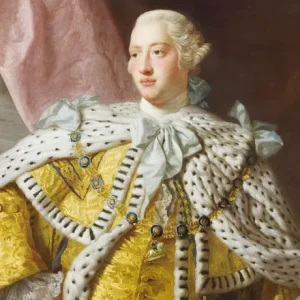
George III
George III (1738–1820)
- Arrived on the throne at twenty-two as the first Hanoverian king born and educated in England,1Wikipedia — George III reigned for fifty-nine years through the Seven Years' War, the loss of the American colonies, and the long struggle against Revolutionary and Napoleonic France — funding William Herschel's forty-foot telescope, building his own astronomical observatory, and signing the Slave Trade Abolition Act in 1807.1Wikipedia — George III
- Castigated in the Declaration of Independence as a tyrant responsible for twenty-seven grievances against the colonies — modern scholarship tends to exonerate him of direct responsibility, finding that he deferred to his ministers throughout the colonial crisis and consistently supported parliamentary initiatives rather than designing them2American Battlefield Trust — George III — while telling John Adams in 1785 that he was the last to consent to the separation but would be the first to meet American friendship as an independent power.
- Suffered recurrent mental illness from 1788, becoming permanently deranged in 1810 — incapable of knowing he had been declared King of Hanover in 1814 or that his wife had died in 18181Wikipedia — George III — and spent his final decade blind, deaf, and incapacitated at Windsor Castle until his death in 1820.
George III is the Royalty domain profile where the gap between historical reputation and variable reality is most productively examined. The American founding mythology requires a tyrant — the Declaration of Independence listed twenty-seven grievances against the king, Thomas Paine called him the Royal Brute of Britain, and the gilded equestrian statue in New York was pulled down. The equations require a constitutional monarch who deferred to his ministers throughout the colonial crisis, whose detailed conduct from 1763 to 1775 tends to exonerate him from real responsibility for the American Revolution in the assessment of modern scholarship,2American Battlefield Trust — George III and who was at the height of his popularity when his final mental collapse occurred in 1810. Both things exist in the historical record. The equations record the second one.
The early reign period establishes the constitutional pattern that defined his entire active kingship. He arrived on the throne at twenty-two with genuine intellectual curiosity — systematic scientific education, a library open to scholars that became the foundation of a national collection, a passion for astronomy and agriculture that earned him the satirical nickname Farmer George before it became a term of genuine affection.1Wikipedia — George III The political instability of the first decade was real: seven prime ministers in ten years, the Wilkes affair, the colonial taxation crisis developing from a parliamentary initiative he supported but did not design. The Stamp Act was Grenville's work. Its repeal was supported by the King. The statues erected in New York to honour both George III and Chatham for that repeal were pulled down a decade later when the narrative required a different story. The equations record the variable profile, not the narrative.
The Congruence score across the American crisis period sits high for a specific analytical reason. The historical record supports the reading that George acted as a constitutional monarch supporting his ministers' initiatives rather than as an autonomous agent of colonial oppression. The gap between his stated constitutional role and his actual conduct was narrow throughout this period. Where it widens — his determination to continue the war after Saratoga, his statement that the rebels should be kept harassed and anxious until discontent became penitence — the equations record it in the Intent and Conviction variables rather than Congruence, because these were openly stated positions rather than concealed divergences from stated values.3Britannica — George III
The American War and Recovery period is analytically interesting because the score should rise despite the strategic defeat. The loss of the thirteen colonies was a failure of the system George operated within rather than a failure of his personal variable quality. His Humility in accepting the outcome — telling John Adams in 1785 that he was the last to consent to the separation but would be the first to meet American friendship as an independent power — is the Humility variable operating at its documented level. His appointment of Pitt the Younger against the wishes of the Fox-North majority demonstrated genuine constitutional sophistication: the capacity to read the public mood and act on it through legitimate means.4History.com — George III His recovery from the 1788 mental episode, and the subsequent surge of personal popularity, reflected a public that had observed his character across three decades and found it trustworthy.5Biography.com — George III
The Pitt and Napoleon period is the profile's peak and the period that most directly contradicts the tyrant narrative. He funded William Herschel's forty-foot telescope — at the time the largest ever built.1Wikipedia — George III He signed the Slave Trade Abolition Act in 1807, legislation that passed both houses with large majorities after decades of campaigning by abolitionists whose cause he had privately supported. During the invasion scare of 1803, he reviewed 27,000 volunteers in Hyde Park before crowds estimated at half a million and wrote to his friend Bishop Hurd that should Bonaparte's troops effect a landing, he would certainly put himself at the head of his armed subjects to repel them. That is Conviction and Value at their documented maximum — a man in his sixties with deteriorating health prepared to take the field against Napoleon.
The Regency and Decline snapshot records the progressive failure of capacity rather than character. Permanently deranged from 1810, blind, increasingly deaf, incapable of knowing that he had been declared King of Hanover in 1814 or that his wife had died in 1818.1Wikipedia — George III Ability declining to its floor, Conviction and Intent following. Congruence remaining at a high level because his character — the piety, the fidelity, the intellectual curiosity, the genuine care for his subjects — was documented as consistent throughout, and the mental illness was a medical event rather than a moral one. The equations do not penalise a leader for illness. They record what the variables produced at each period, and in the final period they produced nothing because there was no operational capacity left to deploy.
He died at eighty-one having reigned for fifty-nine years — the longest-lived and longest-reigning male monarch in British history at the time.1Wikipedia — George III He hoped that the tongue of malice might not paint his intentions in colours she admires. The equations suggest his intentions were more consistently aligned with his stated values than his reputation in the country whose independence he eventually accepted has ever required acknowledging.
Score Comparison
Add up to 10 leaders. Click a name to visit their profile.
The 13 Equations
Scores for: American War — RecoveryThe 22 Variables
Canonical scoresWhat changed: Early Reign — American Crisis → American War — Recovery
Sources & Bibliography
The scores assigned to this leader are derived from publicly available sources. Variable inputs reflect documented behaviour, structural conditions, and historical record at the time of each snapshot.